

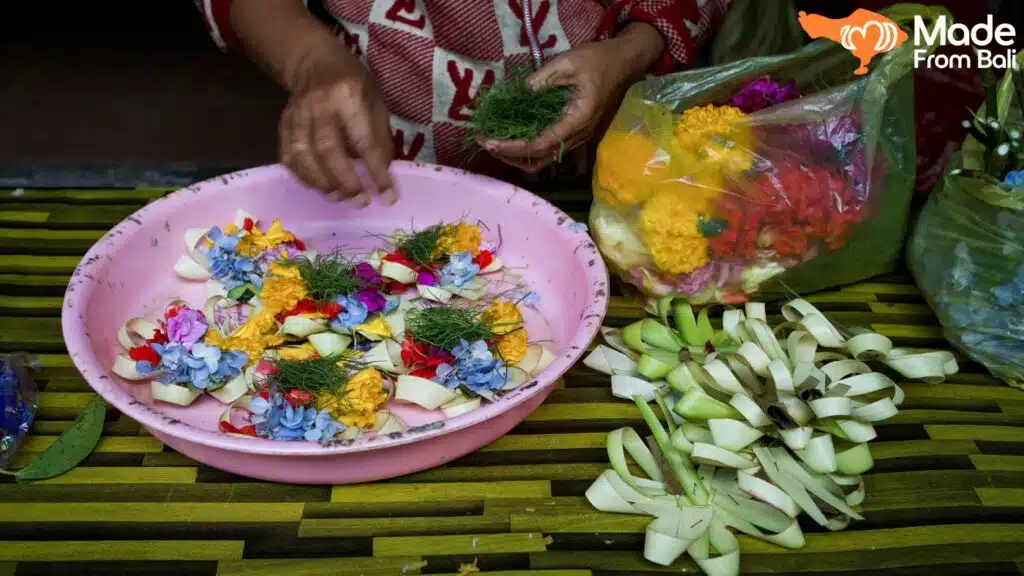
If you spend even one morning in Bali, you’ll see small, colorful offerings placed in front of homes, shops, and temples. These little trays are called canang sari — simple in size, but deeply meaningful. For Balinese Hindus, a canang sari is a daily expression of gratitude and a way to keep harmony between the seen and unseen worlds. It’s not decoration, and not something placed “for tourists”, it’s a reminder that spirituality lives inside everyday life. As a visitor, understanding its meaning is one of the simplest ways to respect Balinese culture
What Is Canang Sari? The Meaning Behind the Offering
At its core, canang sari comes from two words:
- Canang: the small, handwoven tray made from young coconut leaves
- Sari: the “essence” or intention of the offering
So the meaning is simple: the essence of gratitude, placed on a palm-leaf tray.
Balinese people make canang sari to give thanks to Sang Hyang Widhi Wasa, the supreme God in Balinese Hinduism. It’s an offering of appreciation for life, peace, and balance.
But there’s also a second layer: some offerings placed on the ground are meant to keep lower spirits (bhuta kala) calm, ensuring there is no disturbance or imbalance. This is a core part of Balinese understanding, balance is maintained by honoring both the higher and the earthly forces.
Canang sari is one of the clearest real-life examples of Tri Hita Karana, the Balinese philosophy of harmony:
- Parahyangan: connection to God (the offering itself is prayer)
- Pawongan: harmony with others (families often prepare offerings together)
- Palemahan: respect for nature (all components are natural elements)
Balinese do this every day not out of obligation, but out of devotion, a quiet, gentle rhythm woven into life.
What’s Inside a Canang Sari — And Why It Matters?
Every canang sari is built with intention. It begins with a small palm-leaf tray woven by hand, a simple base that represents the human connection to the earth. Into this tray, Balinese women place a few grains of rice (Bija) as a symbol of atma, the divine soul found in every being. At the center lies the porosan, a bundle of betel leaf, lime, and areca nut that represents the Trimurti, which are Brahma, Vishnu, and Shiva, as well as the balance of human thought, speech, and action.
The flowers arranged on top create a tiny map of the universe. Each color faces a specific direction: white to the east for Iswara, red to the south for Brahma, yellow to the west for Mahadeva, and blue or green to the north for Vishnu. A single flower or mixed petals placed in the middle represents Shiva, the unifying force. Together, these colors reflect harmony, a reminder that balance is meant to be lived, not just prayed for.
Just before the offering is set down, incense is lit. Its smoke purifies the surroundings and carries the “essence” of the offering upward. Sometimes you may notice small additions like sugarcane, fragrant pandan, coins, or a tiny snack. These aren’t strict components, they simply reflect sincerity, gratitude, and whatever the household has to give that day.
Why Are Canang Sari Placed on the Ground — Even on Sidewalks?
To many visitors, it may seem unusual to see offerings placed on the street. But each location has purpose:
- On sidewalks or by the road: to neutralize negative energy from human movement and busy activities.
- In front of shops or hotels: asking for smooth business and protection.
- In temples and shrines: dedicated to the gods (dewa yadnya).
- Near vehicles: for safety and protection before traveling.
So when you see a canang sari on the road, it’s not carelessness, it’s part of a cultural system that organizes the relationship between humans and the unseen.
What Tourists Should Not Do
This is the part travelers often get wrong, not because they mean to, but because they don’t know.
- Don’t step on a fresh offering.
Sometimes it’s unavoidable in crowded areas, but always try to walk around it. If you accidentally step on one, don’t panic, locals understand. It’s the intention that matters. - Don’t pick up or play with the offerings.
They are sacred objects, even if they look simple. - Don’t photograph someone making offerings without permission.
The process (mebanten) is a prayer — a quiet, intimate moment. - Don’t kick aside an offering once the incense burns out.
Even when the ceremony is “complete,” the item should be left to return naturally to the earth.
By understanding the meaning behind these daily offerings, you not only show respect, you also get a glimpse into how Balinese culture weaves gratitude and harmony into everyday life.
As you continue your journey, stay open, stay kind, and let Balinese traditions shape a more mindful way of traveling.
Sources
- Parisada Hindu Dharma Indonesia (2023). Pedoman Upakara Harian – Canang Sari.
- Dinas Kebudayaan Provinsi Bali (2024). Makna Filosofi Canang Sari.
- Titib, I Made (2010). Hinduism in Bali.
- Love Bali Campaign – Etiquette Guidelines (2023).