

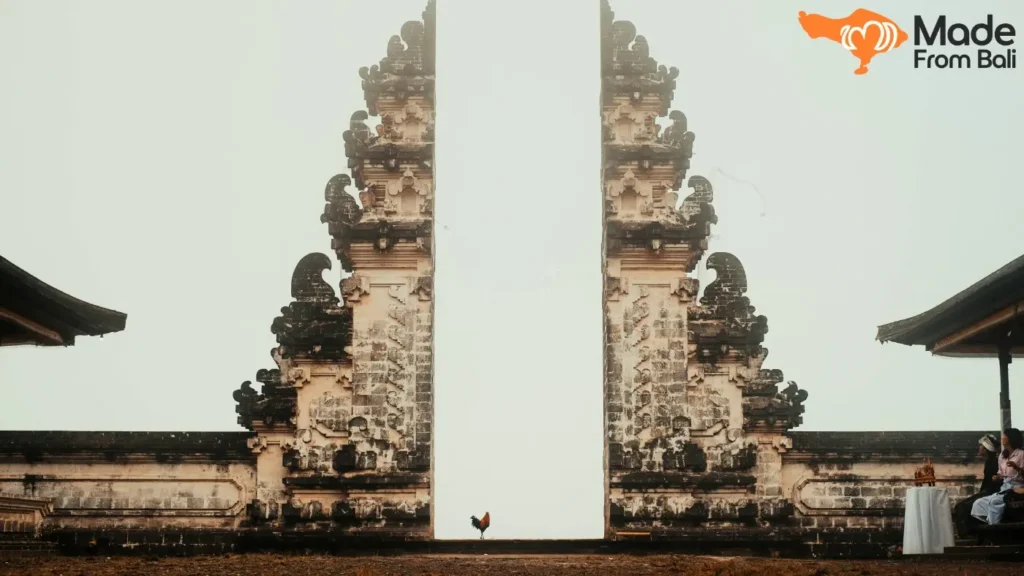
Pura Lempuyang is one of the most searched temple destinations in Bali, and a significant portion of the people searching for it have already seen the photograph: the split stone gate with Mount Agung rising symmetrically in the gap, its reflection perfectly mirrored in still water below. It is an extraordinary image. It is also the source of the most common source of disappointment among visitors who arrive without knowing how that reflection is created, how long the queue to take a photograph at the gate genuinely is, or what the site actually involves beyond the famous first gate.
This guide addresses all of it honestly. The reflection, the queue, the timing, the upper temples that most visitors never reach, the architectural and spiritual significance of the site, and the practical preparation that makes the difference between a frustrating early morning and a genuinely memorable east Bali experience. Lempuyang is worth visiting. The question is whether you arrive prepared for what it actually is, rather than what a filtered photograph suggests it might be.
Understanding What Lempuyang Actually Is Before You Visit
Most content about Lempuyang treats it as a photograph location with a temple attached. The reality is the reverse. Pura Lempuyang Luhur is one of Bali’s most spiritually significant temple complexes, and the famous gate, while genuinely beautiful, is only the entrance to a pilgrimage site that extends up a sacred mountain through seven distinct temple levels. Understanding this before you arrive changes the nature of the visit from a queue for a photograph to something considerably more meaningful.
The Temple Complex Beyond the Famous First Gate
The gate that appears in every Lempuyang photograph is the first candi bentar of Pura Penataran Agung Lempuyang, which is the second of the seven temples in the Lempuyang complex. The full pilgrimage ascends the slope of Gunung Lempuyang through a sequence of temples, beginning at the lower parking area and culminating at Pura Lempuyang Luhur at the summit, approximately 1,175 meters above sea level.
The staircase connecting the temples involves roughly 1,700 steps in total for the full ascent. Each temple level has its own character, its own views, and its own atmosphere. The lower temples are more accessible and more visited. The upper temples, particularly Pura Lempuyang Luhur at the summit, are reached by relatively few tourists despite being the spiritually principal site in the complex. The panoramic view from the upper levels, looking out across east Bali toward the sea, with Gunung Agung visible on one side and the Lombok strait visible on the other on clear days, is one of the most dramatic viewpoints available anywhere in Bali.
The famous first gate is a genuine part of a genuinely significant site. Knowing the full scale of what exists above it makes the first gate feel like an invitation rather than a destination in itself.
Lempuyang as a Sacred Site in Balinese Hindu Cosmology
Pura Lempuyang Luhur holds a specific and essential place in Balinese Hinduism. It is one of the Sad Kahyangan, Bali’s six most important directional temples, whose spiritual function is to maintain the cosmological balance of the island. Each of these temples occupies a specific directional position and serves as a spiritual guardian for its region. Lempuyang is the eastern guardian, sitting on the ridge of Gunung Lempuyang in the Karangasem regency, and its orientation toward the rising sun reflects its role as the temple associated with the east in Balinese spiritual geography.
The mountain itself carries sacred weight that predates the temples built upon it. Gunung Lempuyang, which means “lemon grass mountain” in one interpretation of the etymology, has been a site of Balinese spiritual practice for centuries. The temples are not simply placed on the mountain. They are understood to be part of it, drawing on and contributing to the mountain’s spiritual power in a relationship that shapes the design, placement, and ritual life of the entire complex.
When visitors stand at the famous gate and see Gunung Agung framed in the opening, they are looking at a deliberate architectural relationship between two sacred volcanic peaks, the eastern guardian temple oriented toward Bali’s highest and most sacred mountain. That alignment is not accidental. It is the most spatially significant thing happening in the photograph.
The Reflection in the Photograph and the Truth Behind It
This is the section most Lempuyang guides either skip or bury in a footnote, and it is the one most travelers wish they had read before arriving. The reflection in the famous Lempuyang gate photograph, in which the gate and Gunung Agung appear to be mirrored in a pool of water below, is created by a temple photographer holding a mirror or reflective surface below the camera frame. There is no pool. There is no natural reflection.
How the Mirror Image Is Created and Why It Matters
At the base of the gate, local photographers offer their services to visitors waiting in the queue. When it is your turn at the gate, the photographer positions a mirror on the ground below the camera, tilts it to catch the gate and mountain above, and photographs the camera’s screen or lens through the mirror to create the reflected composition. The final image looks like a natural reflection in still water because the mirror surface is smooth and the angle produces exactly that illusion.
This matters for two reasons. First, travelers who discover this after arriving, having expected a natural phenomenon, sometimes feel they were misled by the photographs that brought them there. That feeling is understandable but avoidable with prior knowledge. Second, and more usefully, knowing that the reflection is created by a photographer’s technique means you can decide in advance whether you want the mirror photograph or a different kind of image entirely.
Neither choice is wrong. The mirror photograph is a beautiful image and a legitimate souvenir of the visit. The gate without the mirror, photographed cleanly in the morning light with Gunung Agung rising behind it, is a different but equally striking image. Knowing the mechanics in advance means you make a deliberate choice rather than a confused one at the gate while a queue of people waits behind you.
What the Real Gate Experience Looks Like Without the Mirror
The candi bentar gate at Pura Lempuyang is striking in person in ways that the famous photograph does not fully convey. The gate is large, elaborately carved from dark volcanic stone, and split precisely at the center to create a framed view through to the staircase and temple grounds beyond. The framing of Gunung Agung in the gap depends on cloud cover, which shifts throughout the morning, and there are windows within most mornings when the mountain is fully visible and the gate and peak align in the composition that has become iconic.
Standing at the gate without a queue, in the early morning before the first tour groups arrive, with the mountain clear and the light coming from the east across the agricultural landscape, is a genuinely atmospheric experience. The smell of incense from the temple beyond, the sound of a water offering vessel at the base of the steps, the cool air of the Karangasem highlands at altitude before the heat builds, these are things that exist in the real gate experience and that no photograph conveys. The mirror is optional. The gate itself is not.
When to Arrive and How the Queue Actually Works
Timing at Lempuyang is the most consequential practical decision a visitor makes, and the generic advice to “arrive early” is insufficiently specific to be truly useful. What “early” means in practice, what each arrival window produces, and what the queue experience involves across different times of day are all things that should be understood before the visit day begins.
What Different Arrival Times Produce in Practice
The following breakdown reflects realistic conditions on a typical day during peak season. Shoulder season (April to May, September to October) has lighter queues across all time windows.
| Arrival Time | Queue at Gate | Mountain Visibility | Light Quality | Overall |
|---|---|---|---|---|
| 5:00 to 6:00am | Minimal, often no queue | Often clear before heat builds clouds | Soft pre-dawn, golden at sunrise | Best overall window |
| 6:30 to 7:30am | Building, 15 to 30 minute wait | Generally good if day is clear | Good directional morning light | Strong option |
| 8:00 to 9:00am | Significant, 30 to 60 minute wait | Variable, cloud building on Agung | Good light but crowds impact experience | Manageable with patience |
| 9:30 to 11:00am | Peak, 60 to 90 minute wait possible | Cloud cover on Agung increasingly common | Flat overhead light | Difficult conditions |
| After 11:00am | Can ease slightly but still heavy | Mountain often obscured | Harsh overhead light | Not recommended |
The 5:00 to 6:00am window is the consistent recommendation from everyone with genuine knowledge of the site. At this hour, the queue is minimal, the light is at its most beautiful, the mountain tends to be clear before the convective clouds that form over Gunung Agung later in the morning develop, and the temple grounds have an atmosphere that busy mid-morning visits cannot replicate. For travelers staying in the Ubud area, departing by 4:00am is necessary to reach the temple parking area by 5:30am.
The Queue System and How Long the Wait Really Is
The gate photograph is managed by a system of local photographers and temple staff who coordinate access to the gate position. Visitors queue on a path near the gate and are called forward one group at a time for their photographs. The photographers handle the mirror positioning, compose the shot, take several images, and show them to the visitor before moving to the next group.
Each group takes approximately three to five minutes at the gate. On a busy morning with sixty groups ahead in the queue, this translates to three to five hours of waiting. At the 5:00am opening, there may be no queue at all. By 8:00am on a peak season day, the wait can be an hour or more. This is not speculation. It is the consistent reality reported by visitors across multiple review platforms, and it is the information that most tour guides choose not to emphasize when selling the experience.
There is a fee payable to the photographers for their service, typically around 50,000 to 100,000 IDR per group depending on the number of photographs taken. This fee is separate from the temple entrance fee and is given directly to the photographer.
What to Do While You Wait and How to Make the Time Useful
A queue at Lempuyang, whether it runs for twenty minutes or two hours, does not have to be dead time. The lower temple complex has several secondary structures, offering platforms, and viewpoints that are accessible while waiting and that most visitors standing in the queue never think to explore.
Practical ways to use the waiting period:
- Walk the secondary viewpoints: The eastern face of the temple area, accessible from the queue path, offers views across the Karangasem agricultural landscape toward the sea. In the early morning light this view is extraordinary and entirely uncrowded.
- Observe the active worship: Balinese Hindu worshippers arrive throughout the morning with offerings. Watching the ceremony from a respectful distance, with offerings being presented and priests conducting blessings, provides context for what the temple means that no amount of reading can substitute for.
- Prepare for the upper temple option: If you plan to ascend to the upper temples after the gate photograph, use waiting time to assess your energy levels, adjust clothing layers, and confirm with your guide the timing implications of adding the upper walk.
- Photograph the gate from secondary angles: The gate looks different from multiple positions around the lower temple complex. While waiting for access to the primary photograph position, the gate visible at a slight angle from the queue path produces a different composition that many visitors find as compelling as the straight-on view.
The Gate Photograph and How to Approach It
The photograph at the Lempuyang gate is the reason most visitors drive two to three hours from south Bali before dawn. Understanding how to approach it practically, what choices are available, and what the light and mountain conditions produce at different times helps travelers make a deliberate decision about what they want from the moment rather than improvising in a time-pressured queue.
Camera Position, Framing, and What the Light Does at Different Hours
The standard gate photograph is taken from approximately five to eight meters in front of the gate, centered on the axis of the split, with Gunung Agung visible in the gap. The temple photographer handles positioning for the mirror photograph. For photographers who want a different approach, understanding the light conditions at different hours is the most useful preparation.
In the 5:00 to 6:30am window, the light comes from low in the east and produces warm, directional illumination on the stone of the gate. The shadows in the carved relief work of the gate face are deep and the texture of the stone is pronounced. The sky above and behind the gate transitions through blue to golden as the sun rises, and the mountain, if visible, is lit from the east. This is the light that makes the gate look three-dimensional rather than flat.
By mid-morning, the light is overhead and the gate surface is uniformly lit without shadow depth. The image is technically cleaner but visually less interesting. This is a practical reason, beyond the queue argument, for the early morning recommendation.
What the Photograph Captures That the Mirror Version Cannot
The gate photograph without the mirror captures something the mirror version inherently obscures: the full vertical relationship between the gate, the mountain, and the sky. The mirror composition requires the camera to be pointed slightly downward to capture the reflection, which compresses the height of the frame and eliminates the sky above the gate. The non-mirror version, shot with the camera horizontal or slightly upward, includes the summit of Agung and the sky above, giving the composition more vertical scale and a different quality of drama.
For travelers who specifically want the mirror photograph, this is a personal preference and entirely valid. For travelers who want something different from the thousands of identical social media versions of the same gate, the non-mirror approach with attention to the light and the mountain’s position in the frame produces an image that stands independently.
Going Beyond the First Gate to the Upper Temples
The most consistent underreporting in Lempuyang content is about what exists above the first gate. The upper temples are where the pilgrimage identity of the site is most fully expressed, where crowds thin dramatically, and where the views from the ridgeline deliver an experience of east Bali that is available almost nowhere else.
The Staircase, the Seven Temples, and What the Ascent Involves
From the first gate, the pilgrimage path ascends through the temple complex via a stone staircase that is steep in sections and climbs through forested terrain on the Lempuyang ridgeline. The seven temples are encountered in sequence as the staircase ascends, each with its own forecourt, shrines, and atmosphere.
The lower temples are ornate and formal. The middle levels have a quality of quiet that grows as the altitude increases and the visitor numbers decrease. The upper temples, particularly Pura Lempuyang Luhur at the summit, have an atmosphere that is difficult to describe and impossible to experience from the first gate: the combination of altitude, cloud mist that sometimes drifts across the path, the sound of wind through the forest, and the knowledge of what you have climbed to reach it creates a sensory and emotional context that is entirely different from the photography queue below.
The ascent to the summit takes approximately one to two hours at a comfortable pace, depending on fitness. The staircase is continuous stone and does not involve scrambling or technical terrain, but it is steep enough that appropriate footwear matters significantly. Flip-flops and smooth-soled sandals make the descent particularly risky on wet stone. Trail shoes or sandals with ankle support and grip are the minimum sensible standard.
Who Should Attempt the Upper Temples and Who Should Not
The decision to ascend to the upper temples is genuinely personal and should be made based on honest self-assessment rather than peer pressure or time pressure.
The upper temples are appropriate for:
- Travelers in reasonable physical condition who are comfortable with sustained stair climbing
- Anyone wearing closed shoes or trail sandals with grip
- Travelers who have budgeted two to three additional hours for the ascent and descent
- Those with a genuine interest in the pilgrimage experience rather than solely the gate photograph
The upper temples are less appropriate for:
- Travelers with significant knee or joint problems, as the descent on steep stone stairs is demanding
- Anyone in sandals or flip-flops without ankle support
- Travelers with very tight schedules who are combining multiple east Bali sites in a single day
- Very young children for whom the staircase length would be physically exhausting
Neither choice diminishes the visit. The first gate is genuinely significant and the photograph experience is the reason many people make the journey. The upper temples are simply a different and deeper version of the same sacred site.
What You See From the Summit That No One Photographs
The view from Pura Lempuyang Luhur at the summit is one of the most genuinely extraordinary panoramas in Bali, and it is almost entirely unphotographed compared to the first gate. Looking west and south from the summit temple, the terrain drops through agricultural terraces toward the Karangasem coast and the deep blue of the Lombok strait. Gunung Agung rises above the western horizon. On clear mornings, Gunung Rinjani on Lombok is visible across the water.
The temple itself at the summit is simpler than the elaborate lower complex, which makes it feel more intimate. The meru towers are smaller. The forecourt is quieter. The priests and worshippers present at this level are almost entirely Balinese, and the atmosphere is one of genuine ongoing religious practice rather than managed tourist access. Respectful visitors who have made the climb are welcomed in the surrounding areas and the experience of being at the summit on a clear morning, with the entire eastern landscape visible below and the sky above, is one that consistently produces the most vivid memories of any Lempuyang visit.
The Architecture and Meaning of the Split Gate
The famous gate is one of the most reproduced images in Balinese travel photography, but the architectural form it represents, the candi bentar, carries meaning that most visitors walk past without registering. Understanding what the split gate is and what it signifies transforms the experience of standing at it.
What Candi Bentar Represents in Balinese Sacred Architecture
Candi bentar means split temple or split gate in Balinese and old Javanese architectural terminology. The form is a single gate structure that has been split exactly down the vertical center and the two halves separated to create a passage between them. The split is precise and deliberate. The two halves are mirror images of each other, and nothing physically connects them above the passage.
The meaning embedded in this architectural form relates to the Balinese Hindu concept of duality: the split represents the division of the sacred from the secular, the inner from the outer, and the spiritual world from the material one. Passing through the candi bentar is a symbolic act of transition. You are moving from the ordinary world into sacred space, and the gate’s design makes that transition architecturally explicit.
This is why the candi bentar appears at the entrance of virtually every significant Balinese temple complex. It marks a threshold that is as much psychological and spiritual as physical. At Lempuyang, where the gate is framed against a sacred mountain and the complex behind it is one of the island’s most spiritually important sites, the threshold the gate marks is one of the most charged examples of the form in Bali.
Why Gunung Agung in the Frame Is Not Coincidental
Gunung Agung, which translates as great mountain, is the spiritual center of Bali in Balinese Hindu cosmology. It is the axis mundi of the island, the point from which all spatial and spiritual orientation derives. Temples across Bali are oriented in relation to the mountain: the kaja direction (toward the mountain) is sacred, the kelod direction (toward the sea) is the direction of impurity. The mountain is present in ritual, in architectural alignment, and in the daily spatial orientation of Balinese life in ways that are fundamental rather than decorative.
The placement of Pura Lempuyang Luhur on the eastern ridge, with its principal gate framing the western direction toward Gunung Agung, is not a happy coincidence that a photographer discovered. It is the spatial logic of a site built to exist in deliberate relationship with the island’s sacred geography. The gate frames the mountain because the temple was designed around that alignment, and the alignment carries the entire spiritual weight of the site’s identity.
When you stand at the gate and look at Agung in the frame, you are looking at five centuries of architectural and cosmological intention made visible in stone.
Practical Preparation for the Visit
Arriving at Lempuyang without practical preparation causes the most avoidable frustrations of any east Bali visit. The dress code is strictly enforced, the site runs on cash, and the terrain above the first gate requires footwear that most casual Bali tourists do not bring to a temple visit by default.
Dress Code, Sarongs, and What to Expect at the Entrance
A sarong is mandatory throughout the Lempuyang complex, worn wrapped around the waist and covering the legs below the knee. A sash tied over the sarong is also required in the temple areas. Both are available for rent at the entrance for a small IDR fee, typically around 10,000 to 20,000 IDR, and are returned on exit. Bringing your own sarong that is clean, long enough, and not a beach-style print is both culturally respectful and avoids the rental process.
Shoulders and upper body coverage are not explicitly required at the gate level, but wearing a top that covers the shoulders is appropriate given the sacred status of the site. For the upper temple ascent, light layers are useful because the temperature on the upper ridge can be noticeably cooler than at the parking area, particularly in the early morning.
Entry Fees, Cash, and What the Site Charges
Lempuyang charges a tiered entry system that typically includes a parking fee, a general entry fee, and a separate fee for the gate photograph service. As of recent years, the combined costs are approximately 30,000 to 50,000 IDR for parking and entry per person for foreign visitors, with the photography fee separate and paid directly to the temple photographer.
Cash in IDR is the only accepted form of payment throughout the complex, at the entrance, at the gate, and at the small warung near the lower temple area. The nearest ATM is in Amlapura town, approximately twenty minutes from the temple. Withdrawing cash before leaving your accommodation or in Amlapura before continuing to the temple removes a logistical problem that otherwise only presents itself at the worst moment.
Footwear, Fitness, and What the Terrain Requires
For the first gate visit only, normal closed sandals or light shoes are adequate. The path from the parking area to the first gate involves stone steps and a level forecourt. Flip-flops are worn at the first gate by many visitors without difficulty.
For the upper temple ascent, the footwear requirement changes significantly. The stone stairs on the upper sections can be wet from morning dew or recent rain, and the gradient is steep enough that smooth-soled footwear becomes genuinely risky on the descent. Trail runners or sandals with rubber grip and ankle support are the minimum appropriate standard. Anyone planning to ascend wearing flat sandals or flip-flops should either reconsider the ascent or reconsider the footwear before the visit day.
Fitness-wise, the upper temple ascent is demanding but not technical. It is a sustained staircase climb, and the primary physical requirement is cardiovascular endurance and knee stability. Most adults in reasonable health can complete the ascent if they move at a comfortable pace and take breaks at each temple level. The descent is the more physically demanding direction for knees specifically.
Combining Lempuyang With Other East Bali Sites
Lempuyang sits in the Karangasem regency of east Bali, a region that contains some of the island’s most extraordinary cultural and natural sites in a relatively compact geographic area. Visiting the temple as a standalone destination is a long drive from south Bali for a single site. Combining it intelligently with nearby sites transforms the day into one of the richest east Bali experiences available.
The Tirta Gangga and Lempuyang Circuit
Tirta Gangga, the royal water garden built in 1948 in the foothills of Gunung Agung, is the natural companion to Lempuyang in an east Bali day. The two sites are approximately thirty to forty minutes apart and occupy completely different aesthetic and experiential registers that complement rather than duplicate each other.
Tirta Gangga is best visited in the early morning before the day heats up, when the pools are still and the rice field landscape surrounding the garden is misty and quiet. The standard east Bali circuit visits Tirta Gangga first, spending an hour in the gardens, then drives to Lempuyang for the gate photograph before the queue builds to its midday peak. Departing from south Bali by 4:00am allows Tirta Gangga arrival by 6:30am and Lempuyang arrival by 8:00am, which produces good conditions at both sites in a single manageable morning.
The Candidasa Coast Road and What It Connects
The coastal road between Candidasa and Amlapura passes through the rocky eastern shoreline of Bali with views across the Lombok strait and occasional glimpses of Gunung Rinjani on clear days. Candidasa itself is a small and quiet beach town that serves as an alternative base for east Bali exploration, and the stretch of road between Candidasa and the turn-off toward Lempuyang includes several viewpoints and small beach access points that reward a slow drive rather than a fast transit.
For travelers based in Candidasa or who are building a multi-day east Bali itinerary, the coast road provides a scenic route between Tirta Gangga, Lempuyang, and Amed that makes the logistics of covering multiple sites more pleasant and less purely functional.
How to Build a Full East Bali Day Around the Temple
A well-constructed full east Bali day from south Bali organizes the sites in a sequence that minimizes backtracking and aligns each stop with its optimal time of day.
- 4:00am: Depart from Seminyak or Ubud area
- 6:30am: Arrive at Tirta Gangga. Walk the water gardens in the early morning quiet. Budget sixty to seventy-five minutes.
- 8:00am: Depart for Lempuyang, arriving by 8:30am
- 8:30 to 11:00am: Lempuyang gate photograph, upper temple option if planned. Budget thirty minutes minimum for gate only, two to three hours if including the upper temple walk.
- 11:30am: Depart east Bali, stop along the Candidasa coast road for lunch at a locally recommended warung
- 1:00 to 2:00pm: Coastal drive back toward Ubud or south Bali via the route through Klungkung
- 3:00 to 4:00pm: Arrive at Ubud or south Bali accommodation
This sequence runs from north to south in the east, ending with the coast road, and avoids the midday traffic that builds heading west toward Ubud and south Bali if the return is delayed until late afternoon.
Approaching Lempuyang With Realistic Expectations and Real Reward
Lempuyang Gate of Heaven is one of the most visited temple sites in Bali for reasons that are entirely legitimate. The gate is beautiful, the mountain framing is extraordinary, and the site carries spiritual significance that gives it a presence beyond its visual appeal. The famous photograph has drawn millions of visitors and will continue to do so.
What makes the difference between a disappointing visit and a genuinely rewarding one is almost entirely preparation. Knowing about the mirror before you arrive means you make a deliberate choice about the photograph rather than feeling deceived at the queue. Arriving by 5:30am means standing at a gate with nobody else around rather than in a line that stretches back fifty meters. Understanding that the first gate is an entrance to a pilgrimage site, not the site itself, means the visit has depth rather than just a photograph.
Made From Bali’s east Bali tours are built on this understanding. The timing, the circuit logic, the decision about the upper temples, and the combination with Tirta Gangga are all handled with the same attention to getting the experience right rather than simply completing the itinerary. The temple is ancient, significant, and worth a long drive before sunrise. Arriving ready for what it actually offers makes all the difference.