

Most people searching for the best diving spots in Bali run into the same problem within the first few clicks. Every list looks the same. Tulamben shows up, Nusa Penida shows up, someone mentions manta rays and mola mola, and the article ends without ever explaining which of these places actually makes sense for a first-time diver arriving from Kuta with two free days, or for someone staying in Ubud who wants one serious dive trip before flying home.
That gap causes real problems on the ground. Divers book a trip to Nusa Penida expecting a relaxed first dive, only to find themselves fighting a current meant for advanced divers. Others skip Tulamben because it sounds basic, then miss one of the most accessible wreck dives in the world. And travelers who are not certified at all often assume diving in Bali is out of reach, when a short introductory dive at a sheltered site could have fit into their itinerary without any prior training.
This guide is built around a simple idea: the right dive site in Bali depends less on which location has the prettiest photos and more on your certification level, how much time you have, and where you are staying on the island. Below, you will find dive sites grouped by experience level, honest notes on marine life timing, and the travel logistics that almost every other guide skips entirely, since knowing a site exists means little if you cannot work out how to actually get there and back.
Why Bali Keeps Ranking Among the World’s Top Diving Destinations
Bali earns its reputation the hard way, through consistency rather than a single showstopper attraction. Divers who have covered destinations across Southeast Asia and beyond keep coming back to Bali because it rarely disappoints, whether you want a five-meter shore dive or a serious wall dropping past sixty meters. That range is unusual for one island of this size, and it explains why the search for the best diving spots in Bali rarely has one simple answer.
The Coral Triangle Advantage Behind Bali’s Marine Biodiversity
Bali sits within the Coral Triangle, a marine region stretching across parts of Indonesia, Malaysia, the Philippines, Papua New Guinea, the Solomon Islands, and Timor-Leste that holds some of the highest coral and reef fish diversity on the planet. This is not a marketing phrase dive shops use loosely. It reflects a genuine ecological pattern, where warm currents moving through the region support an unusually dense concentration of coral species, reef fish, and larger pelagic visitors.
For a diver, this translates into something concrete: a single trip to Bali can realistically include a World War II wreck, a drift dive with reef sharks, a slow macro hunt for nudibranchs no bigger than a fingernail, and an open water encounter with a manta ray, all without changing islands. Few destinations pack that much variety into a two-hour drive radius.
One Island, Six Distinct Diving Regions
Rather than one continuous stretch of reef, Bali’s diving is split across six main regions, each with its own character, access point, and typical diver profile. Tulamben and Amed sit along the northeast coast and are reachable by road. Nusa Penida and Nusa Lembongan are separate islands south of the mainland, reached by boat from Sanur. Menjangan Island sits far to the northwest inside West Bali National Park, and Padang Bai with nearby Candidasa covers the southeast coast.
Understanding this geography matters more than most guides admit, because it directly shapes how much of Bali’s diving you can realistically fit into one trip. Someone based in Seminyak for five days is not going to comfortably dive Tulamben, Nusa Penida, and Menjangan in that window without spending a disproportionate amount of time in transit rather than underwater.
Understanding Your Experience Level Before You Choose a Dive Site
Skipping this step is where most planning mistakes start. A site described online as “great for all levels” can still have specific days or specific parts of the dive that genuinely require experience, and Bali’s currents are not always predictable from a beach or a boat deck. Knowing where you honestly fall on the experience spectrum, not where you would like to be, is what keeps a dive trip enjoyable instead of stressful.
What Beginner, Intermediate, and Advanced Actually Mean in Bali’s Waters
Certification level is only part of the picture. In Bali, dive centers also think in terms of comfort with current, buoyancy control, and recent dive frequency, since someone who got Open Water certified two years ago and has not dived since is functionally closer to a beginner than their card suggests.
| Level | Typical Certification | Comfort Expected | Good Fit in Bali |
|---|---|---|---|
| Beginner | No certification, or Open Water with limited recent dives | Calm water, shallow depth, guided closely | Blue Lagoon, Tulamben shallow reef, Menjangan coral garden |
| Intermediate | Advanced Open Water or Open Water with regular diving | Light to moderate current, depths to 30 meters | Amed’s Jemeluk Wall, Nusa Lembongan’s Mangrove Point, Menjangan’s POS 2 |
| Advanced | Advanced Open Water or higher, comfortable in current | Strong current, drift diving, depths beyond 30 meters | Nusa Penida’s Manta Point and Crystal Bay, Candidasa’s Channel, Tulamben’s Seraya Secrets |
If you are unsure which row fits you, it is worth being honest with your dive center rather than optimistic. Reputable operators in Bali will ask directly about your last dive date and comfort with current before confirming a booking at a demanding site, and a good one will suggest a check dive at a calmer location first if it has been a while.
How Currents, Depth, and Visibility Change the Difficulty of a Dive
Depth alone is a poor predictor of difficulty in Bali. Menjangan’s walls drop to 40 meters, yet the site is consistently recommended for beginners because the water there is calm and the visibility is exceptional, sometimes exceeding 50 meters between October and November. Compare that to Nusa Lembongan’s Mangrove Point, which never goes deeper than about 15 meters but can turn into a fast, adrenaline-heavy drift depending on the tide, which is why it is rated for advanced divers despite its shallow profile.
Current is the variable that catches the most people off guard. Sites near the channels between Nusa Penida, Nusa Ceningan, and Nusa Lembongan sit in genuinely moving water, and the same site can feel completely different depending on the tide table that day. This is also why the best operators check conditions the morning of the dive rather than locking in a fixed itinerary weeks in advance. If a dive shop refuses to adjust plans around current conditions, that itself is worth treating as a warning sign rather than a convenience.
Best Diving Spots in Bali for Beginners and First-Time Divers
Beginners in Bali have more genuinely good options than most guides suggest, largely because operators here are experienced at working with first-timers and Discovery Scuba Diving programs are widely available even without prior certification.
| Site | Region | Max Depth | Best For |
|---|---|---|---|
| Blue Lagoon | Padang Bai | 5 to 18 meters | First dives, muck diving, calm sheltered water |
| Tulamben Shallow Reef / Liberty Entry | Tulamben | 5 to 12 meters (shallow section) | Wreck diving without deep-water pressure |
| Menjangan Coral Garden | Menjangan Island | 3 to 15 meters (shallow zones) | Exceptional visibility, quiet, low current |
Blue Lagoon, Padang Bai
Blue Lagoon earns its reputation because the bay itself does most of the work protecting new divers from the conditions that make other Bali sites intimidating. The water here is sheltered from open ocean swell, the coral sits close to the surface, and the entry is a simple beach walk rather than a boat drop into current. This combination is exactly why Padang Bai’s dive centers use Blue Lagoon as the default location for Open Water training dives.
What surprises many first-timers is how much marine life packs into such a calm, shallow site. Turtles, frogfish, octopus, mantis shrimp, nudibranchs, and blue-spotted rays are all regularly spotted here, and the muck bottom around the bay rewards divers willing to slow down and look closely rather than swim past quickly. It is not a dramatic dive in the way a wreck or a wall is dramatic, but it consistently delivers a satisfying first underwater experience precisely because nothing about the environment is fighting against you.
Tulamben’s Shallow Reef and the USAT Liberty Entry Point
Tulamben deserves a place on any beginner list for one specific reason: its most famous attraction, the USAT Liberty shipwreck, has a shallow section starting at around five meters, meaning a first-time diver can genuinely explore part of a real World War II wreck without needing advanced certification. The wreck itself sank close to shore after a 1963 volcanic eruption pushed it into deeper water, and decades of coral growth have turned the structure into an artificial reef dense with fish life.
The practical advantage here is the entry method. Tulamben is a shore dive, which means no boat, no current at the surface, and a slow, controlled walk into the water over black volcanic sand. This removes one of the more anxiety-inducing parts of diving for beginners, the boat entry, entirely from the equation. Divers who complete their first dive here often describe it as less intimidating than expected specifically because the pace of getting into the water matches the pace of the dive itself.
Menjangan Island’s Coral Garden
Menjangan sits inside West Bali National Park, and its Coral Garden site is frequently recommended as the calmest genuinely spectacular dive in Bali. Visibility regularly exceeds 20 meters and can reach 50 meters in the right season, which means even shallow sections of the reef feel expansive rather than closed in, something that matters psychologically for new divers who can find murky water disorienting.
The trade-off is distance. Menjangan is the furthest major dive region from South Bali, and the dive centers that service it are based in the nearby town of Pemuteran, not in a South Bali tourist hub. This makes Menjangan a poor choice for a spontaneous half-day dive and a strong choice for someone willing to plan around the travel time, since the payoff in calm water and visibility is genuinely difficult to match elsewhere on the island.
Best Diving Spots in Bali for Intermediate Divers
Intermediate divers, generally those with an Advanced Open Water certification or a solid handful of recent dives, are the group Bali serves best. Most of the island’s signature sites sit comfortably in this range, offering enough current and depth to feel engaging without requiring the currents that turn advanced sites into technical exercises.
| Site | Region | Max Depth | Best For |
|---|---|---|---|
| Jemeluk Wall | Amed | Up to 35 meters | Wall diving, underwater temple statues |
| Mangrove Point | Nusa Lembongan | Up to 15 meters | Drift diving in a shallow, current-driven channel |
| POS 2 | Menjangan | Up to 40 meters | Deep wall diving in calm, clear water |
Jemeluk Wall and Bunutan, Amed
Amed’s Jemeluk Bay combines a shallow, colorful reef with a wall that drops to roughly 35 meters, and most divers treat the shallow reef and the wall as two distinct dives rather than one continuous route. What makes this site memorable beyond the marine life is a set of submerged Balinese temple statues placed along the shallow section, offering one of the more visually distinct photo opportunities anywhere in Bali’s dive scene.
A short boat ride north sits Bunutan, a noticeably different experience within the same broader Amed region. Divers start on a black sand patch populated by garden eels and grazing turtles before the terrain shifts dramatically into a reef dominated by giant barrel sponges and gorgonian sea fans. This kind of terrain shift within a single dive is part of what separates intermediate sites from beginner ones, since it demands better buoyancy control to move between different depth zones without disturbing the reef or losing air efficiency.
Mangrove Point, Nusa Lembongan
Mangrove Point is the signature drift dive of Nusa Lembongan, and its difficulty depends almost entirely on tidal timing rather than depth. On a calmer tide, the same route can feel like a relaxed hour-long cruise past healthy coral gardens. On a stronger tide, it becomes a fast twenty-minute ride across the reef that rewards divers who can stay relaxed and let the current do the work rather than fighting it.
This unpredictability is exactly why the site sits in the intermediate to advanced range despite its shallow maximum depth. New divers sometimes assume shallow automatically means easy, and Mangrove Point is a clear counterexample worth understanding before booking, since the honest answer to “is this dive hard” changes depending on the day.
POS 2 Wall, Menjangan
POS 2, short for Position 2, is one of eleven recognized dive sites around Menjangan Island and features the deepest wall in West Bali National Park. Unlike many deep sites elsewhere in Bali, the water here stays remarkably calm, which is why POS 2 works for confident intermediate divers rather than being restricted purely to advanced certification holders.
The dive typically ends above a shallow coral garden populated by sea anemones, clownfish, and small cleaner shrimp, giving divers a gentle, colorful close after spending time along the deeper wall. Frogfish and crocodile fish are commonly spotted along the wall itself, rewarding divers who move slowly and check crevices rather than swimming past at a steady pace.
Best Diving Spots in Bali for Advanced and Experienced Divers
Advanced divers come to Bali chasing specific experiences: strong current, larger pelagic species, and dive sites where local knowledge genuinely changes the outcome of the dive. These sites are not dangerous when handled by a competent operator, but they are not forgiving of poor buoyancy or unfamiliarity with drift technique.
| Site | Region | Max Depth | Best For |
|---|---|---|---|
| Manta Point / Crystal Bay | Nusa Penida | 5 to 30 meters | Manta rays and seasonal mola mola encounters |
| The Channel / Gili Tepekong | Candidasa | 18 to 30 meters | Shark encounters, strong current drift diving |
| Seraya Secrets | Tulamben | Up to 35 meters | Macro photography, pygmy seahorses |
Manta Point and Crystal Bay, Nusa Penida
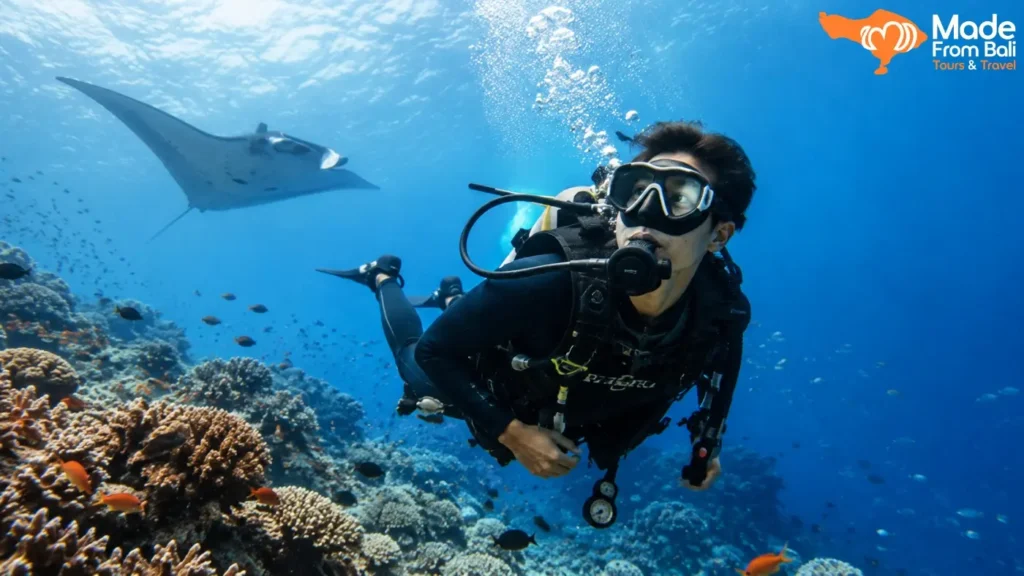
Manta Point sits on Nusa Penida’s south shore and functions as a natural cleaning station where manta rays gather in shallow water, often as little as five meters deep, to have parasites removed by smaller fish. Sightings here are close to guaranteed for most of the year, though winter months can bring current and swell strong enough to limit access. The dive itself is not technically demanding in terms of depth, but the tidal current moving through the site can be enough to bother divers prone to seasickness on the boat ride out, and early morning slots tend to offer calmer conditions and fewer boats competing for the same water space.
Crystal Bay, located in the channel between Nusa Ceningan and Nusa Penida, is where divers come specifically for mola mola, the oceanic sunfish, typically sighted between July and September when cooler water rises from the deep. Visibility during this window can reach 30 to 40 meters, but water temperature drops to around 23 degrees Celsius compared to the usual 28 to 30 degrees elsewhere in Bali, making a 5mm wetsuit a practical necessity rather than an optional comfort choice. This combination of depth, cold water, and current is why Crystal Bay is consistently rated for advanced divers only, despite sitting just a short boat ride from the beginner-friendly waters around Blue Lagoon.
The Channel and Gili Tepekong, Candidasa
For divers who feel their Bali trip is missing sharks, the Channel off Padang Bai and Gili Tepekong near Candidasa are the sites most likely to deliver. The Channel is known for frequent whitetip reef shark sightings resting in rocky overhangs, along with curious giant cuttlefish encounters that surprise many divers with how closely they will approach a group of bubbles. Gili Tepekong adds large walls and a canyon formation, with grey reef sharks, eagle rays, and barracuda joining the sightings list, though its strong currents mean it is genuinely reserved for experienced, confident divers rather than an aspirational stretch goal for someone newly certified.
Nearby, Gili Biaha (sometimes marketed as Shark Cave) combines a dramatic wall with a shallow cavern where whitetip reef sharks often rest near the entrance. No cave penetration is required, which keeps the site accessible to recreational advanced divers rather than requiring technical cave training, but timing around the tide is essential, since the cavern’s exit can become genuinely difficult to manage under the wrong current conditions.
Seraya Secrets and the Deep Wall, Tulamben
Tulamben is not only about the Liberty wreck. Seraya Secrets, a gently sloping black sand site nearby, has become one of the most sought-after macro diving locations in Bali, particularly for underwater photographers hunting the famous “donut” doto nudibranch, harlequin shrimp, frogfish, and pygmy seahorses typically found around 30 meters deep. The site rewards patience over distance covered, since most of what makes it special is centimeters in size and easy to swim straight past without a slow, deliberate search pattern.
Tulamben’s Drop-off site, positioned near the Liberty wreck, offers a different kind of advanced experience: a wall plunging to roughly 80 meters, popular with technical diving trainees and wide-angle photographers chasing the large gorgonian formations found in the deeper sections. Recreational advanced divers typically stay within standard depth limits here, using the upper portion of the wall, while the true depth exists mainly as a training ground for technical certification courses.
Diving or Snorkeling, Choosing the Right Way to Experience These Sites
Not every traveler asking about Bali’s best diving spots is actually looking to scuba dive. Some are exploring whether snorkeling could deliver a similar experience without the certification requirement, and that is a genuinely reasonable question given that several of Bali’s top dive sites sit shallow enough to see meaningful marine life from the surface.
Which Dive Regions Also Work Well for Snorkelers
Nusa Penida’s Manta Point is the clearest example of a site that rewards both groups. When sea conditions are calm, manta rays can be seen from the surface without diving gear at all, which is why many snorkeling tours to Nusa Penida specifically time their visit to overlap with the same conditions divers rely on. Blue Lagoon in Padang Bai works similarly well for snorkelers thanks to its shallow, sheltered coral, and the calmer waters around Nusa Lembongan’s Mangrove Point and Blue Corner offer light snorkeling that avoids the drift conditions divers deal with slightly deeper.
Sites that do not translate well to snorkeling include anything built around wall diving or wreck penetration, such as Tulamben’s Drop-off or Menjangan’s POS 2, since the features that make these dives worthwhile sit well below where surface snorkeling can reach.
When a Guided Snorkeling Trip Makes More Sense Than a Certification Course
For travelers with limited time in Bali, a guided snorkeling trip to Nusa Penida or Blue Lagoon can deliver a meaningful portion of the experience divers describe, particularly the manta ray encounters, without the multi-day commitment an Open Water certification requires. This is a reasonable choice for anyone unsure whether diving is for them long term, or for travelers combining a partner who dives with one who does not, since both activities can often be arranged from the same departure point on the same day.
The honest trade-off is depth of experience rather than access. Snorkelers see the surface layer of these ecosystems, while divers reach the walls, wrecks, and deeper reef structures where much of the marine biodiversity actually concentrates. Neither choice is objectively better, and the right one depends on how much time, budget, and interest in future certification a traveler actually has.
What Marine Life You Can Realistically Expect to See
Bali’s marine life headlines tend to be manta rays and mola mola, but the fuller picture matters for setting realistic expectations before a trip, since sightings depend heavily on timing, location, and a degree of luck no operator can fully control.
Manta Rays and Mola Mola, Where and When Sightings Peak
Manta ray sightings at Nusa Penida’s Manta Point are close to a year-round certainty, with the main risk to visibility being rough winter conditions rather than the mantas’ presence itself. Mola mola sightings are a different story entirely. These oceanic sunfish are seasonal visitors, typically appearing from July through September or into early October as cooler upwelling water rises through the Nusa Penida and Nusa Ceningan channels, and even during peak season a sighting is never guaranteed on any single dive. Divers chasing mola mola specifically should plan flexibility into their itinerary, ideally booking multiple dive days rather than a single attempt, since currents and visibility shift meaningfully day to day.
Wrecks, Walls, and the Macro Critters Worth Knowing About
Beyond the headline species, Bali rewards divers who pay attention to smaller details. Nudibranchs in a huge range of colors and patterns turn up across nearly every region, with Tulamben’s black sand sites particularly famous among macro photographers. Pygmy seahorses, frogfish, ghost pipefish, and harlequin shrimp reward divers who move slowly and search gorgonian fans and coral crevices rather than swimming past at a typical touring pace. Reef sharks, mostly whitetip and occasionally blacktip, are commonly seen resting in overhangs around Padang Bai and Candidasa, while turtles, both green and hawksbill, appear consistently enough across nearly every region that most divers see at least one during a multi-day trip.
Getting to Bali’s Dive Regions from South Bali and Ubud
This is the section most diving guides skip entirely, yet it is often what determines whether a dive trip actually happens or gets pushed off the itinerary. Most travelers stay in South Bali hubs like Kuta, Seminyak, or Canggu, or inland in Ubud, and the drive or boat ride to a dive region can meaningfully shape how the day unfolds.
Road Travel Time to Tulamben, Amed, and Menjangan
| From South Bali (Kuta/Seminyak) | Region | Approximate Drive Time | Notes |
|---|---|---|---|
| Kuta / Seminyak | Tulamben | Roughly 2.5 to 3 hours | Traffic through Denpasar can extend this during peak hours |
| Kuta / Seminyak | Amed | Roughly 2.5 to 3 hours | Similar route to Tulamben, slightly further along the coast |
| Kuta / Seminyak | Menjangan / Pemuteran | Roughly 3 to 3.5 hours | Longest overland drive of the main regions |
| Ubud | Tulamben / Amed | Roughly 1.5 to 2 hours | Shorter than from South Bali due to more direct routing |
| Kuta / Seminyak | Padang Bai / Candidasa | Roughly 1.5 to 2 hours | The most accessible dive region from South Bali by road |
These figures are approximate and shift with traffic, particularly around Denpasar and Sanur, so building in a buffer rather than cutting timing close is a reasonable habit for any dive day where a boat departure or dive briefing has a fixed start time.
Boat Access Points for Nusa Penida and Nusa Lembongan
Diving Nusa Penida or Nusa Lembongan starts with a fastboat crossing rather than a road trip, and Sanur is the primary departure port most dive operators use. From Kuta or Seminyak, reaching Sanur typically takes 30 to 45 minutes depending on traffic, with the boat crossing itself adding another 30 to 45 minutes depending on sea conditions and the specific operator. This means a Nusa Penida dive day realistically starts very early, often before sunrise, to account for hotel pickup, the drive to Sanur, the boat crossing, and arrival at the first dive site while conditions are still calm.
Weather and sea state matter more here than on the mainland routes. Strong winds or high swell in the Badung Strait, the channel between Sanur and the Nusa islands, can delay or cancel boat departures entirely, which is worth knowing before locking a Nusa Penida dive into a tight itinerary with no flexible days around it.
Day Trip or Overnight Stay, Deciding What Actually Fits Your Schedule
Padang Bai and Candidasa work comfortably as day trips from South Bali given their shorter drive time, and most divers return to their original accommodation the same evening without difficulty. Tulamben and Amed sit in a middle zone: a day trip is possible, but the combined drive time on both ends eats significantly into the actual diving window, which is why many divers choose to stay one or two nights near Tulamben or Amed instead, particularly if planning multiple dives across consecutive days.
Menjangan is the clearest case for an overnight stay rather than a day trip. The distance from South Bali makes a same-day round trip exhausting and leaves very little margin if the drive runs long, so most experienced Bali divers treat Menjangan as part of a dedicated north Bali leg of their trip rather than a standalone excursion from Kuta or Seminyak.
Choosing a Dive Operator You Can Trust
The dive site matters, but the operator running it matters just as much, since the same location can feel completely different depending on group size, guide experience, and how seriously safety procedures are handled.
What PADI and SSI Accreditation Actually Guarantees
PADI and SSI are the two most widely recognized scuba certification agencies operating in Bali, and both maintain standards around instructor training, equipment maintenance, and safety procedures that operators must follow to keep their affiliation. Accreditation is a meaningful baseline, confirming that instructors have completed recognized training and that the center follows documented safety protocols, but it is not a guarantee of a good experience on its own. Two PADI-affiliated centers can still differ significantly in group size, how closely guides watch inexperienced divers, and how willing they are to adjust plans around conditions.
Questions Worth Asking Before You Book
A short conversation before booking tends to reveal more than any review score. Worth asking directly:
- What is the diver-to-guide ratio for this specific dive, not just the general policy
- Is equipment included, and when was it last serviced
- What happens if conditions are unsafe on the day, is there a genuine alternative plan
- For non-certified divers, does the Discovery Scuba Diving program include enough shallow-water practice before heading to open water
- Is hotel transfer included, and from which areas of Bali
Operators who answer these questions specifically and without hesitation tend to be the ones worth booking. Vague answers, especially around group size and safety contingencies, are worth treating as a signal to keep comparing options rather than a reason to book quickly.
Practical Details to Sort Out Before Your First Dive
Beyond choosing a site and an operator, a handful of practical details determine whether the actual dive day goes smoothly.
Best Months to Dive by Region and Target Species
| Time of Year | Best Regions | Notes |
|---|---|---|
| April to October (dry season) | All regions, generally best conditions | Calmer seas, better visibility, lower rainfall |
| July to September/October | Nusa Penida (Crystal Bay, Manta Point) | Peak mola mola season, cooler water requires thicker wetsuit |
| October to November | Menjangan | Visibility can exceed 50 meters |
| November to March (wet season) | Tulamben, Amed, Padang Bai | Sheltered sites remain diveable, but Nusa Penida crossings become less predictable |
What to Bring, Wear, and Confirm With Your Operator
A few items make a meaningful difference to comfort and readiness on dive day. Worth having ready:
- Certification card, if you are already certified, since operators need to verify your level before booking advanced sites
- A 3mm wetsuit for most regions, upgraded to 5mm specifically if diving Crystal Bay during mola mola season
- Reef-safe sunscreen, since standard sunscreen chemicals contribute to coral damage in heavily dived areas
- A dive log, if you have one, particularly useful if it has been a while since your last dive and an operator wants to gauge your recent experience
- Confirmation of what is included in the price, since equipment, transport, and lunch are sometimes bundled and sometimes charged separately depending on the operator
Fitness, Health, and Insurance Considerations for First-Time Divers
Scuba diving does not require elite fitness, but it does require reasonable cardiovascular health and the ability to swim comfortably, since most Open Water and Discovery programs include a basic swim assessment. Divers with certain medical conditions, particularly related to the lungs, heart, or ears, should consult a doctor before diving, and reputable Bali operators will ask a basic medical questionnaire before any first dive regardless of how experienced you claim to be.
Dive-specific travel insurance is worth arranging before arrival rather than assuming standard travel insurance covers diving incidents, since many general policies exclude scuba diving or cap coverage at recreational depths only. It is also worth building in at least 18 to 24 hours between your last dive and any flight, since flying too soon after diving increases the risk of decompression sickness, a detail that matters directly if your Bali trip ends with an early departure the same day as a planned dive.
What to Know if You’re Traveling With a Non-Diver
Mixed-interest travel groups are common in Bali, and this is a genuine planning gap most diving content simply ignores, treating every reader as though they are traveling solo purely to dive.
Activities Near Tulamben, Amed, and Menjangan for Companions Who Aren’t Diving
A non-diving companion is not stuck waiting at a hotel while the rest of the group dives. Near Tulamben and Amed, black sand beaches, coastal walking routes with views toward Mount Agung, and traditional fishing villages offer a relaxed few hours while dives are underway. Amed in particular has a slower, less commercial pace than South Bali, which suits travelers who want quiet time rather than organized activities. Near Menjangan, the surrounding Pemuteran area includes calmer beaches and a well-known coral restoration project that can be visited without diving gear, giving non-divers something genuinely engaging rather than a forced consolation activity.
For groups splitting between diving and snorkeling on the same day, several dive operators in Padang Bai and around Nusa Penida offer combined trips where snorkelers and divers depart together and reunite for lunch, which keeps the day social rather than logistically split into two separate excursions.
Mistakes That Turn a Bali Dive Trip Into a Rushed One
A handful of recurring planning mistakes show up repeatedly among first-time visitors, and most are avoidable with a little upfront awareness.
Trying to Fit Too Many Regions Into One Visit
The instinct to see everything, Tulamben, Nusa Penida, and Menjangan, within a single short trip is understandable but usually backfires. Each region involves meaningful travel time, and stacking three distant dive areas into four or five days often means more hours spent in a car or on a boat than actually underwater. Divers consistently report more satisfaction picking two regions and diving them properly across multiple days than rushing through three regions with only one dive at each.
Skipping the Gili Islands and Bali Distinction When Planning
Several diving guides list the Gili Islands, Gili Trawangan, Gili Meno, and Gili Air, as though they belong to Bali. They do not. The Gili Islands sit off the coast of Lombok, a separate island reached from Bali by a speedboat crossing that typically takes around one to two hours from ports like Amed or Padang Bai. This confusion matters practically, since travelers who assume the Gilis are a short local extension of their Bali dive trip sometimes underestimate the additional travel time, cost, and immigration-free but still logistically separate crossing involved. If the Gili Islands are on your list, it is worth treating them as their own destination requiring dedicated planning, not an easy afternoon add-on to a Bali itinerary.
Planning a Bali Trip Around a Few Great Dives Instead of Chasing Every Site
The best diving spots in Bali are not a checklist to complete in a single trip. They are a set of genuinely different experiences, a shallow shore dive at Tulamben, a drift past reef sharks in Candidasa, a slow macro search in Seraya Secrets, that reward focus over volume. Choosing two or three sites that match your actual certification level, travel base, and interests will almost always produce a better trip than an ambitious itinerary that spends more time on transfers than underwater.
For travelers still working out the logistics, particularly getting between South Bali or Ubud and regions like Tulamben, Amed, or the Sanur boat harbor for Nusa Penida, arranging a private driver for the day removes one of the more stressful parts of dive planning. It also leaves room to build in a relaxed non-diving stop, a coastal viewpoint, or a village visit, on the way back, turning a dive day into a fuller day of exploring Bali rather than a rushed there-and-back trip.