


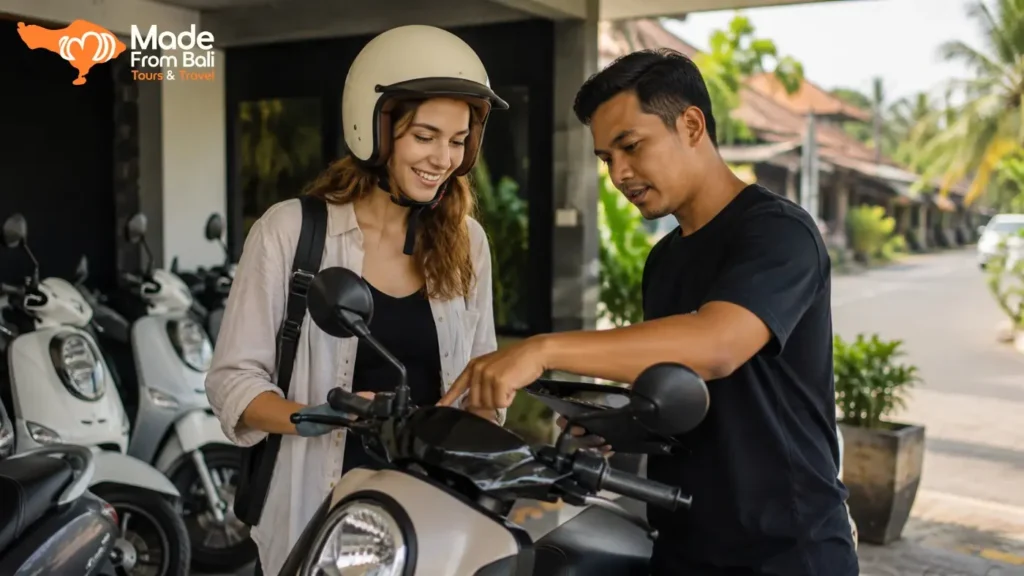
Most people renting a scooter in Bali for the first time think it’s a five-minute transaction. Hand over some cash, get a bike, ride off toward the rice fields. For a lot of travelers it really is that simple. But every year, a smaller and very avoidable group ends up dealing with an invalidated insurance claim after a crash, a IDR 2,000,000 “damage fee” for a scratch they never made, or a roadside fine they didn’t fully understand how to handle.
None of that happens because scooters are dangerous by nature. It happens because the information floating around online is either outdated, written by a rental company trying to sell you their own bikes, or too generic to actually prepare you for what Bali’s roads and checkpoints look like in practice. A helmet reminder and a vague warning about scams isn’t enough anymore, not when enforcement has genuinely tightened over the past couple of years and street-side operators have gotten more creative with their tricks.
This guide goes through what you actually need before you ride, what fair pricing looks like right now, how the common scams work and how to shut them down calmly, and what to do if something goes wrong. It also gets honest about something most rental-focused articles avoid saying out loud: a scooter isn’t the right choice for every traveler or every trip. By the end, you’ll know exactly where you stand.
Is Renting a Scooter the Right Way to Get Around Bali
For a huge share of visitors, yes, and the reason is simple. Bali has no meaningful public transport network, taxis are expensive if you’re moving around all day, and the island’s worst traffic (locals call it macet) can turn a 15 minute drive into an hour in a car. A scooter lets you filter through that traffic, park almost anywhere for free, and take the narrow village lanes, locally called gang, that a car physically can’t fit through.
That said, the decision shouldn’t be automatic just because it’s cheap and everyone else seems to be doing it. A scooter genuinely makes sense when your situation looks like this:
- You’re staying in one area for several days or longer, so the daily cost drops with a weekly or monthly rate
- You’ve ridden a scooter or motorbike before, even casually, and feel comfortable with basic controls
- Your plans involve a lot of short, spontaneous trips (cafes, the beach, a gym, dinner) rather than one long cross-island day
- You’re traveling solo or as a confident couple, not managing kids, elderly parents, or a pile of luggage
If most of that doesn’t describe your trip, it’s worth reading through to the later sections on regional differences and alternatives before committing. Renting because it “feels like the Bali thing to do” is exactly how people end up on roads they’re not ready for.
What You Legally Need Before You Ride
Bali’s rental shops have a reputation, deserved in many cases, for handing over a scooter to anyone with cash and a passport, no questions asked. That doesn’t make it legal, and it definitely doesn’t make it insured. If you’re stopped without the right paperwork, or worse, if you’re in an accident, the gap between “the shop let me rent it” and “I was actually allowed to ride it” becomes very expensive very fast.
National Driving Licence and Motorbike Category
A lot of travelers assume any driving licence from home covers them here, as long as it shows some kind of motor vehicle entitlement. That’s usually wrong. What matters is whether your home licence specifically authorizes you to ride a motorcycle or scooter, not just a car.
If your licence only covers passenger cars, renting a 125cc automatic scooter in Bali still leaves you technically unlicensed for that vehicle class, even though the rental shop won’t check and the bike will start just fine. This becomes a real problem after an accident, because travel insurers routinely deny claims when the rider wasn’t legally licensed to operate that specific vehicle type in the first place. Check your home licence’s vehicle categories before you travel, not after you’ve already booked a bike.
International Driving Permit and the Convention That Actually Matters
An International Driving Permit (IDP) is essentially an official multilingual translation of your home licence, and Indonesia requires one alongside your original licence for foreign riders. Where most guides stop short is explaining that not all IDPs are treated the same.
There are two international frameworks an IDP can be issued under: the 1949 Geneva Convention on Road Traffic and the 1968 Vienna Convention. Indonesia’s traffic rules are generally understood to align with the 1949 Geneva format, which most Western countries’ automobile associations (like AAA in the US, the AA in the UK, or CAA in Canada) issue by default. In practice, many riders carrying a 1968-format IDP haven’t run into trouble, but relying on informal tolerance isn’t the same as being correctly documented. If you’re applying for an IDP specifically for a Bali trip, it’s worth confirming with your issuing association that you’re getting the 1949 Geneva version, and keeping both your IDP and home licence together at all times.
Vehicle Registration Papers (STNK) and Why You Must Carry Them
The STNK is the scooter’s own registration document, similar to a vehicle registration certificate, and it should be handed to you by the rental company along with the keys. It proves the bike is legally registered and that you have the right to be operating that specific vehicle.
Police checkpoints commonly ask for three things together: your national licence, your IDP, and the STNK. Missing any single one of them usually results in a separate fine, so a rider missing all three can end up paying multiple penalties in one stop rather than just one. Before you ride off from any rental shop, physically confirm the STNK is in the seat compartment or given to you directly. Some smaller operators forget, or hand you a photocopy that doesn’t match the bike you’re actually riding.
How Much Does Scooter Rental in Bali Cost
Pricing swings a lot depending on where you rent, what condition the bike is in, and whether insurance is genuinely included or just implied. Understanding realistic ranges helps you spot when a deal is too good to be safe, and when a slightly higher price is actually buying you real protection.
Daily, Weekly and Monthly Rental Rates
| Rental Period | Typical Automatic Scooter (e.g. Vario, Scoopy) | Typical Maxi Scooter (e.g. NMax, ADV160) |
|---|---|---|
| Daily | Around USD 5 to 12 | Around USD 10 to 20 |
| Weekly | Noticeably cheaper per day, often 20 to 30 percent off the daily rate | Similar proportional discount |
| Monthly | Best value for long stays, often the equivalent of 15 to 20 days at the daily rate | Available, though less commonly advertised upfront |
Street-side vendors sometimes advertise well below these ranges, occasionally as low as USD 3 a day. That’s not automatically a scam, but it’s almost always a sign that insurance, delivery, and proper maintenance aren’t part of the deal. Treat unusually low prices as a prompt to ask more questions, not as a reason to walk away immediately.
What’s Usually Included and What Costs Extra
Before agreeing to a price, it’s worth confirming exactly what’s bundled in, because “included” means very different things from one operator to the next.
- Helmet: Almost always included, but quality varies a lot. Street rentals often hand over a worn, poorly fitted helmet, while established companies tend to provide cleaner, better-maintained ones.
- Insurance: Frequently not included by default with cheaper rentals. Ask specifically whether it covers damage, theft, or both, and whether it’s voided by missing documents like your IDP.
- Delivery: Common with rental companies and some hotels or villas, rare with street vendors who expect you to collect the bike yourself.
- Fuel: Bikes are typically handed over with a full tank and expected back the same way, so there’s usually no separate mileage or fuel charge, just the cost of topping up before you return it.
- Damage and late fees: Where the real extra cost risk lives. Ask upfront how damage is assessed and what happens if you return the bike a few hours late.
Where and How to Rent a Scooter in Bali
Choosing where to rent matters just as much as choosing what to rent. The three main paths available to travelers each come with a different balance of price, convenience, and risk, and picking blindly based on whichever shop is closest to your hotel is how most avoidable problems start.
Street Rentals vs Villa-Arranged Rentals vs Insured Rental Companies
| Option | Typical Price | Convenience | Risk Level | Best For |
|---|---|---|---|---|
| Street-side or independent vendor | Lowest | Low, usually requires you to walk in and collect the bike | Higher, inconsistent insurance and documentation practices | Confident riders comfortable negotiating and inspecting bikes themselves |
| Villa or hotel arranged rental | Mid-range | High, bike often delivered to your door | Moderate, quality depends entirely on which vendor the property partners with | Travelers who want convenience and some accountability through the accommodation |
| Established rental company with real insurance | Higher | High, usually includes delivery and support | Lower, clearer insurance terms and documented condition reports | Anyone planning to ride a lot, ride longer distances, or who wants real accident coverage |
There isn’t a single universally “correct” choice here. A confident, experienced rider on a short trip might reasonably choose the cheaper street option and accept the tradeoffs. A first-time rider planning two weeks of daily use is taking on real financial exposure by skipping proper insurance to save a few dollars a day.
What to Inspect Before You Sign Anything
Whichever option you choose, the inspection step is non-negotiable, and skipping it is exactly how the pre-existing damage scam gets its opening. Walk through this before you hand over any money or documents.
- Photograph the entire bike from multiple angles, including close-ups of any existing scratches, dents, or worn plastic. Timestamp matters here, so use your phone’s camera rather than a screenshot.
- Test the brakes, both front and back, at low speed in a safe area before committing to the rental.
- Check the tyres, looking at tread depth and air pressure. Bald or soft tyres are a real safety issue on Bali’s slick, pothole-prone roads.
- Test the lights, horn, and indicators. A bike with a broken headlight is both a safety risk and an easy target for a police stop.
- Confirm the fuel level at handover so there’s no dispute about what you’re expected to return.
- Ask the vendor to acknowledge existing damage out loud, on record if possible, ideally by having them initial or verbally confirm the same photos you just took.
None of this takes more than five minutes, and it removes almost all the leverage a dishonest vendor would otherwise have at return time.
Choosing the Right Scooter for Your Trip
The bike you ride should match the riding you’re actually planning to do, not just whatever’s parked out front when you arrive. Getting this wrong usually shows up as either overpaying for power you don’t need, or struggling on hills and highways with a bike that’s underpowered for two people and luggage.
Automatic Scooters for City and Short-Distance Riding
Models like the Honda Scoopy, Honda Vario, or similar 110cc to 125cc automatics are the default choice for a reason. They’re light, easy to handle at low speed, cheap to fuel, and genuinely forgiving for someone still getting comfortable with Bali traffic. If your days revolve around one area, Canggu cafes, Seminyak beaches, Ubud’s town center, this class of bike covers essentially everything you’ll need without unnecessary cost or bulk.
The tradeoff shows up on longer rides. Climbing toward Kintamani or covering serious distance on the bypass roads, a small automatic can feel strained, especially riding two-up with bags.
Maxi Scooters for Longer or Hillier Routes
Bikes like the Yamaha NMax, Honda ADV160, or Yamaha XMAX sit in the 150cc to 160cc-plus range and handle hills, higher speeds, and two-person loads far more comfortably. They’re the more sensible pick if your plans include day trips to North Bali, longer rides toward the east coast, or regularly riding with a passenger and gear.
They cost more to rent and burn slightly more fuel, but for anyone covering real distance regularly, that extra cost usually pays for itself in comfort and control, particularly on the rougher, less maintained roads outside the main tourist belt.
Common Scooter Rental Scams in Bali and How to Avoid Them
Most scam reports coming out of Bali follow a small number of repeating patterns. Recognizing the mechanics behind each one, rather than just being told to “be careful,” is what actually protects you.
The Pre-Existing Damage Scam
This is the most common complaint by far. A vendor points to a small, often pre-existing scratch or dent when you return the bike and insists you caused it, then demands an inflated payment, sometimes framed as the only alternative to “calling the police.” The fix isn’t complicated, but it has to happen before the ride, not after: document the bike’s condition thoroughly at pickup, as described in the inspection checklist above, and keep those photos accessible on your phone. If a vendor pushes back hard against you taking photos in the first place, treat that as a warning sign and consider renting elsewhere.
The Passport Deposit Trap
Some operators ask travelers to leave their original passport as a security deposit instead of cash. This should be an automatic no. Once your passport is in someone else’s hands, you’ve lost significant leverage in any dispute, and reclaiming it can turn into exactly the kind of standoff the scam is designed to create. A cash deposit, or a photocopy of your passport paired with your accommodation details, is a reasonable alternative that most legitimate operators will accept without much resistance.
Bait Pricing and Last-Minute Bike Swaps
An advertisement promises a specific bike at a specific price, but on arrival you’re told that model is unavailable and offered a pricier alternative instead. It’s a soft pressure tactic that works because travelers, often tired from a flight or eager to start their day, don’t want to walk away and start the search over. Screenshotting the original advertised price and terms before you show up gives you something concrete to point back to, and being willing to simply leave if the terms change is usually the fastest way to end the negotiation in your favor.
Police Checkpoints and What Happens If You’re Stopped
Checkpoints in areas like Canggu and Seminyak have become a routine part of riding in Bali, particularly during peak tourist months. Officers typically ask for your national licence, IDP, and STNK together, and missing documentation is the single most common reason tourists get flagged.
If you’re stopped, staying calm and polite makes an enormous practical difference. Officers generally have discretion in how a violation is handled, and a cooperative attitude tends to lead to a smoother interaction than arguing or acting defensive. There are two realistic paths a fine can take: an official process involving a receipt and a set fine amount, or an informal on-the-spot resolution that some officers may suggest as an alternative. Whichever direction it goes, always ask for a receipt if money changes hands, since that simple step adds accountability to the interaction and discourages inflated informal demands.
Having every document ready and visible, rather than digging through bags at the roadside, also shortens the stop considerably and reduces the chance of it escalating into something more complicated.
Safety Rules Every Rider Needs on Bali’s Roads
Bali’s roads combine dense tourist traffic, unpredictable local riding habits, and infrastructure that varies wildly between a smooth main road and a cratered village lane a hundred meters later. A handful of rules make an outsized difference to how safely that combination gets navigated.
Helmet Law and Passenger Rules
Helmets are legally required for both rider and passenger, with fines around IDR 250,000 for riding without one. Beyond the legal angle, it’s simply the single most effective piece of protective equipment available to you on a scooter, and a poorly fitted or loose helmet offers far less real protection than it appears to. Check the fit properly rather than accepting whatever’s handed to you.
Riding Etiquette Locals Expect
A few local habits catch first-time riders off guard, and understanding them makes riding noticeably less stressful.
- Honking is communication, not aggression. A short beep before overtaking or approaching a blind corner is standard practice, signaling presence rather than frustration.
- Traffic filters constantly, in ways that feel chaotic at first. Riders move between lanes and around stopped cars in a pattern that looks disorganized but generally follows an unspoken rhythm most locals read instinctively.
- Headlights stay on during the day, which is an actual traffic rule in Indonesia, not just a suggestion for visibility.
- Bali rides on the left side of the road, which trips up travelers from countries where driving is on the right, especially in the first day or two.
Riding in Rainy Season
Wet season, roughly November through March, changes the riding experience considerably and gets surprisingly little coverage in most guides. Roads become noticeably more slippery, particularly on painted lane markings and metal drain covers, and visibility drops fast during heavy downpours. Braking distances increase, so leaving more space between you and the vehicle ahead becomes genuinely important rather than optional caution. A lightweight rain poncho, kept in the scooter’s seat compartment, is worth carrying even on days that start dry, since afternoon storms can appear with very little warning.
What to Do If You Have an Accident or Breakdown
Even careful riders occasionally deal with a minor spill, a mechanical issue, or a more serious collision. Knowing the sequence of steps in advance removes a lot of the panic and confusion that makes these situations worse than they need to be.
- Move to safety first, both yourself and the bike if it’s possible to do so without further risk, since a stopped vehicle in an active lane creates a secondary hazard.
- Assess injuries honestly. For anything beyond minor scrapes, prioritize getting medical attention over dealing with the bike or paperwork.
- Document the scene with photos of both vehicles, the road position, and any visible damage, before anything gets moved or cleaned up.
- Contact your rental company immediately, since most have a process for exactly this situation and can advise on next steps, including whether a replacement bike or roadside pickup is available.
- Understand the cash reality of local clinics. Many Bali medical facilities expect payment upfront in cash before treatment, with reimbursement handled afterward through your travel insurance. Carrying enough cash or a card with sufficient limit for an unexpected clinic visit is worth planning for.
- File a police report for anything involving another party or significant damage, since most travel insurance claims require this documentation to process a payout.
- Contact your embassy only for serious incidents, such as a major injury, hospitalization, or a dispute you can’t resolve locally. For minor scrapes and paperwork, this step usually isn’t necessary.
Fuel, Repairs and Everyday Practicalities
Day to day maintenance on a rented scooter in Bali is refreshingly simple once you know the basics. Fuel is sold through official Pertamina stations, identifiable by their branded canopies, at a fairly standard price per liter. In areas without a nearby station, small roadside stalls known as Pertamini or informal vendors sell fuel by the bottle, often literally in reused glass bottles, at a slightly higher price per liter but with far more convenience for a quick top-up.
Flat tyres are common enough on Bali’s roads that roadside repair shops, called bengkel, are almost never far away. If you need air added, the local phrase “tambah angin” gets the point across, and specifying “ban depan” for the front tyre or “ban belakang” for the rear helps avoid confusion. A basic tyre repair or air top-up typically costs a small, negotiable amount, usually just a few thousand rupiah, and takes only a few minutes.
Scooter Rental by Region: South Bali, Ubud, North Bali and Nusa Penida
Renting conditions and road experience differ meaningfully depending on where you’re based, and treating “Bali” as one uniform riding environment leads to some avoidable surprises.
| Region | Road Character | Checkpoint Frequency | Notes |
|---|---|---|---|
| South Bali (Canggu, Seminyak, Kuta) | Dense traffic, mostly paved, narrow gangs common | High, especially around Canggu and Seminyak | Widest rental selection, most competitive pricing |
| Ubud | Mix of busy center and quieter surrounding roads | Moderate | Popular for day trips into rice terrace areas, roads can narrow quickly outside town |
| North Bali and Amed | Rougher surfaces, more hills, less traffic overall | Lower | A maxi scooter is genuinely more comfortable here than a small automatic |
| Nusa Penida | Rough, often unpaved sections, steep terrain | Low, but road conditions themselves are the bigger risk factor | Scooters generally can’t be transported by boat from mainland Bali, so renting happens locally on the island itself |
The Nusa Penida point trips up a surprising number of travelers who assume they can simply bring their mainland rental across on the ferry. In practice, most fast boats don’t accommodate rented scooters, and even where it’s technically possible, most rental agreements explicitly prohibit taking the bike off Bali itself. Plan to rent separately once you arrive on the island.
When a Scooter Isn’t the Right Fit for Your Trip
Not every traveler benefits from riding, and being honest about that upfront saves both money and stress. This isn’t about discouraging scooter rental as a whole, it’s about matching the choice to your actual situation rather than defaulting to it because it’s the most talked-about option online.
Traveling With Kids, Luggage or a Larger Group
Fitting a family or a group of friends onto multiple scooters, each managing their own bags, documents, and navigation, adds coordination stress that most people underestimate until they’re actually doing it. A single air-conditioned car with a private driver covers the same ground without splitting the group across several bikes or worrying about who’s comfortable riding and who isn’t. For multi-stop sightseeing days especially, a private driver service keeps everyone together and removes the parking and navigation burden entirely.
First Time in Bali or Not Confident Riding in Traffic
Bali’s traffic is not a beginner-friendly place to learn to ride for the first time, and there’s no shame in acknowledging that. A common and sensible approach is spending the first day or two relying on a driver or ride-hailing apps while getting oriented, then switching to a scooter once the roads feel more familiar. If your trip starts with an airport transfer rather than heading straight into rush-hour traffic on an unfamiliar bike, that early comfort tends to pay off in confidence for the rest of the trip.
Scooter, Private Driver or Ride-Hailing: Matching the Option to Your Day
Rather than picking one transport method for the entire trip, most experienced travelers end up mixing two or three depending on what a given day actually requires.
| Situation | Best Fit | Why |
|---|---|---|
| Solo or couple, staying local, comfortable riding | Scooter | Cheapest, most flexible for spontaneous stops |
| Group or family covering several distant stops in one day | Private driver | No splitting the group, no parking stress, everyone travels together |
| Quick point-to-point trip within one neighborhood | Ride-hailing (Grab or Gojek) | No commitment, fixed upfront pricing, no rental paperwork |
| First day or two in Bali, not yet comfortable with traffic | Private driver or ride-hailing | Lower stress while you get oriented, switch to a scooter once settled |
| Multi-stop sightseeing day, temples, waterfalls, viewpoints | Private driver or tour package | Covers ground efficiently without navigation or fatigue |
There’s no single right answer here, only the option that fits the day you’re actually planning. Many travelers end up using two or three of these across a single trip, and that flexibility is often more practical than committing entirely to one method for two weeks straight.
Frequently Asked Questions About Renting a Scooter in Bali
Do I need an international driving permit to rent a scooter in Bali?
Renting itself often doesn’t require one, since many shops will hand over a bike with just a passport. Legally riding it does require an IDP alongside your home licence, and this is the document police checkpoints most commonly ask for.
Is it safe for a beginner to rent a scooter in Bali?
It’s possible, but not recommended for someone who has never ridden any kind of motorbike before. Bali’s traffic patterns, road surfaces, and checkpoint enforcement are demanding even for experienced riders, and a first-ever ride is better attempted somewhere quieter than a busy tourist area.
How much does scooter rental in Bali typically cost per day?
Expect somewhere between USD 5 and 20 per day depending on the bike type and whether real insurance is included, with weekly and monthly rentals bringing the daily rate down noticeably.
What happens if I get into an accident on a rented scooter?
Prioritize safety and medical attention first, document the scene, contact your rental company, and be prepared to pay upfront in cash at most local clinics before claiming reimbursement through travel insurance afterward.
Can I rent a scooter without leaving my passport as a deposit?
Yes, and it’s worth insisting on this. A cash deposit or a passport photocopy paired with your accommodation address is a reasonable alternative that most legitimate rental operators accept.
Is renting a scooter cheaper than hiring a private driver in Bali?
For solo riders covering local ground daily, a scooter is usually cheaper. Once you’re splitting a private driver’s day rate across three or four people covering the same multi-stop itinerary, the per-person cost gap narrows considerably.
Getting Around Bali on Your Own Terms
There’s no single correct way to move around this island, only the option that actually fits the trip you’re on. A scooter can be one of the most rewarding parts of a Bali holiday when the paperwork is right, the bike is properly inspected, and the rider genuinely feels ready for the traffic. It can just as easily turn into the most stressful part of the trip when any of those pieces are missing.
If you read through this and realize a scooter isn’t quite the right fit, whether that’s the group size, the itinerary, or simply not feeling ready to ride yet, that’s a completely reasonable conclusion to land on. A comfortable, air-conditioned ride with a local driver who already knows the shortest route past the traffic covers the same ground without the learning curve. Whichever way you choose to explore, the goal is the same: spend less time worrying about how you’re getting there, and more time actually enjoying being there.