

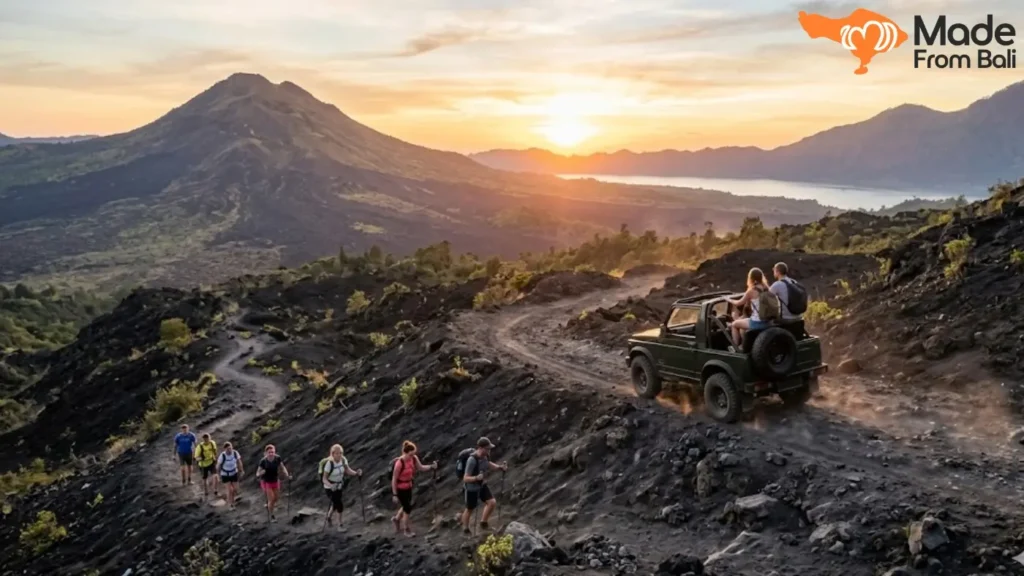
Somewhere between reading about the Mount Batur sunrise trek and imagining yourself hiking a volcano at 3am, a lot of travelers hit a wall. Maybe it is a knee that has not been reliable lately. Maybe it is children who are too young for a two-hour night ascent. Maybe it is simply that the idea of a physically demanding hike in the dark does not match the kind of holiday this is supposed to be. And then the jeep tour appears as an option, and the question becomes: is this actually worth doing, or is it just a compromise for people who could not manage the real thing?
That framing is the first thing this guide is going to correct. The Mount Batur jeep tour is not a lesser version of the trek. It is a genuinely different experience that accesses a different part of the volcano, moves through terrain that trekkers never touch, and delivers a sunrise moment that is quieter and more intimate than the summit crowd that congregates every morning above. Whether it is better or worse than trekking depends entirely on who you are, what you want from the morning, and what your body or your group actually needs.
This guide covers all of it. The route, the terrain, the viewpoints, the honest comparison with trekking, the traveler profiles it suits, the complete logistics, and what to prepare for when you are sitting in an open-top 4×4 at altitude before dawn.
What the Mount Batur Jeep Tour Actually Is
The jeep tour at Mount Batur is frequently described in a single sentence on most booking platforms, which tells you almost nothing useful. It gets called a “4×4 adventure” or an “off-road sunrise experience,” and while neither description is wrong, neither one communicates what actually happens between pickup and the moment you sit down for breakfast on a volcanic hillside. Understanding the format is the starting point for knowing whether it is the right choice for you.
The Route, the Terrain, and What the Jeep Drives Through
The jeep used on these tours is a traditional open-top 4×4, typically a Land Rover or similar vintage off-road vehicle with bench seating in the rear. Open-top is not a styling choice. It means you are exposed to the air, the wind, and the pre-dawn cold at altitude, which is relevant for preparation purposes and discussed in detail later in this guide.
The route begins from the Toya Bungkah area on the western shore of Danau Batur, the caldera lake that sits at the base of the volcano. From there, the jeep climbs into the caldera landscape through terrain that most Bali visitors never see from the ground level: volcanic lava fields that solidified after the 1994 eruption of Mount Batur, wide expanses of dark rock and ash where almost nothing grows, and tracks that follow the natural contours of the volcanic flow in ways that feel genuinely remote despite being thirty minutes from the nearest village.
The lava fields are worth understanding before you arrive. Mount Batur has erupted multiple times in recorded history, with significant eruptions in 1917, 1963, and 1994. The 1994 flow destroyed several villages and reshaped the lower caldera landscape into the dramatic black rock terrain the jeep traverses today. Driving through it in the early morning darkness, with headlamps illuminating the volcanic rock on either side and the smell of sulfur faint in the air, is an experience with a geological weight to it that most travelers do not anticipate.
What the Jeep Reaches and What It Does Not
This is the part most tour descriptions skip, and it matters for setting accurate expectations. The jeep route accesses the caldera floor and lower volcanic slopes, including viewpoints on the caldera rim that offer wide panoramic views across the lake and toward the summit. It does not reach the summit crater. The highest accessible point by vehicle is a series of viewpoints positioned on the ridgeline above the lava fields, from which the sunrise is visible across the full caldera landscape.
This is not a limitation so much as a distinction. The summit view from trekking looks down into the caldera and out across the island. The jeep viewpoints look across the caldera at the same elevation, with the volcanic peak visible above and the lake visible below. Both perspectives are dramatic. They are simply different.
Steam vents, which are one of the memorable features of the summit experience for trekkers, are also accessible on the jeep route. The caldera area has active thermal zones at ground level, and jeep tours typically include stops near visible steam activity where the volcanic geology is close and immediate in a way that a distant summit view cannot replicate.
Experiencing Sunrise From the Jeep Route
The sunrise is the reason most people come to Mount Batur, and whether you are on foot or in a jeep, the core experience of watching the sun emerge above the caldera on a clear morning is genuinely extraordinary. The difference lies in the perspective, the atmosphere, and what surrounds you in that moment.
What the Viewpoints Look Like and How They Feel
The jeep route viewpoints are positioned on elevated ground above the lava fields, typically reaching between 1,300 and 1,500 meters depending on the specific route and operator. At this elevation, the pre-dawn darkness is complete, the air is cold and still, and the silence of the caldera floor below is striking in a way that is hard to describe without having experienced it.
As the horizon begins to lighten, the outline of the surrounding volcanic peaks becomes visible, the lake surface below catches the first reflected light, and the steam rising from thermal vents on the caldera floor begins to glow faintly against the brightening sky. The sunrise unfolds slowly and then rapidly, and within ten to fifteen minutes of the first glow, the entire landscape is transformed by the quality of early morning volcanic light. The dark lava fields take on texture. The lake shifts through colors that change faster than they can be named. On clear mornings, the view extends east toward Mount Agung and, on exceptional days, toward Lombok’s Mount Rinjani on the horizon.
What the jeep viewpoints offer that the trekking summit does not is space and quiet. The summit of Mount Batur at sunrise draws a significant number of trekkers, and while the view from there is undeniably impressive, the experience is a shared one. The jeep viewpoints, by nature of the route’s different character and smaller group sizes, tend to feel more private. For couples, families, and travelers who want the sunrise to feel like a personal moment rather than a spectacle, this difference is meaningful.
How the Jeep Sunrise Compares to the Summit Sunrise on Foot
The honest comparison between the two sunrise experiences is one that most travel content avoids because it requires acknowledging trade-offs rather than simply recommending one option. Here is the direct version.
| Factor | Jeep Tour Sunrise | Trekking Summit Sunrise |
|---|---|---|
| Elevation | 1,300 to 1,500 meters approx. | 1,717 meters summit |
| View direction | Across the caldera toward the summit | Down into the caldera and across the island |
| Crowd level | Smaller groups, more space | Can be crowded at peak season |
| Physical access | No physical demand | 2 to 2.5 hours ascending steep terrain |
| Atmosphere | Ground-level volcanic terrain, lava fields | Above-cloud perspective, volcanic rim |
| Steam vents | Accessible at ground level | Visible at crater rim |
| Emotional payoff | Intimate, geological, caldera-immersive | Elevated, panoramic, achievement-driven |
Neither experience is objectively superior. The trekking summit offers an elevated panorama and the physical satisfaction of having climbed there. The jeep route offers geological intimacy with the volcanic landscape, accessibility, and a sunrise moment that is less crowded and more conducive to quiet observation. The right choice depends on what kind of morning you are looking for.
Jeep Tour vs Trekking at Mount Batur
The question most travelers arrive at when researching Mount Batur is a direct one: should I hike or take the jeep? The answer is not the same for everyone, and giving a blanket recommendation would be less useful than giving you the framework to make the decision yourself.
The Honest Differences Between the Two Experiences
Beyond the sunrise perspective comparison above, the two formats differ in several practical and experiential dimensions that affect the entire morning, not just the viewpoint moment.
The physical dimension is the most obvious. Trekking requires approximately two to two and a half hours of ascending moderately steep volcanic terrain in the dark, with the upper section involving loose rock and sustained effort. The jeep tour requires nothing physically demanding beyond getting in and out of a vehicle and walking short distances at viewpoint stops. This is not a judgment. It is simply a factual difference that is highly relevant for certain travelers.
The time dimension is also different. A trekking group typically departs between midnight and 2am from south Bali and returns by late morning. A jeep tour departs slightly later, around 2am to 3am, with a shorter total duration, and returns by late morning as well. Neither saves dramatic time over the other because the drive to Kintamani is the same regardless of format.
The sensory experience differs more than most descriptions suggest. Trekking is about vertical movement through changing terrain, rising temperature from exertion, and the achievement of reaching an elevated point through physical effort. The jeep tour is about horizontal movement through the caldera floor, the immediacy of the volcanic landscape at ground level, and the sense of moving through a geological event rather than rising above it.
Which One Suits You Based on Your Situation
Rather than a vague recommendation, this is a direct matching guide based on the situations travelers actually describe when choosing between the two.
- Choose trekking if: You are in reasonable physical condition, want the elevated panoramic perspective, value the achievement of the ascent, and are comfortable with an early night departure and sustained physical effort.
- Choose the jeep tour if: You have physical limitations that make sustained hiking impractical, are traveling with children, older companions, or anyone whose fitness makes the trek inadvisable, prefer an experience that prioritizes the volcanic landscape over the elevated view, or simply want the sunrise moment without the physical intensity.
- Consider both if: You are visiting Bali for an extended period and want to experience Mount Batur from two different perspectives on separate days. Some travelers do exactly this, and the two experiences are complementary rather than redundant.
The jeep tour is not the right choice because trekking feels too hard. It is the right choice because of what it specifically offers and who it specifically serves well.
Who the Jeep Tour Is Really Designed For
One of the gaps in most jeep tour content is the lack of honest, specific guidance about who the experience actually suits. Generic phrases like “suitable for all ages” are not useful. What follows is traveler-specific guidance that reflects the real situations people bring to this decision.
Families With Children and Travelers With Young Kids
The Mount Batur jeep tour is one of the most genuinely family-friendly adventure experiences in Bali, and it works well for families in ways that trekking simply cannot. Children under ten, in particular, are not well-suited to a two-plus hour night hike on steep volcanic terrain, but they are absolutely capable of sitting in an open jeep, watching the sunrise over a caldera lake, and spending the morning on a volcanic lava field with steam vents and dramatic scenery.
The practical considerations for families are worth addressing directly. Children need to be kept warm in the open vehicle, which means bringing extra layers and having them wear more than feels necessary for a Bali morning. The jeep ride itself is bumpy and exciting for children in the way that off-road vehicles always are, which means it tends to hold their attention and energy rather than exhausting it. The viewpoint stops allow for movement and exploration, and the volcanic terrain is visually striking enough to hold a child’s curiosity without requiring explanation.
Pre-book the jeep tour with a provider who can confirm the vehicle configuration for families. Some operators can arrange additional seating arrangements or specify vehicles that are more comfortable for children.
Older Travelers and Anyone With Physical Considerations
For older travelers, those managing joint issues, or anyone for whom sustained physical effort is not advisable, the jeep tour makes the Mount Batur sunrise experience genuinely accessible rather than theoretically possible with a lot of difficulty. This is the clearest case for the jeep format: it delivers a meaningful, authentic volcanic sunrise experience to people who would otherwise have to skip Mount Batur entirely.
The physical demand of the jeep tour is minimal. Getting into and out of a raised vehicle, walking short distances on relatively flat volcanic ground at viewpoint stops, and standing for the sunrise observation period is the extent of it. For travelers managing knee problems, cardiovascular considerations, or general fitness levels that make trekking inadvisable, the jeep tour is a genuine solution rather than a compromise.
It is worth communicating any specific physical needs to your provider when booking. A good operator will select the vehicle configuration and route that best accommodates the group’s situation, and knowing in advance allows them to plan more thoughtfully.
Couples and Small Groups Wanting Adventure Without the Climb
The jeep tour has a specific appeal for couples and small groups that is often underappreciated in generic tour descriptions. The open-top jeep traversing volcanic lava fields in the pre-dawn darkness is, by any reasonable measure, an adventurous and atmospheric experience. It does not require physical endurance to feel like an adventure. The setting does that work.
For couples on honeymoon or romantic trips who want the Mount Batur sunrise without the physical intensity, the jeep tour offers something that trekking cannot: the ability to be fully present and comfortable at the viewpoint rather than recovering from the exertion of the ascent. The sunrise moment feels different when you arrive at it rested rather than breathless, and for a romantic occasion, that difference matters.
Small groups of friends who include members with varying fitness levels will find the jeep tour resolves the inclusion problem that trekking creates when one or two members of the group are not up for the hike. Everyone arrives together, experiences the same sunrise, and the morning works for the whole group rather than creating a divided experience.
Your Complete Jeep Tour Timeline From Pickup to Return
The logistics of the Mount Batur jeep tour are straightforward once you understand the sequence, but most descriptions leave enough gaps that travelers arrive with questions they should have had answered at the booking stage. The following timeline reflects a typical jeep tour departing from south Bali, which covers the majority of tours run for international visitors.
Departure, the Drive to Kintamani, and What to Expect on Arrival
Most Mount Batur jeep tours collect travelers from their south Bali accommodation between 2:00am and 3:00am depending on their location. Ubud-based travelers are typically picked up closer to 3:00am given the shorter drive. The journey to the Toya Bungkah area on the caldera lake shore takes approximately one to one and a half hours.
The pickup timing feels extreme until you consider what it is timed for. Sunrise at Mount Batur occurs between roughly 6:00am and 6:30am depending on the season. The jeep tour needs time to reach the caldera, transfer to the 4×4 vehicles, and drive to the viewpoint before first light. The sequence works when every element is coordinated, which is why booking with a provider who manages the full logistics rather than a piecemeal arrangement matters.
On arrival at the jeep staging area, travelers transfer from the transfer vehicle into the 4×4, receive a briefing on the route, and are given any additional gear or layers that the operator provides. This transition typically takes fifteen to twenty minutes before the off-road section begins.
The Route, the Stops, and Breakfast on the Volcano
The off-road section of the jeep tour typically covers the following sequence, though specific operators may vary the order or add stops based on conditions:
- Lava field traverse: The jeep enters the 1994 lava field terrain and follows tracks through the solidified volcanic flow. This section is dramatically dark and atmospheric before dawn, and the volcanic landscape is unlike anything most travelers have encountered.
- Steam vent stop: The tour pauses near an active thermal area where volcanic steam is visible and the sulfur smell is noticeable. This is one of the most distinctive moments of the jeep experience and a significant photography opportunity.
- Caldera rim viewpoint: The jeep climbs to the primary viewpoint position where the full caldera view opens up. This is where the group waits for sunrise and where the main observation period takes place.
- Sunrise observation: Depending on cloud cover and conditions, the sunrise unfolds over approximately fifteen to twenty minutes. Most operators allow free time at the viewpoint during this period.
- Breakfast stop: After sunrise, the tour moves to a breakfast location, typically a sheltered spot on the volcanic hillside where eggs cooked on volcanic steam, fresh fruit, and hot drinks are served. This is a consistent highlight of the experience.
The return drive covers the same caldera terrain in daylight, which transforms the visual experience. Seeing the lava fields in morning light reveals the full scale and texture of the volcanic landscape that was only visible in headlamp beams on the way in.
The Return Journey and How to Plan the Rest of Your Day
After breakfast and the return drive to the staging area, the transfer vehicle collects the group and begins the journey back to south Bali accommodations. Most travelers are back at their hotels between 10:00am and 12:00pm depending on their location.
The post-jeep day is worth planning with some awareness of the early departure. Unlike trekking, the jeep tour does not produce significant physical fatigue, which means the afternoon is genuinely available for other activities. That said, the early morning pickup means most travelers have had limited sleep, and a gentler afternoon, perhaps a spa treatment, a beach stop, or a relaxed lunch somewhere scenic, tends to be more enjoyable than a packed itinerary.
If you are continuing to another destination from the Kintamani area, it is worth discussing this with your provider at booking. Some operators can arrange the return route to pass through Ubud, Sidemen, or other points of interest in the highlands rather than heading directly south, which turns the return journey into part of the experience.
What to Prepare for the Open Jeep at Altitude
Preparation for the Mount Batur jeep tour is simpler than for trekking, but there are specific variables that the open vehicle format introduces that generic tour packing advice does not address. The biggest one is temperature, and it consistently surprises travelers who arrive in Bali from warm climates and do not fully process what “open-top vehicle at 1,400 meters before dawn” actually means in physical terms.
Clothing, Layers, and Why the Cold Surprises People
The ambient temperature at Mount Batur’s caldera elevation before sunrise sits between 10 and 15 degrees Celsius on most mornings, and in an open vehicle the wind chill brings the felt temperature noticeably lower. This is not a subtle difference from the 30-degree warmth of south Bali. It is a change that requires actual clothing preparation, not just a light jacket.
The layering approach for the jeep tour is slightly different from trekking because you are not generating body heat through sustained physical effort. In a jeep, you are stationary and exposed, which means you need to dress for the temperature rather than for the activity.
The layers that matter:
- Base layer: A long-sleeve thermal or moisture-wicking top. Even without physical exertion, the base layer traps warmth against the body.
- Mid layer: A fleece or light insulated jacket. This is the primary warmth layer for the vehicle ride and the viewpoint wait.
- Outer layer: A windproof jacket or packable rain shell. Wind in an open vehicle at altitude is constant and significant. This layer is essential, not optional.
- Leg coverage: Long trousers rather than shorts. The caldera is cold before sunrise, and there is no body heat from exertion to compensate.
- Gloves and ear covering: These feel excessive in the hotel room and genuinely necessary on the jeep. Thin gloves and a beanie or buff take almost no space and make a significant difference.
The viewpoint wait, which can run fifteen to twenty minutes before sunrise and another fifteen to twenty watching it unfold, is the period where clothing choices are most felt. Arriving prepared means those thirty-plus minutes are spent looking at one of Bali’s most extraordinary natural displays. Arriving underprepared means spending them focused on being cold.
What to Bring, What to Leave Behind, and Camera Considerations
The jeep tour does not require a loaded pack. You are not covering significant distances on foot, you have a vehicle to return to, and the experience is relatively contained. A small daypack or even a large tote bag is sufficient.
Items worth bringing:
- Water: At least one liter. The cold and the early hour make it easy to forget to hydrate, but the dry air at altitude dehydrates regardless of temperature.
- Snacks: A small amount of food for the pre-sunrise period if you tend to need something before the breakfast stop. The breakfast itself is usually generous.
- Cash in IDR: Some stops and operators operate on cash only, and the Kintamani area has limited ATM access.
- Small torch or phone light: Useful at the viewpoint during the very early dark period before the jeep’s lights are sufficient.
For photography, the open-top jeep is both an advantage and a challenge. There are no windows obstructing shots during the lava field drive, which makes wide-angle volcanic landscape photography possible in a way that enclosed vehicles do not allow. The challenge is vehicle movement and vibration, which affects long-exposure shots. A small flexible tripod that can be positioned on the jeep’s frame is useful. For the viewpoint sunrise shots, conditions are stable and the light is extraordinary on clear mornings.
Drone operators should note that flying near Mount Batur requires awareness of local regulations and should be discussed with the operator in advance. Not all viewpoint locations permit drone use.
Booking the Jeep Tour and Choosing a Reliable Provider
The Mount Batur jeep tour market includes a wide range of operators, and the quality difference between a well-run tour and a poorly organized one is significant enough to affect the entire experience. Understanding what to look for before you commit to a booking saves a lot of frustration.
What Good Jeep Tour Operators Actually Provide
A reliable operator does more than put a jeep and a driver together. The logistical coordination of an early morning pickup, the jeep transfer, the route management, the timing relative to sunrise, and the breakfast logistics all require planning and communication that distinguishes organized operators from casual ones.
Specifically, a good operator will:
- Confirm the pickup time based on your exact accommodation location rather than giving a generic departure time
- Provide clear information about what is included in the price: entrance fees, breakfast, guide, vehicle fuel
- Have a contact number that responds via WhatsApp for pre-tour coordination and on the morning of the tour
- Offer a vehicle that is properly maintained for off-road volcanic terrain, not a repurposed road vehicle
- Employ a guide who knows the route, the geological context of the terrain, and the best viewpoint positions for the specific conditions that morning
Made From Bali’s approach to jeep tour bookings follows these principles as a baseline rather than as extras. The early morning logistics are managed with the same care as their other tour operations because a tour that starts badly at 2am does not recover easily.
Questions to Ask Before You Confirm a Booking
Before confirming any Mount Batur jeep tour booking, ask these specific questions and evaluate the answers for clarity and confidence:
- What is included in the price and what is extra? Entrance fees and breakfast should be specified clearly, not vaguely mentioned.
- What is the vehicle type and seating configuration? Open-top 4×4 is the standard format. Confirm this and ask about seating for your group size.
- How is the pickup time determined? It should be based on your accommodation location, not a fixed time for everyone regardless of where they are staying.
- What is the guide’s familiarity with the specific route? Ask for specifics, not general assurances.
- What happens if weather is poor or visibility is low at the viewpoint? A good operator has a plan and communicates it honestly.
- What is the cancellation and rescheduling policy? Given the weather-dependent nature of the sunrise experience, this matters more than it might for other tour bookings.
Operators who answer these questions specifically and confidently are demonstrating the kind of operational knowledge that translates into a well-run morning. Vague or deflective answers to basic logistics questions are worth noting before you pay.
Choosing the Right Way to Experience Mount Batur
Mount Batur offers two genuinely different ways to experience the same volcanic landscape at the same extraordinary hour, and the case for either one depends entirely on who you are and what you actually need from the morning. The jeep tour is not the easy option. It is the appropriate option for a specific range of travelers and travel situations, and it delivers an experience that is entirely its own rather than a reduced version of something else.
The lava fields at ground level, the steam vents close enough to photograph properly, the caldera view from the rim without the physical cost of reaching it on foot, and the intimate sunrise observation from a viewpoint that is quieter and less crowded than the summit: these are not consolation features. They are the actual experience, and for the right traveler, they are exactly what a Bali morning should feel like.
Book early, especially during peak season. Prepare for the cold seriously, especially if you are bringing children or older travelers who feel temperature changes more acutely. And go with a provider who treats the early morning logistics with the same attention they would give any other part of your Bali trip. The mountain is worth it regardless of how you choose to experience it.