

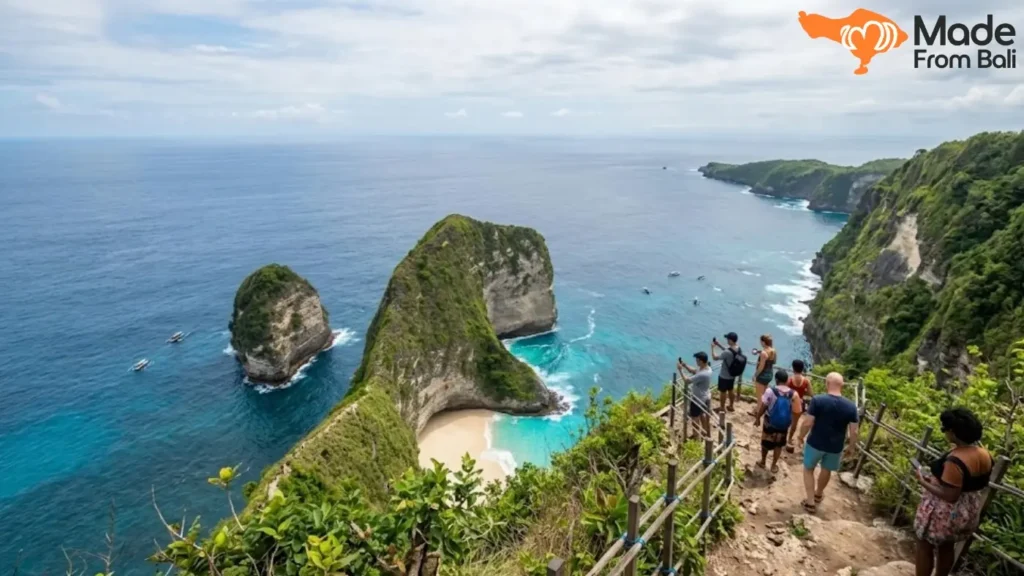
The west side of Nusa Penida is responsible for most of the images that turned a previously unknown island into one of the most searched travel destinations in Southeast Asia. Kelingking Beach with its T-Rex cliff silhouette, the natural rock arch of Broken Beach, the crystalline pool of Angel Billabong, and the impossibly blue water of Crystal Bay have appeared on travel feeds, magazine covers, and bucket lists for years. The problem is that almost nobody explains what actually happens when you get there.
How steep is the Kelingking descent, really? When is it actually safe to enter Angel Billabong, and what happens if you go at the wrong time? How long does each stop take when you account for the actual terrain and not just the photograph? How early do you need to be at Kelingking before the crowds make the viewpoint feel like a queue? These are the questions travelers arrive with and leave half-answered.
This guide is built around the honest version of the west Nusa Penida experience. Every major site is assessed for what it actually delivers, what the physical demands are, what conditions affect it, and what you need to know before you arrive rather than after. The day timeline is realistic, the preparation guidance is specific to the west route, and the decisions you face along the way are addressed directly. By the time you finish reading, the west route will feel like a plan rather than a gamble.
Why the West Route Is Where Most Nusa Penida Stories Begin
The west side of Nusa Penida is not just the most famous part of the island. It is the part that best represents what makes Nusa Penida worth the fast boat from Sanur. The limestone cliff formations, the natural ocean architecture of Broken Beach, and the quality of the water color at Crystal Bay are all concentrated in the western circuit in a way that makes a single day feel genuinely eventful. For most first-time visitors to Nusa Penida, this is the right starting point.
What Makes the West Side of the Island Distinct
The western coast of Nusa Penida is defined by dramatic limestone cliff formations that drop directly into the Indian Ocean, creating a series of natural features that exist almost nowhere else in this accessible combination. The cliffs are not uniform. Each site along the west coast is geologically and visually distinct from the others, which is why the west route functions as a genuine circuit rather than a series of variations on a single theme.
The water color along the western coast is a specific shade of turquoise and deep blue that results from the interaction of Indian Ocean currents with the shallow limestone shelf. On clear days, the color gradient visible from the clifftops at Kelingking and from the water at Crystal Bay is the kind of visual that does not need photographic enhancement. It looks like it should, and that is both the draw and the honest reality.
What the west route does not offer is quiet remoteness. This is the busiest part of Nusa Penida, and managing that reality through timing and pacing is the most important practical decision you make in planning the day.
How the Sites Cluster and Why the Sequence Matters
The four main sites of the west route, Kelingking Beach, Broken Beach, Angel Billabong, and Crystal Bay, sit in a geographic arc along the southwestern coast of the island. Understanding their arrangement helps explain why experienced guides run the circuit in a specific order rather than visiting them based on personal preference.
The standard west route sequence runs north to south from Kelingking, then loops to Broken Beach and Angel Billabong, then finishes at Crystal Bay. This sequence is not arbitrary. Kelingking draws the largest crowds and benefits most from early morning arrival before tour groups concentrate. Broken Beach and Angel Billabong share a parking area and are naturally visited together, making it logical to combine them in a single stop. Crystal Bay sits furthest south and functions as a calmer, more relaxed final experience before the drive back toward the port.
Deviating from this sequence is possible, but it typically means arriving at Kelingking after the crowds have built, which significantly changes the atmosphere at what is otherwise the most dramatic viewpoint on the route. Letting the geography and the crowd logic guide the sequence is the single most effective timing decision you can make.
Kelingking Beach and the Choice Every Visitor Has to Make
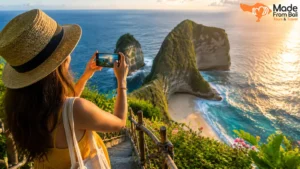
Kelingking Beach is the photograph. The T-Rex shaped cliff formation dropping into a curved white sand cove with turquoise water is the image that made Nusa Penida internationally famous, and the viewpoint at the top of the cliff is where most visitors stand to take their version of it. But there is a beach at the bottom of that cliff, and whether to attempt the descent to reach it is the most meaningful practical decision on the entire west route.
The Viewpoint Experience and What It Delivers
The clifftop viewpoint at Kelingking does not require any significant physical effort to reach from the parking area. The walk from the vehicle to the viewpoint takes a few minutes along a path that anyone with normal mobility can manage. What you see when you arrive is genuinely extraordinary. The cliff drops away to a narrow strip of white sand beach, the water in the cove below is the blue that photographs consistently fail to reproduce accurately, and the cliff formation itself from above takes on a different shape than the one in the famous photograph, which is shot from a slightly elevated angle further along the rim.
The viewpoint is best before 8am. At this hour, the light is soft and directional, the colors of the water are most vivid, and the number of other visitors is manageable. By 10am, the combination of tour groups arriving simultaneously creates a crowded atmosphere at the viewpoint that fundamentally changes the experience. The physical view is identical, but the ability to stand quietly and absorb it disappears. If you can be at Kelingking by 7:30 to 8:00am, the morning window rewards you with the experience most people imagine when they plan this visit.
The Descent to the Beach and Who Should Attempt It
The descent from the Kelingking viewpoint to the beach below is not the gentle hike that the word “descent” might suggest. It is a steep, loose, physically demanding path that drops approximately 150 to 200 meters in elevation over a distance of roughly 400 to 500 meters. In dry conditions, the path involves stepping between loose rocks, navigating sections where hands are needed for balance, and concentrating on footing throughout. After rain, parts of the path become muddy and considerably more slippery.
The descent takes most people between 30 and 45 minutes going down. The climb back up takes 45 minutes to over an hour depending on fitness. Completing the return trip adds approximately two hours to your time at Kelingking. That time cost is real and affects the rest of the day’s schedule.
Who should attempt it:
- Confident descenders: Travelers who are comfortable on steep, uneven terrain and not prone to vertigo. Sections of the path have significant drop-offs on one side.
- Appropriate footwear wearers: This is non-negotiable. Closed-toe shoes with grip are the minimum. Anyone attempting the descent in sandals, flip-flops, or smooth-soled shoes significantly increases their risk of slipping.
- Groups without time pressure: If your itinerary is tight, the two-hour addition may not be feasible. The viewpoint delivers a genuinely remarkable experience, and staying at the top is a completely valid choice.
The beach at the bottom is beautiful and rarely crowded, the swim is extraordinary, and the view back up at the cliff formation from sea level is completely different from the viewpoint perspective. For travelers who can manage it, the descent is one of the most rewarding physical efforts available in Bali. For those who cannot, the viewpoint is its own experience.
Timing, Crowds, and the Window That Makes Kelingking Worthwhile
The timing window at Kelingking is shorter than most planning guides acknowledge. The sweet spot is between 7:00am and 9:00am. Before 7:00am, the light is not yet strong enough to fully illuminate the cove. After 9:00am, the accumulation of tour groups from the 7:00am and 8:00am fast boats begins to produce the queuing atmosphere that appears in frustrated traveler reviews.
Practical timing actions worth taking:
- Book the earliest possible ferry from Sanur, ideally departing by 7:00am, which allows arrival at Toya Pakeh port by approximately 7:45am and a drive to Kelingking by 8:15 to 8:30am.
- Go directly to Kelingking on arrival without stopping at other sites first. The early morning window at Kelingking is the most time-sensitive element of the entire west route.
- If descending to the beach, begin the descent by 8:30am at the latest to complete the round trip before the midday heat and the ascending crowd of late-arriving visitors make the climb back up more difficult.
The Kelingking viewpoint is also the one site on the west route where a private tour makes the most meaningful difference. A private guide can time the departure precisely for your accommodation pickup location, which a group tour cannot adjust for. Arriving at Kelingking ten minutes earlier than the next group is not a trivial advantage here.
Broken Beach and Angel Billabong as a Paired Experience
Broken Beach and Angel Billabong sit close enough together to be visited in a single stop, and most west route itineraries treat them this way. Understanding what each one is, how they relate to each other, and why the order in which you visit them matters helps you get the most from what is genuinely one of the most visually striking combinations on the island.
What Broken Beach Actually Looks Like and How Long to Spend There
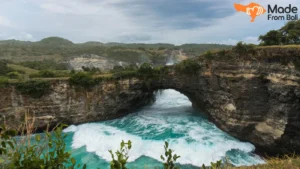
Broken Beach, known locally as Pasih Uug, is a natural archway in the limestone cliff that allows the ocean to circulate into a protected lagoon below. The name comes from the break in the coastal cliff rather than any damage to the site. You view it from the clifftop, looking down through the archway at the lagoon below, and the structural scale of the formation takes a moment to register properly. The archway itself is broad enough to drive a truck through, and the lagoon water inside is a different shade from the open ocean beyond because of the enclosed depth and light refraction.
There is no access to the water at Broken Beach. The site is entirely visual, which means the experience is front-loaded. The first five minutes delivers the full visual impact. After that, the value shifts to photography and observing the water movement through the arch. Most visitors spend between fifteen and twenty-five minutes at Broken Beach before moving to Angel Billabong. Budget thirty minutes here to feel unhurried without overstaying.
Angel Billabong, the Tide Window, and Why Entry Timing Is Not Optional
Angel Billabong is a natural rock pool carved into the cliff edge at the meeting point of the cliff face and the sea. When tide and wave conditions are calm, the pool fills with extraordinarily clear water over a rock base that creates the visual effect often described as a natural infinity pool. This is the experience travelers come for and what the photographs show.
The critical variable is tide and wave state, and this is not a minor consideration. When conditions are active, waves break over the pool edge with enough force to push a person off the rock into the open ocean beyond. This has resulted in serious accidents. The Angel Billabong entry window requires calm conditions, which means low tide combined with minimal swell activity. On rough sea days or at high tide when wave action is unpredictable, the pool cannot be safely entered and the on-site attendants will prevent it.
How to approach Angel Billabong safely:
- Check swell and tide conditions before departing for Nusa Penida. Apps that show local tide charts and swell forecasts for the Nusa Penida area are available and accurate.
- Ask your guide or driver on the morning of the visit whether Angel Billabong entry is expected to be possible based on current conditions.
- Follow the guidance of the on-site attendants without exception. Their assessment of whether the pool is safe to enter on any given day is authoritative.
- If conditions are not suitable for entry, the viewpoint of the pool from the surrounding rock is still remarkable and worth stopping for.
In calm conditions, the Angel Billabong experience, standing in clear shallow water at the edge of a limestone cliff with the Indian Ocean visible just beyond, is one of the most genuinely unique moments on the entire Nusa Penida visit.
The Best Order to Visit These Two Sites and Why It Matters
The practical question of whether to visit Broken Beach or Angel Billabong first has a straightforward answer based on logistics. The parking area serves both sites, with Angel Billabong closer to the vehicle access point and Broken Beach a short walk further. Most guides take visitors to Angel Billabong first, particularly in the morning when conditions are most likely to be calm for pool entry, then walk along the clifftop path to Broken Beach for the viewpoint experience afterward.
This order makes sense for an additional reason. If conditions at Angel Billabong are too rough for entry on your visit, you know this immediately on arrival and can adjust expectations before spending the full stop. Finishing at Broken Beach, which does not depend on conditions, provides a satisfying visual endpoint to the combined stop regardless of what happened at the pool.
Crystal Bay and the Marine Life Beneath It
Crystal Bay sits on the western coast of Nusa Penida in a sheltered position that explains both its name and its popularity. The water clarity here is exceptional on most days, the bay is calm enough to swim in when the ocean beyond is not, and the reef system accessible directly from the beach supports a quality of marine life that makes Crystal Bay one of the most rewarding snorkeling sites in Bali without requiring a boat. For the west route itinerary, it functions as the natural final stop before heading back toward the port: calmer, more relaxed, and a pleasant physical wind-down after Kelingking and the cliff sites.
Swimming, Snorkeling, and What the Water Actually Offers
Swimming at Crystal Bay without snorkeling gear is already a pleasant experience because the clarity of the water and the color of the sandy bottom are visible without any equipment. With snorkeling gear, the experience expands considerably. The reef along the eastern edge of the bay and beneath the point at the bay’s entrance supports healthy coral formations and a diverse fish population including angelfish, parrotfish, and the occasional reef shark at depth. Sea turtles are frequently seen at Crystal Bay and are the marine encounter most non-divers hope for.
The beach at Crystal Bay is black volcanic sand on the northern end and lighter sand toward the south. A small selection of beach warungs provides food, drinks, and rental snorkeling equipment. The equipment rental quality varies, and travelers who have their own mask and fins will have a noticeably better snorkeling experience than those using borrowed gear with ill-fitting masks.
Crystal Bay works best as a thirty to forty-five minute stop within a west route day. Enough time to swim, potentially snorkel, and rest in a genuinely beautiful setting without making it the primary focus of a day built around the cliff sites.
Mola Mola Season and What It Means for Your Visit
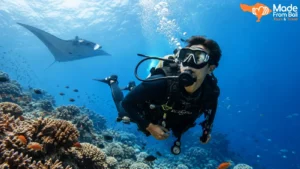
Mola mola, the ocean sunfish, is one of the most remarkable animals in the sea. The world’s heaviest bony fish, capable of reaching two to three meters in length, it appears in the waters around Crystal Bay and the wider Nusa Penida area during the dry season months of roughly July through October. During this period, cold upwelling currents from the deep channel between Nusa Penida and Lombok bring the mola mola to shallower depths where they visit cleaning stations on the reef.
The mola mola encounter is primarily a diving experience. The fish typically appear at depths between 15 and 30 meters, which is below comfortable snorkeling range for most visitors. Divers who specifically target the mola mola season at Crystal Bay book through dive operators with current sighting intelligence and dive at the right time of day, typically early morning when the upwelling is strongest. For snorkelers and swimmers on a west route day tour, the mola mola is not the reason to visit Crystal Bay but is a genuinely exciting bonus if conditions bring one closer to the surface, which occasionally happens during peak season.
Outside of mola mola season, Crystal Bay is still an excellent swim and snorkel stop. The reef conditions do not change significantly between seasons, and the turtle sightings are consistent throughout the year.
How Crystal Bay Fits Into the West Route Day
Crystal Bay works best positioned at the end of the west circuit rather than the beginning or middle. The reasoning is practical. After Kelingking, and particularly if you have descended to the beach and back, the physical effort involved in the morning portion of the day is significant. Crystal Bay offers a genuine recovery point: flat ground, calm water, shade available, and food and drinks accessible. Ending the active west circuit here before the drive back to the port gives the body and the mind a natural wind-down that makes the return journey feel earned rather than rushed.
If snorkeling is a priority rather than a pleasant addition, it is worth spending more time at Crystal Bay, perhaps forty-five to sixty minutes, and trimming time from the earlier stops slightly. The balance point is making sure Kelingking receives its full morning window before compressing it for snorkeling time elsewhere.
Adding Snorkeling at Manta Point to Your West Route Tour
Manta Point sits off the southwestern coast of Nusa Penida, reachable by boat from the port area or from the beach at Crystal Bay, and it offers manta ray encounters that are among the most reliably accessible in the world. Adding it to a west route day is possible, but the logistics require honest assessment of what the addition involves and whether the day can absorb it without sacrificing quality at the land-based sites.
What the Manta Ray Experience at Manta Point Is Really Like
Manta Point is an ocean cleaning station. Manta rays return here regularly because smaller fish remove parasites from their skin, making it one of the few sites in the world where manta encounters are structurally predictable rather than opportunistic. The rays are not confined or trained. They move through the water on their own schedule, and the quality of an encounter depends on how many rays are present, how the current is running, and how calmly snorkelers behave in the water.
In calm conditions with multiple mantas present, being in the water at Manta Point is one of the most extraordinary wildlife experiences accessible from Bali. The mantas are large, typically with wingspans of two to three meters for reef mantas, and they move through the water with an effortlessness that makes their size difficult to process immediately. Staying still in the water rather than chasing them is the behavior that produces the longest and closest encounters. Mantas are curious about stationary snorkelers in ways they are not about those who pursue them.
The boat ride to Manta Point takes approximately fifteen to twenty minutes from the Crystal Bay area, and the snorkeling session itself is usually thirty to forty minutes. Total time addition to the day is approximately ninety minutes including transfer and preparation.
How to Add Manta Point Without Overloading the Day
Adding Manta Point to a west route day is achievable, but it requires deliberate choices about where else to trim time. The most practical approach is to position the Manta Point snorkeling session either in the morning before the land sites begin, if the ferry departure is early enough to allow it, or after Crystal Bay as a final activity before heading to the port.
The morning positioning works better from a condition standpoint because seas tend to be calmer before the afternoon trade winds develop. It requires a very early ferry departure from Sanur, typically the 6:30 to 7:00am boat, and a provider who can coordinate the water activity seamlessly before the first land stop.
The afternoon positioning after Crystal Bay works logistically but carries the risk of sea conditions having worsened by that time of day. On days when swell is building in the afternoon, the boat ride to Manta Point becomes uncomfortable and the operator may cancel the session. Travelers who specifically want the manta ray experience as a guaranteed highlight should book a dedicated Manta Point snorkeling trip on a separate morning rather than appending it to an already full day.
Your Complete West Nusa Penida Day Timeline
Understanding the abstract information about each site is useful. Seeing how a full day actually unfolds in practice is more useful. The timeline below reflects a realistic west route day departing from south Bali with a private guide, building in appropriate time at each site without the rushing that makes reviews complain about feeling processed through the itinerary.
From Sanur to the Island and Getting to the First Site
The logistics of reaching Nusa Penida begin the evening before the tour day. Confirm your pickup time with your provider specifically based on your accommodation location. Pickup times from south Bali for a 7:00am fast boat departure from Sanur range from 5:30am for Seminyak to 6:15am for accommodations closer to the harbor.
- 5:30 to 6:15am: Pickup from accommodation, drive to Sanur Harbor
- 7:00am: Fast boat departs Sanur. The crossing takes approximately 35 to 45 minutes. Bring motion sickness medication if you have any tendency toward seasickness. The Badung Strait can be choppy, particularly in the afternoon, which is an additional reason to take the morning boat.
- 7:40 to 7:50am: Arrive at Toya Pakeh port on Nusa Penida. Transfer to the island vehicle, brief orientation with your guide.
- 8:15 to 8:30am: Arrive at Kelingking Beach viewpoint. This is the target arrival time for the best crowd and light conditions.
Moving Through the West Circuit With Realistic Timing
The following timing assumes a viewpoint-only visit to Kelingking. Add two hours to the morning block if the descent to the beach is planned.
| Time | Location | Notes |
|---|---|---|
| 8:15 to 9:15am | Kelingking Beach viewpoint | 45 to 60 minutes allows proper time without rushing |
| 9:30 to 10:15am | Drive to Broken Beach and Angel Billabong | 20 to 30 minute drive on the west coast road |
| 10:15 to 11:15am | Angel Billabong and Broken Beach combined stop | 60 minutes allows pool entry plus Broken Beach viewpoint |
| 11:15am | Drive to lunch warung | 10 to 15 minutes |
| 11:30am to 12:15pm | Lunch stop | Local warung near the west circuit |
| 12:30 to 1:15pm | Crystal Bay swimming or snorkeling | 45 minutes for a relaxed water experience |
| 1:15pm | Drive back toward Toya Pakeh port | 30 to 45 minutes depending on road conditions |
| 2:00 to 2:30pm | Arrive at port area for the return ferry | |
| 2:30 to 3:00pm | Return fast boat to Sanur | |
| 4:00 to 5:00pm | Arrive back at south Bali accommodation | Depending on pickup distance from Sanur |
This timeline works with the 7:00am ferry and produces a manageable, unhurried day. Adding the Kelingking descent pushes everything later by two hours and requires either an earlier ferry or a compressed afternoon schedule.
The Return Journey and What to Plan Around It
The last reliable fast boat from Toya Pakeh to Sanur departs between 4:00 and 5:00pm depending on the operator. Missing it means an unplanned overnight on the island, which is an expensive and disruptive surprise for travelers with accommodation and plans in Bali that evening. Building a buffer of at least thirty minutes before the intended return boat departure is minimum planning discipline.
The return boat crossing can be rougher than the morning crossing because afternoon winds typically pick up across the Badung Strait. If you experienced motion sickness on the way over, take medication before boarding for the return regardless of how calm it looks from the dock. Conditions at sea change faster than dock-level conditions suggest.
Arrival back at Sanur is followed by the drive to your accommodation, which adds forty-five minutes to ninety minutes depending on location and traffic. Plan the evening accordingly and do not commit to a dinner reservation that requires arriving before 7pm on a west Nusa Penida day unless you are confident your ferry timing allows it.
Practical Preparation for the West Route
The west Nusa Penida route has a specific set of practical requirements that differ meaningfully from a standard Bali day tour. Preparing correctly for these takes less than thirty minutes of thought the evening before and prevents the majority of the avoidable frustrations that appear in negative reviews of the experience.
Footwear, Sun Protection, and What the Cliff Sites Require
Footwear is the most consequential gear decision for the west route and the one most commonly ignored. The Kelingking descent requires closed-toe shoes with grip. The paths at Broken Beach and Angel Billabong involve wet, uneven rock surfaces. The terrain throughout the west circuit is not sandal-friendly if you intend to move beyond the main viewpoints.
Closed-toe trail runners or hiking shoes are ideal. Sandals with ankle straps are acceptable for the viewpoint-only stops but inadequate for the Kelingking descent. Flip-flops create a real risk on any of the west route’s rocky paths and should not be worn beyond Crystal Bay’s beach.
Sun protection is the other preparation that most travelers underestimate. The clifftop viewpoints at Kelingking, Broken Beach, and Angel Billabong are fully exposed. There is no shade at the viewpoints themselves, and the combination of direct tropical sun and sea reflection off the water below makes the UV exposure at these sites significantly higher than it feels in the moment. Apply sunscreen before leaving accommodation, reapply before each cliff stop, and wear a hat and light long sleeves if sun sensitivity is a concern.
Cash, Entry Fees, and What the Island Runs On
Nusa Penida operates almost entirely on cash. ATMs exist on the island but are unreliable for availability and sometimes out of cash during peak season. Bringing all necessary cash from Bali is strongly recommended.
A realistic cash requirement for the west route day:
- Entry fees: Kelingking Beach approximately 10,000 to 15,000 IDR, Broken Beach and Angel Billabong combined approximately 10,000 to 20,000 IDR, Crystal Bay approximately 10,000 IDR. These fees are subject to change and cash-only.
- Parking fees: Small amounts, typically 2,000 to 5,000 IDR per site, paid by the driver.
- Lunch at a local warung: 30,000 to 80,000 IDR per person depending on food and drinks ordered.
- Snorkeling equipment rental at Crystal Bay: 50,000 to 100,000 IDR for mask and fins if needed.
- Guide tip: Optional but genuinely appreciated if the guide provided real value. 50,000 to 100,000 IDR is a meaningful gesture.
Total cash recommended: 200,000 to 350,000 IDR per person for a comfortable day, in addition to any tour cost already covered by the provider.
Mistakes That First-Time West Route Visitors Consistently Make
These are the avoidable errors that produce the majority of west route disappointments. Knowing them in advance is the simplest form of trip insurance available.
- Arriving at Kelingking after 9am: The viewpoint experience after this hour is shared with significantly larger crowds. The morning window is the one thing on the west route that cannot be recovered once missed.
- Ignoring footwear guidance for the Kelingking descent: Slipping on loose rock in poor footwear is not a minor inconvenience. It creates a real risk of injury that affects the rest of the Bali trip.
- Entering Angel Billabong without checking conditions: The pool can look calm while wave action is building. Following the on-site attendant’s guidance is not optional. Several serious incidents at this site have involved visitors who dismissed advice about conditions.
- Not bringing cash from Bali: Arriving on the island without IDR cash and discovering the ATM is empty or out of service creates a stressful situation with no good solution.
- Underestimating the return timeline: Travelers who plan the return ferry too tightly, without buffer, create pressure on the afternoon that compresses Crystal Bay and creates anxiety during what should be the relaxed wind-down portion of the day.
- Attempting both the Kelingking descent and a full west circuit in one day without an early start: The combination is possible but requires the first ferry, a private guide who knows the timing, and no deviation from the plan. Most travelers who attempt this without those conditions end up rushed throughout the day.
Private Tour vs Group Tour on the West Route
The tour format decision on Nusa Penida’s west route carries more practical weight than on many other Bali day trip destinations, because the timing sensitivity at Kelingking and the logistics of the crossing and island transport make the difference between a private and group experience more consequential.
What Private Tours Allow on a Route Like This
A private west Nusa Penida tour means the ferry crossing is timed to your pickup location, the island vehicle moves when your group is ready rather than waiting for others, and the time at each site responds to your group’s pace and interest. At Kelingking, this means arriving exactly when the morning window is optimal rather than when the group’s combined logistics allow. At Angel Billabong, it means staying if conditions are excellent and moving on efficiently if they are not.
The descent decision at Kelingking is the clearest example of where private tour flexibility matters most. A group tour on a fixed schedule cannot realistically build in the two-hour addition for the descent, because doing so would push the entire group’s day into a compressed afternoon. A private group can make this decision on the morning based on energy levels, conditions, and available time, and adjust the rest of the itinerary accordingly.
For couples celebrating a special occasion, families with specific needs, and any group that has a strong preference about how to use the day at specific sites, private is the format that makes the west route experience genuinely personal.
When a Group Tour Works for the West Circuit
Group tours on the west Nusa Penida route work well for solo travelers who want the structure of a shared itinerary and the company of other visitors, and for budget travelers for whom the cost difference represents a meaningful saving. A well-run group tour covers Kelingking, Broken Beach, Angel Billabong, and Crystal Bay in a full day with sufficient time at each stop to experience the sites properly, even if the schedule is less flexible than a private format allows.
The limitation of a group tour on this route is primarily around Kelingking timing. Group departure logistics from multiple accommodation locations mean that arrival at Kelingking is sometimes later in the morning than the optimal window. If the Kelingking viewpoint is the specific reason you are doing the west route, this timing variable matters. If the overall experience across all four sites is the goal and morning crowd levels at Kelingking are acceptable, a quality group tour delivers the full west circuit effectively.
Going Into the West Route Ready for What It Actually Delivers
The west Nusa Penida circuit is one of the most visually extraordinary day trips accessible from Bali. That statement is not marketing language. It is the honest assessment of a route that concentrates four genuinely remarkable natural formations into a single manageable day, connected by island roads that are challenging but navigable, and culminating in water that looks exactly as it does in the photographs.
What the west route requires in exchange for that experience is preparation, honest self-assessment at Kelingking, and enough respect for the conditions at Angel Billabong to let the water make the safety call rather than your enthusiasm. The travelers who have the best experiences on this route are the ones who arrived knowing what to expect, chose their footwear deliberately, got on the early ferry, and let the day unfold at the pace the geography demands rather than the pace their itinerary assumed.
Made From Bali’s west Nusa Penida tours are organized with all of this in mind. From the ferry coordination and pickup timing to the site sequence logic and the guide knowledge of daily conditions at Angel Billabong and Manta Point, every element of the day is designed to give the west route the best chance of being exactly what you came for. Book early, prepare the evening before, and go ready for one of Bali’s most genuinely extraordinary days.