

Most travelers who visit Ubud spend their days navigating Jalan Monkey Forest, squeezing past scooters on Jalan Raya Ubud, and waiting in line at Tegalalang rice terrace for a photo spot that feels anything but peaceful by 10 in the morning. That version of Ubud is real, and it has its appeal. But it is not the whole picture. Just a short distance south of the town center, past the Monkey Forest and into a corridor of quieter roads and village lanes, a noticeably different experience begins. The traffic thins. The crowds dissolve. The pace drops to something that actually feels like the Bali people describe when they talk about why they keep coming back.
Southern Ubud is not a hidden gem in the overused sense of that phrase. It is a geographic and cultural zone with its own identity, its own anchors, and its own reasons to visit. If you are planning a trip to Bali and trying to figure out whether Ubud can offer something beyond the obvious checklist, this part of the answer starts south of the Monkey Forest.
Most Travelers Only See the Center. Southern Ubud Is Where the Slower Version Starts
The confusion begins before travelers even arrive. When most people say “Ubud,” they mean the town center, the stretch of road between Ubud Market and the Monkey Forest, the cafes on Jalan Hanoman, the palace, and the nearby rice terraces. This is what appears in every travel guide, every Instagram reel, and every tour package description. It is also the most congested part of the area, particularly between 9 in the morning and 3 in the afternoon.
What rarely gets explained is that Ubud is not just a town. It functions more like a loose collection of villages and neighborhoods, each with its own character, connected by winding roads and surrounded by farmland and jungle. Some of these villages sit north or east of the center and are well documented in travel content. The ones to the south receive almost no coverage despite offering some of the most accessible and rewarding experiences in the area.
Understanding this geography changes how you plan. It is the difference between building an itinerary around the most visited spots and building one around what actually fits your travel style.
Where Southern Ubud Actually Begins on the Map
If you walk south from Ubud’s central market along Jalan Monkey Forest, you pass through the commercial strip of cafes, yoga studios, and boutiques, then into the Sacred Monkey Forest sanctuary itself. Exit from the southern end of the forest, and you are already entering a different zone. The road shifts from tourist-facing infrastructure to something that feels far more residential and village-like.
This southern corridor extends from Padang Tegal, which begins just south of the forest, through the village of Nyuh Kuning along Jalan Nyuh Bojog, and continues southeast along Jalan Raya Pengosekan through the neighborhood of Pengosekan. Push further south and you eventually reach Mas Village in the Gianyar Regency, roughly 6 kilometers from Ubud’s center. Each of these areas has a distinct character. None of them feel like a continuation of the busy town center, which is exactly the point.
Why the Area South of the Monkey Forest Gets Overlooked
The short answer is that major travel content tends to be built around what is easiest to photograph and easiest to book. Tegalalang rice terraces to the north have swings and cafes with views. The Monkey Forest has monkeys. The Ubud Palace has dance performances on a fixed schedule. These are easy to describe, easy to package, and easy to rank for.
Southern Ubud does not have a single famous landmark that anchors it in the popular imagination. What it has instead is an accumulation of experiences, a quieter texture of village life, a concentration of serious wellness facilities, and a living artisan tradition that takes longer to describe and cannot be reduced to a single photo. That is precisely why travelers who discover it tend to return to it, and why those who skip it often wish they had been told.
Nyuh Kuning Village Is the Quietest Walk You Can Take Near Ubud
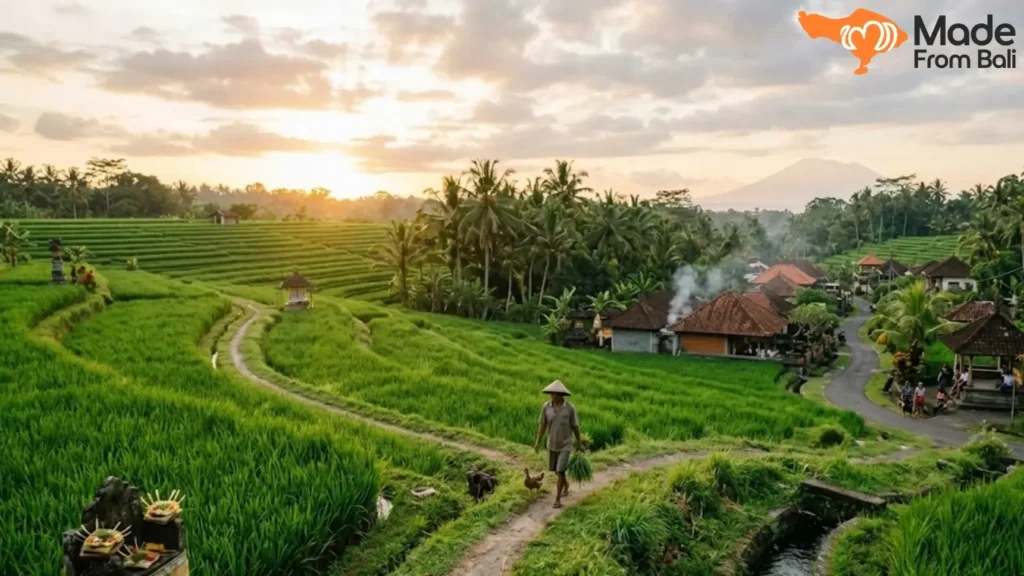
There is a particular kind of morning walk that travelers describe long after their Bali trip is over. Not the hike to a waterfall, not the sunrise at a rice terrace, but a walk through a functioning Balinese village where daily life is visibly, quietly in motion. Offerings placed on doorsteps. A temple gate half-draped with a fresh cloth. Children heading somewhere on a bicycle while an older woman sweeps her front step. Nyuh Kuning is that walk, and it sits approximately 20 minutes on foot from Ubud’s central market, reachable directly through the southern exit of the Monkey Forest.
The village centers on Jalan Nyuh Bojog and its side lanes. The roads are narrow and largely free of through traffic. There are guesthouses, small warungs, a handful of cafes, and gardens with roosters. It feels like a place where people actually live rather than a place built to accommodate visitors, which is increasingly rare in the more developed parts of Ubud.
What the Village Actually Looks Like When You Walk Through It
Walking through Nyuh Kuning early in the morning means encountering the village in its natural rhythm before the day fully opens. The main lane is wide enough for a scooter but narrow enough that you can hear conversations from open doorways. Traditional Balinese compounds sit behind their gates with small family temples visible inside. There are occasional art studios and small galleries belonging to local painters and craftspeople, some of whom work from Pengosekan-style painting traditions.
The walk is flat and manageable, even without much physical preparation. There are shaded sections where vegetation from surrounding gardens creates a canopy over the road. For couples looking for a genuinely unhurried morning, or solo travelers who find the center of Ubud overwhelming early in their trip, this is one of the few walks near Ubud that does not require a plan, a guide, or a ticket.
Why the Road Into Nyuh Kuning Stays This Calm
This is one of the details that travel content almost never mentions, and it explains something that visitors notice immediately when they arrive. Nyuh Kuning is not calm by accident. The village community decided that the level of traffic on their main road was not acceptable, and they took action as a collective. Residents funded improvements to the road themselves rather than waiting for government intervention, and they introduced a small local fee for non-residents using the road. Jalan Nyuh Bojog is also designated as a no-through road for cars, with only scooters and motorbikes permitted to continue through the narrow passage past the Monkey Forest. The forest itself acts as a physical barrier against further commercial development pressing in from the center.
The result is a neighborhood that has actively protected its own quality of life. For travelers, this means Nyuh Kuning delivers on the quiet village promise in a way that many Ubud neighborhoods simply cannot because of the traffic that flows through them.
Pengosekan Has Become Ubud’s Wellness Corridor for Good Reason
If someone tells you they spent a week in Ubud focused on yoga, sound healing, or personal retreat, there is a reasonable chance they spent most of that week along Jalan Raya Pengosekan or the roads immediately surrounding it. This stretch, running southeast from the Monkey Forest end of Jalan Monkey Forest into Pengosekan proper, has accumulated a concentration of wellness facilities that is unusual even by Ubud’s standards.
This did not happen because of a single development project or a branding campaign. It grew organically over roughly two decades as practitioners and studio founders chose the area for its accessibility and its relative quiet compared to the central streets. The result is that someone staying in or near Pengosekan can walk between yoga classes, healing sessions, and organic cafes without needing to call a driver or navigate traffic. That kind of practical daily convenience is rare in a place as spread out and hilly as Ubud.
The Yoga Barn Sits Right Here, and It Is Not the Only Studio
The Yoga Barn is the most recognized wellness venue in the area and one of the most well-known yoga complexes in Southeast Asia. Located on Jalan Hanoman where it merges with Jalan Pengosekan, the facility operates six studios and runs more than 100 classes every week covering disciplines from Vinyasa and Yin to sound healing, meditation, ecstatic dance, breathwork, and Ayurvedic treatments. Drop-in classes start at around IDR 160,000. There is also on-site accommodation, a garden cafe, and a healing center, which means guests on a retreat program rarely need to leave the property at all.
What is less often explained is that the Yoga Barn is not an isolated venue. Walking distance from it along the same corridor are studios including Radiantly Alive, consistently regarded as one of the most technically rigorous yoga schools in Bali, and Lumeria, a smaller boutique studio on Jalan Raya Pengosekan that keeps class sizes under 15 people and offers a noticeably more intimate experience. For travelers who want yoga without the feeling of attending a large-scale wellness production, the smaller studios nearby provide a genuine alternative.
The combination of these venues within walking distance of each other is what makes Pengosekan function as a wellness zone rather than just a neighborhood with a famous yoga studio in it.
What a Morning in Pengosekan Feels Like Compared to Central Ubud
By 8 in the morning, Jalan Raya Ubud and Jalan Monkey Forest in the town center are already building toward their midday density. Delivery scooters, tour vehicles, and streams of visitors on foot create a level of sensory activity that some travelers find energizing and others find exhausting. The experience of a morning in Pengosekan is structurally different. The main road sees traffic, but it moves. Side lanes are quiet enough for a comfortable walk. The clientele at cafes in this area skews heavily toward people who are mid-way through a retreat, familiar with the neighborhood, and not rushing.
For travelers who arrive in Bali expecting the calm they read about in travel descriptions of Ubud, the southern zone tends to match that expectation far more reliably than the center does, particularly during peak season between July and August when the town center is at its most congested.
Mas Village Produces Carvings That Tourists Often Miss the Significance Of
Mas Village sits approximately 6 kilometers south of Ubud’s center along the main road connecting Ubud to Denpasar. It is the kind of place that appears on tour itineraries as a brief stop, a checkbox between the rice terraces and the temple. That framing undersells it considerably. Mas Village has been a center of Balinese woodcarving for centuries, and the tradition practiced there is not a tourist craft, it is a living discipline passed down through families and continuously developed by working artists.
The village is home to numerous galleries and open workshops where artisans carve pieces ranging from small ceremonial objects to large architectural elements. Walking through Mas, particularly in the morning, you hear the sound of chisels against wood coming from inside compounds and open studio spaces. The scale and precision of the work, much of it depicting scenes from Hindu mythology, deities, and characters from the Mahabharata and Ramayana, reflects a level of skill that takes years to develop.
Why the Woodcarving Tradition Here Has Roots Competitors Never Mention
The history of Mas Village as an artisan center predates modern tourism entirely. The village traces its name and cultural identity to a visit by the Hindu saint Dang Hyang Nirartha, who stopped here centuries ago and honored a local nobleman named Mas Wilis with the title of Prince Manik Mas. A ceremonial staff planted by Nirartha reportedly grew into a Tangi tree still present at the village’s Pura Pule Mas temple.
The artistic tradition in Mas received significant outside influence during the 1930s through the Pita Maha movement, an artistic revival initiated with the help of European artists Rudolf Bonnet and Walter Spies who were based in the broader Ubud region. This movement encouraged Balinese artists to move beyond purely ceremonial carving into more expressive and varied forms. The influence is visible in Mas today in the range of styles available, from deeply traditional religious iconography to more contemporary interpretations. Surrounding villages in this corridor each developed their own specialization simultaneously: Celuk for gold and silver, Tohpati for batik, Batuan for painting, and Mas for woodcarving.
Understanding this context changes what you see when you walk into a Mas Village gallery. The carved figures are not production items assembled for tourist shops. They are the current expression of a tradition that has been formally practiced and refined in this village for over a hundred years.
Visiting a Workshop Is Not the Same as Buying at the Market
Ubud’s central market sells woodcarvings. So do shops along Jalan Monkey Forest and dozens of roadside stalls throughout the area. These items vary enormously in quality, and much of what is sold in high-turnover tourist retail has been mass-produced rather than individually hand-carved in the traditional manner. The difference becomes obvious once you have stood in a working studio in Mas Village and watched an artisan work.
Several studios in Mas Village offer workshop experiences where visitors can observe the carving process and, in some cases, try their hand at basic technique under guidance. The experience is not about producing a finished object. It is about understanding the time, skill, and cultural knowledge embedded in the work. Travelers who do this consistently report that it changes how they look at Balinese crafts for the rest of their trip. For those interested in purchasing a carving as a serious piece rather than a souvenir, buying directly from a Mas Village studio also means a greater likelihood that the work is genuinely handmade and produced by the person or family selling it.
Southern Ubud Works Differently Depending on the Traveler
One of the more useful things to understand about the southern Ubud zone is that its appeal is not uniform across visitor types. The experience it offers is genuinely different depending on what you are looking for, and being honest about this is more useful than a blanket recommendation.
Here is a practical breakdown of how southern Ubud tends to work for different travelers:
- Couples looking for a quieter base: Nyuh Kuning and Pengosekan are both strong options. The accommodation choices in these areas skew toward boutique villas and smaller guesthouses set in gardens, and the morning atmosphere in both neighborhoods supports a slower, more private kind of travel that is harder to find in the busier center.
- Solo travelers on longer stays or retreats: Pengosekan is particularly well-suited because the yoga and wellness facilities nearby make it easy to structure a daily routine without much transport planning. Many people doing 7 to 14 day retreats based in this area find the combination of accessible facilities, cafe culture, and relative quiet genuinely supports the kind of reset they came for.
- Travelers focused on Balinese culture and art: Mas Village and the Pengosekan painting studios are the primary draws. This profile benefits most from a guided visit that provides cultural context rather than a self-directed browse through galleries.
- First-time Bali visitors: Southern Ubud works well as a complement to the central Ubud experience, ideally as a morning half-day that gives a sense of what the area feels like away from its busiest zones. It is generally not the right choice as the sole focus of a first visit to Bali, since having some reference point for central Ubud’s landmarks helps frame the contrast.
- Families with young children: Nyuh Kuning’s walkable, traffic-reduced lanes make it more manageable than many parts of Ubud for families traveling with small children. Mas Village is also accessible and does not require significant physical effort to explore.
Couples and Solo Travelers Often Experience This Zone in Completely Different Ways
For couples, the appeal of southern Ubud often centers on the texture of unscheduled time. A morning walk through Nyuh Kuning, a shared yoga class at one of the smaller Pengosekan studios, lunch at a garden cafe, and an afternoon at a spa is a day that requires almost no coordination and no navigation stress. The compactness of the area makes spontaneous planning easy.
For solo travelers, particularly those on extended stays, the dynamic is more social than it might appear. The wellness community around Pengosekan creates natural points of connection, whether through shared classes, workshop sessions, or the cafe culture that develops around retreat schedules. Solo travelers who chose this area often describe it as one of the easier places to meet people in Bali who are traveling at a similar pace and with similar intentions.
First-Timers May Be Surprised by How Much Is Within Walking Distance
One of the more persistent misconceptions about staying in or exploring southern Ubud is that you need a scooter to get anywhere. This is partly a function of how Bali is generally described in travel content, where scooter or private driver is treated as the default mode of transport for all situations. In southern Ubud, it is not always necessary.
From Nyuh Kuning, you can walk north through the Monkey Forest to reach the center of Ubud in roughly 20 minutes, paying the standard forest entry fee as you pass through. This makes Nyuh Kuning genuinely connected to central Ubud on foot, which surprises many travelers who assume the distance rules out walking. From the southern end of Jalan Monkey Forest, Pengosekan and the Yoga Barn are also walkable. A private driver or Grab app becomes more necessary for reaching Mas Village or for moving between multiple zones in a single day, but for a morning exploration of either Nyuh Kuning or Pengosekan individually, walking is a realistic and often preferable option.
Getting Around the Southern Zone Without Making the Common Planning Mistakes
The practical experience of navigating southern Ubud is not complicated, but a few specific details make a noticeable difference and are almost never covered in standard travel content.
The first thing to understand is the zone’s internal geography. Nyuh Kuning, Pengosekan, and the road to Mas Village are not on the same road. Nyuh Kuning is accessed via Jalan Nyuh Bojog, which branches west from the southern end of Jalan Monkey Forest. Pengosekan is accessed by continuing south and east along Jalan Raya Pengosekan. Mas Village is further south on the main Denpasar road. Moving between all three in a single day is manageable but requires either a scooter or a driver, since the distances between them are not walkable in combination without significant time and physical effort.
Common planning mistakes travelers make in this zone:
- Assuming that “southern Ubud” is one compact area you can walk between in a single morning. The individual sub-zones are walkable internally, but they are not all walkable from each other.
- Booking accommodation described as “Ubud” without checking the map and discovering it is in Nyuh Kuning or Pengosekan, then being surprised by the taxi cost to reach the central market (typically IDR 60,000 to 80,000 from Nyuh Kuning due to the no-through-road requiring a longer route).
- Visiting Mas Village between 11 in the morning and 2 in the afternoon, when heat and midday traffic make the experience less comfortable than an earlier arrival.
- Booking yoga classes at the Yoga Barn without checking the weekly schedule in advance. Popular classes fill up, and walk-in availability is not guaranteed during peak season.
When a Private Driver Makes More Sense Than a Scooter Here
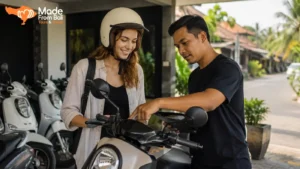
For most international travelers visiting Bali on a trip of 7 to 14 days, a private driver for day exploration is a more practical choice than self-driving a scooter in the southern Ubud zone, for a few specific reasons. The roads in and around Nyuh Kuning are narrow and occasionally poorly lit in the early morning. The route from central Ubud to Mas Village passes through active traffic on the main arterial road. And if the plan involves visiting multiple stops across Nyuh Kuning, Pengosekan, and Mas Village in a single day, managing the route and parking at each stop adds friction that is easily avoided with a driver.
A driver also provides something beyond transport. In the context of Mas Village, a driver familiar with the area can distinguish between gallery showrooms built primarily for tourist volume and smaller studios where working artists are actually present. That kind of local orientation is not available from a map.
Traffic Timing and the Morning Window That Changes the Experience
Southern Ubud is noticeably calmer between 7 and 10 in the morning than at any other point in the day. This is when the village walk through Nyuh Kuning delivers its best version of itself, when Pengosekan’s cafes have space and the morning air before the heat builds is comfortable for walking. By midday, Jalan Raya Pengosekan carries considerably more traffic as tour vehicles and private cars move between Ubud and points south, and the heat on open roads becomes a real factor.
For Mas Village specifically, arriving between 8 and 10 in the morning means finding workshops in active operation and galleries with working staff rather than the quieter midday and early afternoon period. The same timing principle applies to the Monkey Forest path: walking south from the forest into Nyuh Kuning before 9 in the morning means avoiding the bulk of tourist foot traffic moving in the opposite direction into the forest from the central Ubud side.
How Much Time Southern Ubud Actually Deserves in a Bali Itinerary
A single morning is enough to understand the character of Nyuh Kuning or Pengosekan independently. A full day gives you the space to combine both zones meaningfully, add a visit to Mas Village, and have lunch somewhere along the Pengosekan corridor without rushing. For travelers based in central Ubud, a southern Ubud day trip requires no overnight planning and is straightforward to arrange.
For travelers who are specifically drawn to yoga, wellness, or a retreat format, building the stay around Pengosekan rather than the central town makes practical sense. Staying in or near this zone for 3 to 5 days creates a very different Ubud experience than the same duration spent in the town center, and many people who have done both describe the southern base as the more restful of the two.
For Mas Village, a standalone visit of 2 to 3 hours is sufficient for a meaningful experience that includes a gallery walk, a workshop observation, and time to interact with artisans. Trying to combine Mas Village with a full morning in Nyuh Kuning and a yoga class in Pengosekan on the same day is possible with a driver, but it creates a full itinerary that requires an early start and realistic timing expectations.
Seeing Southern Ubud With a Local Makes the Difference Between Passing Through and Actually Getting It
The practical information in this article gives you the framework for understanding and navigating southern Ubud. What it cannot replicate is the on-the-ground orientation that comes from traveling with someone who knows which Mas Village studio is currently run by a working artisan and which has shifted to retail volume, which morning is best for the Nyuh Kuning village walk based on recent community events, or which yoga teacher in Pengosekan is particularly suited to travelers who have never practiced before.
Made From Bali Tour and Travel specializes in exactly this kind of guided experience in the southern Ubud zone and beyond. Private driver services, curated village walks, and tailored day itineraries that build around your pace and interests rather than a fixed group schedule are the core of what the team provides. For travelers who want to leave the logistical questions to someone with genuine local knowledge and focus on experiencing what this area actually offers, this is the practical next step.
Southern Ubud rewards travelers who come to it with some preparation and a willingness to move at a different pace than the rest of the island. It is not the Bali of crowds and swings over rice paddies. It is quieter, more layered, and in the experience of many people who find it, more lasting.