

If you’ve already searched this topic once, you know the problem. Every list has ten, fifteen, sometimes twenty waterfalls, and they all start sounding the same after the fifth entry. Tall drop, lush jungle, small entrance fee, bring a swimsuit. By the time you reach the bottom of the page, you still don’t know which two or three actually fit your trip.
That’s the real issue. Ubud waterfalls aren’t short on options, they’re short on guidance. Pick the wrong combination and you’ll spend half your day driving between places that turned out to feel almost identical, or you’ll end up stuck behind a queue of people taking the same photo you wanted. Pick well, and a single morning can feel like one of the best parts of your whole Bali trip.
This guide skips the inventory approach. Instead of listing every waterfall within driving distance, it groups them by what kind of day you’re planning, who you’re traveling with, and how you’re getting there. By the end, you should be able to name the two or three waterfalls worth your time, roughly how your day should flow, and what to expect once you arrive.
Ubud Itself Has No Waterfalls, and That Changes How You Should Plan
Here’s something most articles gloss over. There are no waterfalls inside Ubud town. Not one. Every waterfall commonly listed under “Ubud waterfalls” sits somewhere in the surrounding countryside, usually in a different regency entirely, and you’ll need to drive to reach any of them.
This matters more than it sounds like it should. A lot of first-time visitors assume they can wander out from their Ubud accommodation, maybe rent a bicycle, and stumble onto a waterfall the way they might stumble onto a rice paddy view. That’s not how it works here. Every waterfall worth visiting requires at minimum a twenty-minute drive, and some require closer to an hour. Knowing this upfront changes how you build your day, because it means waterfalls need to be planned as a dedicated outing, not a casual add-on between lunch and dinner.
Most “Ubud Waterfalls” Are Really in Gianyar or Bangli
Almost every waterfall associated with Ubud actually sits in Gianyar Regency, with a smaller number further out in Bangli. Tegenungan, Kanto Lampo, Tibumana, and Goa Rang Reng are all in Gianyar. Tukad Cepung sits closer to the Bangli border. Ubud is simply the most convenient and recognizable base nearby, so it gets used as the reference point in searches and travel content, even though the waterfalls themselves belong to a different administrative area.
This isn’t just a geography footnote. It explains why drive times vary so much between waterfalls that all get lumped under the same “near Ubud” label. Some are a quick fifteen-minute hop across the Gianyar border, others involve winding further into Bangli’s hillier terrain, where roads narrow and travel slows down even though the map distance looks similar.
Why This Matters for How You Budget Your Day
Once you accept that every waterfall is a drive away, the real planning question becomes how much driving you’re willing to do versus how much time you want standing at the actual waterfall. A common mistake is treating drive time as an afterthought and then feeling rushed once you realize the waterfall itself only needs forty minutes, but getting there and back ate up two hours.
A practical way to think about it: for every waterfall you visit, budget roughly double the actual time you’ll spend there once you add driving, parking, and the walk down and back up. A waterfall that takes thirty minutes to enjoy might realistically cost you an hour and fifteen minutes door to door. Multiply that by two or three stops and you can see why trying to cram five waterfalls into one day usually backfires.
The Waterfalls Worth Building a Day Around
Out of the long list of waterfalls technically reachable from Ubud, a handful consistently deliver enough of a distinct experience to justify the trip. The rest tend to feel like minor variations of these five, which is exactly why competitor lists that pile on fifteen or twenty options start to blur together.
The waterfalls below were chosen because each one offers something genuinely different from the others, whether that’s the type of swim, the photo angle, the crowd level, or the physical setting. Knowing what makes each one distinct is more useful than knowing all twenty exist.
| Waterfall | Best for | Drive from Ubud | Physical effort |
|---|---|---|---|
| Tegenungan | First-timers, easy access | Around 20 to 25 minutes | Low, paved paths and railings |
| Kanto Lampo | The photo people have seen online | Around 30 minutes | Low to moderate, short stair walk |
| Tibumana | A real swim without a long hike | Around 25 to 30 minutes | Moderate, jungle path with steps |
| Tukad Cepung | A completely different kind of waterfall | Around 50 minutes | Moderate, wading through shallow water |
| Goa Rang Reng | Fewer crowds, more solitude | Around 35 to 40 minutes | Moderate, less developed trail |
Tegenungan for an Easy First Stop With Real Power Behind It
Tegenungan is usually the first waterfall most travelers from Ubud encounter, and there’s a reason it stays popular despite the crowds. The water itself is genuinely powerful, dropping over fifteen meters into a wide pool, and the surrounding infrastructure makes it the most accessible waterfall on this list. Paved walkways, railings along the descent, and a changing area at the bottom mean you don’t need much physical confidence to enjoy it.
The tradeoff is exactly what you’d expect from somewhere this easy to reach. Tegenungan gets busy, particularly from mid-morning onward once tour groups start arriving in waves. If photos without strangers in the background matter to you, this isn’t the waterfall to visit at noon. What it does offer well is a low-friction introduction to what a Bali waterfall actually feels like, which makes it a sensible starting point if this is your first one of the trip.
One detail that often gets missed: there’s a small shopping and dining area built up around the entrance, which gives Tegenungan a more developed, almost resort-adjacent feel compared to the others on this list. That’s a plus if you want food and drinks nearby without planning ahead, but it does mean the experience feels less like discovering a hidden jungle spot and more like visiting a well-managed attraction.
Kanto Lampo for the Photo Everyone Has Seen Already
Kanto Lampo’s black rock cascade is probably the single most recognizable Ubud-area waterfall image on social media at this point, and that recognition is both the draw and the catch. The waterfall flows down a wide, stepped rock face rather than dropping in one clean fall, which means you can actually climb onto the rocks and stand directly under the flow, something you can’t do at most of the others on this list.
That accessibility comes with a real cost: queues. Visitors often wait fifteen to twenty minutes just to get a clear shot in the main spot, and that wait stretches longer as the morning goes on. If your priority is the photo, plan to arrive at opening time, because by midday the rock formation can have a constant rotation of people climbing on and off it.
Worth knowing before you go: ride-hailing apps like Grab and Gojek are restricted at Kanto Lampo, and only local taxis are allowed to pick passengers up from the site. This catches a surprising number of self-guided travelers off guard, especially anyone who arrived by scooter or dropped off by a ride-share and assumed they could simply call another one for the return trip. If you’re not driving yourself, arranging transport that covers the full round trip avoids this problem entirely.
Tibumana for an Actual Swim Without a Long Hike
If swimming, not just photographing, is the actual goal, Tibumana tends to be the better choice over Tegenungan or Kanto Lampo. The single-tier waterfall drops into a deep, clear pool that’s genuinely swimmable, and the walk down from the parking area takes roughly ten minutes along a marked trail through small shrines and bamboo bridges, which is short enough not to feel like a hike but long enough to feel like you’ve left the road behind.
The water clarity here depends heavily on recent rainfall. After dry stretches, the pool tends to run clear and inviting. After heavy rain, it can turn murky for a day or two, which matters if a clean swim is the whole point of the visit. There are no facilities directly at the waterfall itself, just small shops and a changing area near the start of the trail, so plan accordingly if you’re bringing anything you’d want to keep dry.
Tibumana pairs naturally with Kanto Lampo since both sit in a similar direction from Ubud, which is one reason it shows up so often in combined day routes rather than as a standalone trip.
Tukad Cepung for a Completely Different Kind of Waterfall
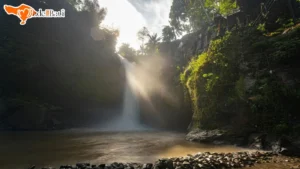
Every waterfall mentioned so far drops from above into an open pool. Tukad Cepung breaks that pattern entirely. It sits inside a narrow rock cavern, and the water falls through a gap in the rock ceiling, creating shafts of light that cut through the cave in a way that looks dramatic in photos and feels genuinely different in person. This is the waterfall to choose if the goal is variety rather than another version of the same experience.
Reaching it involves wading through shallow river water for the final stretch, which means closed shoes with grip matter more here than at any other waterfall on this list. The rocks underfoot are uneven and slick, and the cave’s lighting is best in the late morning when sunlight angles directly through the opening above. Arrive too early or too late and the light shaft that makes this place distinctive simply won’t be there.
Because Tukad Cepung sits closer to the Bangli border, it’s also the furthest drive of the group, at around fifty minutes from central Ubud. That distance is exactly why it works best paired with one other stop rather than squeezed in as a third or fourth waterfall in a packed day.
Goa Rang Reng for Travelers Who Want Fewer People Around
Goa Rang Reng remains noticeably quieter than the four waterfalls above it, mostly because fewer day tours include it and it requires a slightly longer walk to reach. The site actually contains three separate waterfalls along the same river gorge, with a current strong enough to feel genuinely powerful rather than decorative, plus a rope swing and small caves that add a sense of exploration missing from the more polished, developed sites.
This is the waterfall for travelers who specifically want to avoid the queues and crowd noise that come with Tegenungan or Kanto Lampo, even if it means a less manicured path and fewer amenities nearby. The tradeoff is straightforward: less convenience in exchange for more solitude.
Picking Two or Three Instead of Trying to See Them All
This is the part most lists skip entirely. They’ll tell you fifteen waterfalls exist and leave you to figure out the rest. But the honest answer to “how many should I visit” is almost always two, occasionally three if you start early and keep moving.
Trying to fit four or five into a single day usually means rushing through each one, which defeats the point of visiting somewhere meant to feel calm and a little removed from the rest of your trip. The better question isn’t how many you can fit in, it’s which combination gives you the most variety for the time you actually have.
Why Tegenungan and Kanto Lampo Back to Back Feels Repetitive
This is a genuinely common planning mistake. Both Tegenungan and Kanto Lampo are easy, popular, and crowded by mid-morning, which means visiting them together gives you two versions of a similar experience rather than two different ones. You’ll spend your day managing crowds twice instead of balancing a busy stop with a quiet one.
A more satisfying combination pairs one accessible, well-known waterfall with one that offers genuine contrast, whether that’s the swimming focus of Tibumana, the cave setting of Tukad Cepung, or the solitude of Goa Rang Reng. Variety, not proximity, should drive the pairing decision.
A Half Day Combination That Actually Works
If you only have a morning or afternoon free, here’s a pairing that consistently works well without feeling rushed:
- Start at Kanto Lampo right at opening. Arriving early avoids the worst of the photo queue and gives you the rock formation with relatively few people climbing on it.
- Drive to Tibumana next. It’s a short hop from Kanto Lampo, and by the time you arrive midmorning, you’ll have built up enough heat to actually want the swim.
- Allow roughly four hours total, including driving, parking, and the walk down and back at each stop.
This combination works because it pairs a photo-focused stop with a swim-focused one, giving you two different reasons to visit rather than two similar ones.
A Full Day Route for Waterfall-Focused Travelers
If waterfalls are genuinely one of the main reasons for your Bali trip and you’re willing to dedicate a full day, this route covers more ground while still avoiding the repetition trap:
- Begin at Tegenungan early, before the tour buses arrive, to get the easy, powerful waterfall experience without the worst crowds.
- Move to Tukad Cepung around late morning, timed so the light shaft through the cave ceiling is at its best.
- Finish at Goa Rang Reng in the afternoon, when the crowds elsewhere have thinned and you’ll likely have the quieter site mostly to yourselves.
This route covers three genuinely distinct experiences, an easy powerful drop, a dramatic cave setting, and a quiet river gorge, rather than three variations of the same waterfall formula.
What Changes Depending on Who You’re Traveling With
The “best” waterfall isn’t the same answer for everyone, and most lists treat all visitors the same way. A solo traveler optimizing for speed and a family managing a six-year-old on slippery stairs need genuinely different advice, even if they’re looking at the exact same five waterfalls.
Traveling With Kids Changes Which Stairs Matter
Stair count and railing quality matter far more with children than the waterfall’s height or power. Tegenungan is the strongest choice for families specifically because of its paved paths and railings along the descent, which reduce the real risk of a small child slipping on wet stone. Tibumana’s path, while short, lacks consistent railings and involves a few uneven steps, which makes it manageable for older kids but trickier for toddlers or anyone unsteady on their feet.
Tukad Cepung is worth approaching with more caution if you’re traveling with young children. Wading through the river to reach the cave means uneven, slippery footing in moving water, which is a different kind of risk than simply walking down stairs. It’s not off-limits, but it requires closer supervision than the other waterfalls on this list.
Solo Travelers Can Move Faster Through the Busy Spots
Traveling alone removes a lot of the friction that slows groups down. There’s no waiting for everyone to finish photos, no negotiating who wants to swim versus who wants to sit, and no group pace to manage on the walk down and back up. This makes solo travelers the best positioned to actually fit three waterfalls into one day if they choose to, since the time lost to coordination simply doesn’t exist.
That speed advantage also makes solo travel a good match for the busier waterfalls like Kanto Lampo. Arriving alone, you can slot into a gap in the photo queue more easily than a group of four waiting for a single clear shot together.
Couples Often Care More About Crowds Than Distance
For couples, the deciding factor is usually less about physical effort and more about atmosphere. A loud, crowded waterfall full of tour groups taking turns for photos doesn’t deliver the kind of experience most couples are hoping for, even if it’s the easiest one to reach. This is where Goa Rang Reng or an early morning visit to Tukad Cepung tends to outperform Tegenungan or Kanto Lampo for couples specifically looking for a quieter, more intimate setting, even though both require a slightly longer drive or walk.
Getting There Is Where Most People’s Plans Actually Break Down
Every waterfall on this list is reachable. The actual difficulty isn’t finding them, it’s getting there smoothly and getting back without losing an hour to logistics you didn’t plan for. This is the part of the trip that competitor content mentions in passing but rarely explains clearly, and it’s often where a well-planned day starts to fall apart.
Why Grab and Gojek Don’t Work at Every Waterfall
This is one of the most overlooked practical details in waterfall planning. Several sites, Kanto Lampo included, restrict ride-hailing pickups and require visitors to use local taxis instead, a system put in place to support local transport drivers in the area. If you arrived by Grab or Gojek expecting to call another one for the return trip, you may find the app simply won’t connect you with a driver nearby, or that drivers cancel once they realize the pickup location.
The practical implication is straightforward: if you’re not driving yourself, you need transport arranged for the entire round trip from the start, not just the way there. Assuming you can sort out the return once you arrive is a common and avoidable source of stress.
Scooter Gives Flexibility but Not Always Comfort
Renting a scooter remains the cheapest and most flexible way to reach Ubud’s waterfalls, typically running somewhere around 70,000 to 100,000 IDR per day depending on the bike and rental length. For confident riders, it allows stops whenever something catches your eye and avoids any dependency on ride-share restrictions at the waterfalls themselves.
The honest tradeoff is fatigue and risk. Bali’s roads near these waterfalls often involve potholes, narrow shoulders, and unpredictable local traffic, and riding back after a long day of walking down and up multiple sets of stairs is more tiring than it sounds. Scooters work best for confident, experienced riders visiting one or two waterfalls, not for a packed multi-stop day where tired legs and a motorbike are a genuinely poor combination.
When a Private Driver Quietly Solves the Whole Day
A private driver removes the two biggest friction points in one move: the ride-share restrictions at specific waterfalls, and the fatigue of self-driving between multiple stops. You’re dropped at the entrance, picked up again afterward without needing to negotiate a local taxi on the spot, and free to spend your energy on the walk and the swim rather than navigating unfamiliar roads.
This matters most on the half day and full day combination routes described earlier, since stringing two or three waterfalls together is exactly where transport friction compounds. Made From Bali’s drivers know these routes directly, including which waterfalls restrict ride-hailing pickups and roughly how the timing works between stops, which removes the guesswork from building a multi-waterfall day. For travelers who’d rather spend their energy on the actual experience than on transport logistics, arranging a private driver for the day is generally the most stress-free way to cover this kind of route.
Timing and Season Change What You’ll Actually See
The same waterfall can feel like two different places depending on when you show up. Time of day shapes the crowd, and season shapes the water itself, and both matter more than most lists acknowledge.
Morning Versus Afternoon Crowd Patterns
Crowds at the popular waterfalls follow a fairly predictable rhythm. Tegenungan and Kanto Lampo tend to start filling up between 9 and 10am as tour groups arrive in waves, and they typically stay busy through early afternoon before thinning out closer to 4 or 5pm as day tours head back toward the coast. Arriving right at opening, usually around 7 to 8am depending on the site, consistently gives you the clearest paths and shortest photo waits.
Tukad Cepung runs on a slightly different clock, since the cave’s signature light shaft only appears clearly when the sun angles directly through the rock opening, generally late morning into early afternoon. Arriving too early means missing the lighting that makes the place distinctive in the first place, so for this one specifically, slightly later isn’t a compromise, it’s necessary.
What Rainy Season Does to the Water and the Trail
Bali’s rainy season, roughly October through April, changes more than just whether you’ll need an umbrella. Heavier rainfall increases the volume and force of water at every waterfall on this list, which can make for more dramatic photos but also murkier pools, since increased runoff stirs up sediment that takes days of dry weather to settle. Tibumana’s swimmable pool in particular tends to run clearer in the dry season and visibly cloudier after a heavy rain.
Trails also become genuinely more slippery during rainy season, particularly the stone steps at Tegenungan and the riverbed wading section at Tukad Cepung. None of this means rainy season visits aren’t worth it, the waterfalls are often more powerful and visually striking, but footing requires more care, and swimming in a pool that’s currently murky from recent runoff might not be the experience you were hoping for. If a clear swim matters more to you than dramatic water volume, the dry season months between May and September give you better odds.
Turning This Into a Day You’ll Actually Enjoy
By now the picture should be fairly clear. The waterfalls themselves aren’t the hard part of this decision, narrowing them down is. Pick two that genuinely contrast with each other rather than two that feel similar, match the physical effort to who you’re traveling with, and sort out your transport for the whole round trip before you leave rather than improvising the return.
If you take nothing else from this guide, take this: a calm, well-paced half day with two contrasting waterfalls will almost always beat a rushed attempt to check off five. The waterfalls near Ubud reward travelers who slow down enough to actually enjoy the spot they’re standing in, rather than treating each stop as a box to tick before moving to the next one.
If you’d rather not handle the driving, the parking, or the local taxi restrictions yourself, Made From Bali can arrange a private driver who knows these routes and the timing between them, so the only thing left to plan is which waterfalls you want to see.