

Bali has somewhere around twenty thousand temples, give or take, and that number alone makes the question “which ones should I actually visit” almost impossible to answer by browsing photos online. Most travelers don’t have a problem finding temples in Bali. They have a problem narrowing the list down to something that fits into five or six days without spending half the trip in the car. That’s the real issue behind a search like this one, and it’s rarely addressed directly. Articles either dump thirty temples on you with no order, or they tell a personal travel story without explaining why certain temples belong together and others don’t.
This guide takes a different approach. Instead of ranking temples by how photogenic they are, it groups them by what actually matters when you’re planning real days on the ground: the history that explains what you’re looking at, the region each temple sits in, and the timing and access quirks that change whether a visit feels rushed or rewarding. By the end, you’ll know which temples carry genuine historical weight, which ones realistically pair together in a single day, and which mistakes quietly ruin a temple day for a lot of first-time visitors. If you’re trying to turn a long list of names into an actual plan, this is the part most guides skip.
What Actually Makes a Temple “Famous” in Bali
Not every famous Bali temple is famous for the same reason, and that distinction matters more than most lists let on. Some temples are famous because of their age and religious importance to Balinese Hindus. Others are famous mainly because a photo of them went viral, and the line between “spiritually significant” and “Instagram famous” isn’t always where visitors assume it is.
This matters practically because it shapes what kind of experience you’re signing up for. A temple that’s culturally central to daily Balinese life, like a village pura, behaves very differently from a temple built primarily to receive tourists. Knowing which category a temple falls into before you arrive changes your expectations about crowd size, photography rules, and how much of the experience is actually about worship versus sightseeing.
The Difference Between a Pura and a Tourist Landmark
In Bali, the word for temple is pura, and it refers to something specific: an open-air walled compound used for Balinese Hindu worship, built according to a layout that separates outer, middle, and inner courtyards based on how sacred each zone is. A pura is not a single building you walk into the way you would a church or mosque. It’s closer to a series of nested gardens and shrine towers, each section more restricted than the last as you move toward the center.
This explains a lot of confusion visitors run into. People often expect to walk straight into a temple and look around freely, the way they might at a European cathedral. In reality, most puras restrict the innermost zone to worshippers only, and at some sites, foreign visitors can’t enter the main temple area at all. That’s not a tourism rule invented to extract entrance fees. It reflects how the space is sacred at different intensities depending on which courtyard you’re standing in.
Tourist landmarks, by contrast, are temples where the visitor experience has become a primary function of the site, even if the religious purpose still exists underneath it. Tanah Lot is the clearest example: it’s a genuine place of Hindu worship, but its modern identity is built around sunset photography, souvenir stalls, and a steady flow of tour buses. Understanding this distinction before you go helps set the right expectations. A quiet village pura and a heavily visited landmark temple are not interchangeable experiences, even if both technically qualify as “famous.”
Why Bali Has Thousands of Temples but Only a Handful Get Visited
The sheer number of temples in Bali comes down to how deeply temple-building is woven into daily life rather than being reserved for major religious occasions. Balinese Hindu cosmology follows a sacred axis running from the mountains, considered the realm of the gods, down to the sea, considered the realm of demons and impurity. Villages, family compounds, rice fields, and even individual homes typically have their own small temple oriented along this same mountain-to-sea axis.
Most of these temples are never visited by tourists, and that’s by design rather than oversight. A family temple or a small village pura serves a specific community and has no real reason to appear on a travel itinerary. The temples that do become famous tend to share one or more of these traits:
- Dramatic natural setting, like a cliff edge, an offshore rock, or a crater lake, which makes the site visually striking independent of its religious meaning
- A documented historical figure, usually a priest credited with founding or expanding the site, which gives the temple a story beyond “this is old”
- A role in the nine directional temples, a system of guardian sites believed to protect the island from evil spirits arriving from each cardinal direction
- A specific ritual visitors can participate in, such as the purification bathing at Tirta Empul, which turns a passive viewing experience into something more memorable
Understanding this filtering logic is useful because it explains why certain temples appear on every list while equally old, equally sacred temples nearby remain almost unknown outside their own village. Fame in this context has very little to do with religious importance and a lot to do with visual drama, accessibility, and a good origin story.
The Sea Temples Everyone Photographs but Few Understand
Bali’s sea temples are probably the most recognizable category to anyone who has scrolled through Bali photos online, and they’re also the most likely to be visited without much context. Knowing the history behind these sites changes how you experience them, particularly around the rules that confuse first-time visitors the most: why you can’t walk inside, and why timing matters so much more here than at inland temples.
Tanah Lot and the Legend That Keeps Visitors Outside the Walls
Tanah Lot sits on a rocky outcrop just off Bali’s southwestern coast, and the temple you see in nearly every Bali postcard dates back to the 16th century. According to local tradition, a Hindu priest named Dang Hyang Nirartha was traveling along the coastline spreading Hindu teachings when he became drawn to the dramatic rock formation rising out of the sea. He’s said to have settled there briefly, and the temple was eventually built to honor that connection and to worship Bali’s sea gods.
This history directly explains the rule that confuses almost every first-time visitor: you cannot walk inside the main temple at Tanah Lot. It isn’t a tourism restriction invented to control crowds. The temple is reserved for Balinese Hindu worship, and as with most Balinese sea temples, the inner sanctum stays closed to non-worshippers regardless of how many people are visiting that day. What you’re free to explore is the surrounding grounds, the coastal walkways, and the area around the base of the rock during low tide.
Tide timing is the detail almost nobody plans around but should. Access to the area right at the base of the temple depends entirely on whether the tide is in or out. During low tide, you can walk close enough to the rock to see it properly and even reach a small freshwater spring near its base. During high tide, that same area disappears underwater and the temple becomes genuinely cut off, visible only from the cliffside paths above.
Tanah Lot is open daily from around 7am to 7pm, and the entrance fee for international visitors sits at roughly IDR 75,000 for adults and IDR 40,000 for children, separate from parking. Sunset is the obvious draw, with the temple silhouetted against the sky, but that popularity comes at a cost. If you want a decent viewpoint for sunset, plan to arrive by around 4:30pm, because the cliffside fills up fast on weekends and during peak season. The quieter alternative, which almost nobody mentions, is arriving right when the gates open. Morning light at Tanah Lot is softer, the crowd is a fraction of the sunset rush, and you get a genuinely different read on the place without fighting for space along the rail.
Uluwatu’s Clifftop History Behind the Sunset Kecak Crowds
Pura Luhur Uluwatu sits roughly 70 meters above the Indian Ocean on the southwestern tip of the Bukit Peninsula, and its history stretches back further than Tanah Lot’s. Tradition credits its founding to Mpu Kuturan, a Javanese priest believed to have established the site around the 11th century, with later expansion attributed to the same Dang Hyang Nirartha connected to Tanah Lot. As one of Bali’s nine directional temples, Uluwatu is dedicated to Dewa Rudra and is believed to protect the island from evil spirits approaching from the sea.
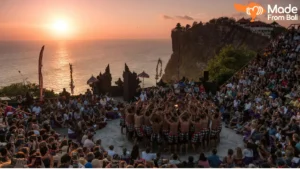
What separates Uluwatu from most other Bali temples is the way its religious history and its modern tourist identity sit directly on top of each other without much friction. The clifftop setting alone would draw visitors, but the nightly Kecak fire dance, performed at an open-air theatre within the temple grounds as the sun sets, is what turns Uluwatu into one of the busiest single attractions on the island during the late afternoon. The dance retells a story from the Ramayana through rhythmic chanting rather than instruments, and it’s genuinely worth seeing, but it also means Uluwatu at sunset is crowded in a way that has nothing to do with temple visiting hours and everything to do with show timing.
A few practical points reduce friction here. Tickets for the Kecak performance are sold separately from temple entrance and can sell out on busy evenings, so buying ahead or arriving early matters if you specifically want the show. The temple’s resident monkeys are mischievous rather than dangerous, but they’re genuinely skilled at grabbing sunglasses, hats, and anything loosely held, so keep valuables zipped away rather than in a hand or pocket. If your main interest is the clifftop scenery and temple history rather than the performance, visiting earlier in the afternoon gives you the view without competing for space with the entire sunset crowd.
Besakih Is Bigger Than Most Visitors Expect
Most travelers arrive at Besakih expecting a single temple and discover instead that they’ve walked into something closer to a small religious city. That gap between expectation and reality is the single biggest reason Besakih visits go wrong for first-timers, and it’s almost entirely solvable with the right framing before you arrive.
How an 80 Temple Complex Actually Works for a First Time Visit
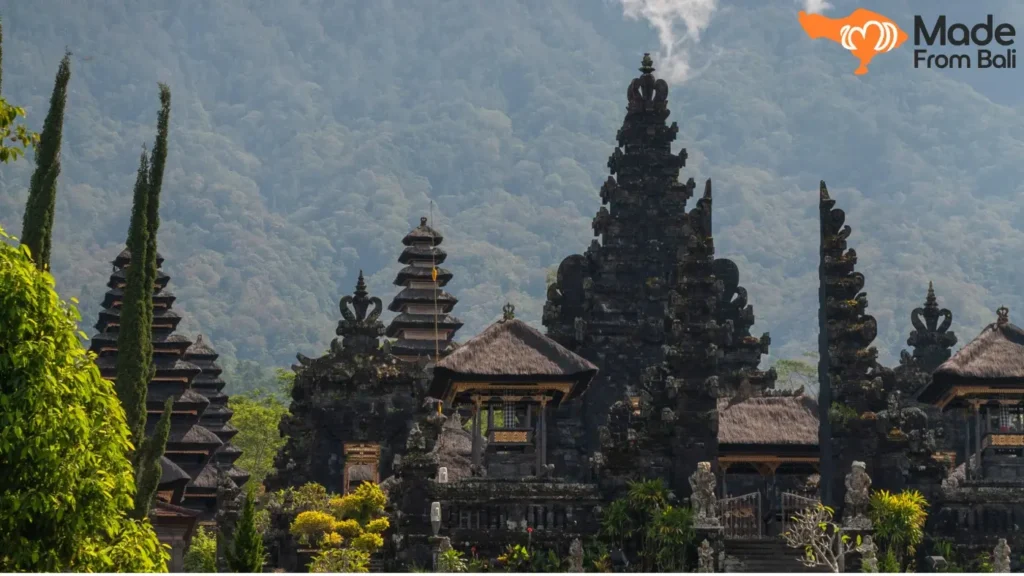
Pura Besakih, known as Bali’s Mother Temple, sits roughly 900 meters up the slopes of Mount Agung in East Bali. Some historical accounts trace religious activity at the site back nearly 2,000 years, which would make it considerably older than any of the sea temples covered above, though dating claims this old are difficult to verify with precision. What’s better documented is that Besakih functions less as one temple and more as a complex of more than 20, and by some counts over 80, individual temples spread across six ascending terraces.
The main structure, Pura Penataran Agung, sits at the highest point most visitors reach and houses a lotus throne honoring the Hindu trinity of Brahma, Vishnu, and Shiva. The terraced layout means a visit to Besakih is as much a walk through a hillside as it is a temple tour, and that physical reality catches people off guard, particularly visitors expecting something compact like Tanah Lot.
The entrance fee runs around IDR 150,000 per person, noticeably higher than most other famous temples on this list, and that price typically includes a sarong rental and the cost of an accompanying guide. The complex hosts more than 70 recorded ceremonies each year, which means there’s a real chance you’ll arrive during an active religious event, in which case access to certain areas may be restricted regardless of your ticket.
Why a Guide Changes the Besakih Experience More Than at Other Temples
At a single-structure temple like Tanah Lot, a guide adds context but isn’t essential to having a coherent visit. Besakih is different. Without someone explaining the layout, most visitors end up wandering between buildings with no clear sense of which terrace they’re on, which shrine belongs to which deity, or which sections they’re permitted to approach.
This is also where Besakih’s reputation for pushy unofficial guides comes from, and it’s worth naming directly rather than glossing over. Around the parking area, it’s common to be approached by people offering to “guide” you for a fee well above standard rates, sometimes implying that a guide is mandatory when it isn’t always the case. The safer approach is sticking with the guide included in your entrance ticket or one arranged through a known operator rather than negotiating with whoever approaches you first in the car park.
A few details make the Besakih visit noticeably smoother:
- Go early, ideally before mid-morning, since the site is large enough that midday heat on exposed stone terraces becomes genuinely tiring, and lighting for photos is better in soft morning light anyway
- Confirm with your guide which sections are open that day, since active ceremonies can close specific temples within the complex without affecting the rest
- Wear proper walking shoes rather than sandals, given the uneven stone steps across multiple terraces, something easy to underestimate from photos alone
- Avoid menstruating if you are a woman planning to enter any part of the complex, as this restriction is taken seriously across Balinese temple culture and applies here as strictly as anywhere on the island
Besakih rewards patience and a guide far more than it rewards rushing through with a checklist mentality. The scale is the point. Trying to see it the way you’d see a single shrine misses what makes it the Mother Temple in the first place.
The Water Temples Where History and Daily Ritual Still Overlap
Unlike the sea temples, which are mostly viewed from the outside, Bali’s water temples invite a different kind of engagement. Several of them are still actively used for the exact rituals that built their reputation centuries ago, which means visitors aren’t just looking at history here. In some cases, they can participate in it directly.
Tirta Empul’s Purification Pools and What Happens If You Join the Bathing Ritual
Pura Tirta Empul, located near Tampaksiring north of Ubud, centers on a holy spring believed to date back to around 960 AD, making it one of the older continuously used religious sites on the island. According to tradition, the spring appeared when the god Indra pierced the earth to create a source of healing water, an antidote to poison used by a rival king. Whether or not you take the legend literally, the spring still flows today and still anchors a living ritual rather than a historical reenactment.
The temple’s two main pools feature a row of fountain spouts, each associated with a different purification purpose. Balinese Hindus, and visitors who choose to participate, move along the row of spouts in sequence, dipping under each one as part of a cleansing ritual called melukat. This is one of the few famous temples in Bali where tourists are actively invited to take part rather than simply observe from a respectful distance, and that hands-on element is exactly why Tirta Empul tends to leave a stronger impression than temples you only walk around.
If you’re considering joining the ritual, a few practical points matter. You’ll need a sarong, which can be rented on-site, and you should bring a change of clothes since you will get genuinely wet, not just splashed. There’s a specific sequence to follow at the spouts, and it’s worth asking a guide or temple attendant to walk you through it rather than guessing, since skipping certain spouts or doing them out of order is considered disrespectful even if it’s an innocent mistake. The pools can get crowded by mid-morning as tour groups arrive, so an early visit gives you both shorter queues and a calmer atmosphere for what is meant to be a reflective experience.
Ulun Danu Beratan’s Floating Illusion and the Mountain Climate Around It
Pura Ulun Danu Beratan sits on the shores of Lake Bratan in the Bedugul highlands, roughly an hour’s drive from Ubud, and was constructed in the 17th century to honor the Hindu trinity alongside Dewi Danu, the goddess of lakes and water. The temple’s defining visual feature, the eleven-tiered meru tower dedicated to Shiva and his consort Parvati, appears to float on the lake when water levels rise, an effect that has made this temple one of the most photographed in Bali despite being far less discussed in terms of its actual history.
The “floating” appearance isn’t a permanent feature, and that’s worth knowing before you build expectations entirely around a single photo you saw online. Lake levels fluctuate with the season, and the dramatic floating illusion is strongest when the water is high, typically during and shortly after the wet season. During drier months, the same temple can look noticeably more grounded, with more visible shoreline around the base.
What almost no description mentions is the climate shift. Bedugul sits at higher elevation than most of southern Bali, and the temperature drop is real, not subtle. Visitors arriving straight from the coast in beachwear are often caught off guard by how cool and misty the mountain air feels, particularly in the early morning. Bringing a light layer isn’t optional advice here so much as a practical necessity if you want to enjoy the lakeside walk rather than rush back to the car shivering.
East Bali’s Older Sites Reward Travelers Willing to Climb
East Bali holds some of the island’s oldest archaeological sites, and the temples here generally ask more of visitors physically than the South Bali landmarks do. That tradeoff, more effort for a deeper sense of history, is exactly why these sites tend to attract travelers with a specific interest in archaeology or photography rather than the general sightseeing crowd.
Gates of Heaven at Lempuyang Without the Wait Most Visitors Get Stuck In
Pura Penataran Agung Lempuyang sits at the foot of Mount Lempuyang and is considered one of Bali’s oldest and most sacred Hindu temples, with the broader Lempuyang complex regarded as one of the island’s nine directional temples. Its modern fame, though, comes almost entirely from a single photo composition: a split gate framing Mount Agung perfectly in the background, widely known online as the “Gates of Heaven.”
Here’s the detail that almost never gets explained clearly: that iconic photo spot is not actually at the main temple most visitors think they’re climbing toward. The famous gate sits at a mid-level point in the complex, reached by car or shuttle, and is a separate stop from the upper temple, which requires climbing well over 1,500 steps to reach. A lot of visitors arrive expecting one short walk to a gate and are surprised to learn there’s a mandatory shuttle bus system from the parking area, plus a queue at the photo spot itself where staff manage timed turns so everyone gets their shot without the background filling with other tourists.
This shuttle and queue system is exactly why “go early” is the single most useful piece of advice for Lempuyang, more so than almost any other temple on this list. Arriving right at opening, generally before 8am, can mean a wait of only a few minutes for the photo spot. Arrive by mid-morning during peak season and that same wait can stretch well past an hour, with buses backed up and a long line forming at the gate itself. If climbing the full 1,700-plus steps to the upper temple interests you, that’s a separate and far more demanding undertaking, generally requiring two to three hours round trip and a genuine level of fitness, not something to attempt on a whim after a long morning of temple hopping elsewhere.
Goa Gajah’s Carved Entrance and the Smaller Sites Most People Walk Past
Goa Gajah, meaning Elephant Cave, sits just outside Ubud and despite the name has no historical connection to actual elephants. The site dates to roughly the 11th century and was used for meditation and spiritual practice, though it fell out of use and was reclaimed by jungle growth for centuries before Dutch archaeologists rediscovered it in 1923. The most likely explanation for the name is the large carved face at the cave’s entrance, which some historians believe represents Ganesh, the elephant-headed Hindu deity, though the carving’s exact meaning is still debated among researchers.
Inside the cave, narrow meditation chambers and weathered statues remain, along with fragmentary remains of a lingam and yoni, symbolic representations connected to Shiva worship. Most visitors spend their time at the cave entrance and the surrounding courtyard, where bathing pools and statues of women holding water pitchers, representing the seven holy rivers of India, draw most of the photography.
What a surprising number of visitors miss entirely is what sits just beyond the main courtyard. A path leads down through active rice terraces to Sungai Petanu, a riverside area with crumbling stone carvings of stupas on a cliff face and a smaller cave that almost no tour group bothers to visit. This stretch takes maybe twenty extra minutes round trip and offers a genuinely different, quieter version of the same archaeological period, without the steady stream of buses that fills the main courtyard for most of the day. If your interest in Goa Gajah is more about the historical setting than checking off the main carved entrance for a photo, this riverside extension is worth the short walk.
Taman Ayun and the Royal History Hiding in a Quiet Garden Setting
Pura Taman Ayun, in the village of Mengwi, was built in 1634 and served as the royal family temple for the Kingdom of Mengwi during a period when Bali was divided into nine separate kingdoms, each with its own ruling family and territory. The temple’s name translates roughly to “beautiful garden,” and unlike most of the famous temples covered so far, its history is tied directly to a specific royal lineage rather than a wandering priest or a religious legend.
The layout reflects that royal origin clearly. Taman Ayun is designed like a temple set within a garden estate, surrounded by a wide moat and featuring a series of meru towers visible from across the water, an architectural choice meant to convey the temple’s status as a center of both religious and political power. The site earned UNESCO recognition for its role in Bali’s subak irrigation system and its broader cultural significance, and Bali’s regional government formally proposed it for World Heritage status in the early 2000s.
What makes Taman Ayun genuinely different from the temples covered earlier isn’t its religious importance so much as its atmosphere. Because tourists can’t enter the inner temple area, which remains locked and accessible only by walking along the surrounding moat, the visitor experience here is closer to walking through a peaceful museum garden than navigating a busy religious landmark. There’s no sunset rush, no shuttle bus queue, and no Kecak performance crowd. For travelers who’ve already hit two or three high-energy temples earlier in the day, Taman Ayun functions almost as a deliberate pace change, a calm, contemplative stop rather than another box to check.
Grouping Temples by Region Saves More Time Than Most Itineraries Admit
Here’s where most temple guides fall short, and it’s the part that actually determines whether your temple days feel relaxed or rushed. Bali is not as small as it looks on a map, and the island’s traffic patterns mean drive time rarely matches the straight-line distance between two points. Grouping temples by region, rather than by how famous each one is, is what separates a smooth day from one spent mostly in the car.
Which Temples Realistically Fit Into One Day Together
The clearest natural groupings on this list follow Bali’s geography rather than any particular theme:
| Region | Temples | Realistic for One Day |
|---|---|---|
| South Bali coastal | Tanah Lot, Uluwatu | Yes, but only if timed carefully around sunset at one or the other, not both |
| Ubud and central highlands | Tirta Empul, Goa Gajah | Yes, comfortably, often combined with a stop at Tegalalang rice terraces nearby |
| East Bali | Besakih, Lempuyang | Possible but demanding, given Besakih’s scale and Lempuyang’s queue system both require significant time |
| Bedugul highlands | Ulun Danu Beratan, Taman Ayun | Yes, and the drive between them passes through scenic mountain roads worth the trip on its own |
Tanah Lot and Uluwatu sit on opposite ends of South Bali’s coastline, and while the drive between them is only around 45 minutes to an hour without traffic, both temples have their own sunset draw. Trying to catch sunset at both in one evening simply isn’t possible. Most experienced visitors pick one for sunset and visit the other earlier in the day, which is a tradeoff almost no generic itinerary spells out clearly.
Tirta Empul and Goa Gajah pair naturally because they sit close together near Ubud and require a similar kind of energy, walking through compact sites rather than climbing extensive terrain. Besakih and Lempuyang, despite both being in East Bali, are a tougher combination than most lists admit. Besakih alone can take two to three hours done properly with a guide, and Lempuyang’s queue system adds unpredictable waiting time on top of the drive. Attempting both in a single day usually means rushing one of them, which defeats the purpose of visiting either.
Where Drive Time Quietly Eats Into a Temple Day
The detail that catches most self-planned itineraries off guard is that Bali’s roads, particularly anything passing through or near Ubud, Denpasar, or the southern tourist hubs, can slow dramatically during certain hours regardless of actual distance. A drive that Google Maps estimates at 50 minutes can stretch to 90 or more during a weekday afternoon, especially around school pickup hours or near major intersections.
This is where flexible timing matters more than most travelers expect. A fixed group tour bus typically departs and returns on a set schedule regardless of traffic conditions that day, which means a bad traffic day eats directly into your time at each stop. A private driver, by contrast, can shift the day’s order in response to real conditions, leaving earlier for a site that’s likely to be busy, or adjusting the route if traffic reports suggest a delay on the planned road. Made From Bali’s drivers build routes this way as a matter of course, sequencing stops based on patterns they’ve observed across hundreds of repeated trips between the same regions, rather than following a fixed script regardless of what the road actually looks like that day.
The practical takeaway, regardless of how you’re getting around: build buffer time into any day that includes more than two temple stops, and treat the straight-line distance between temples on a map as a rough starting point rather than a reliable estimate of your actual drive time.
Mistakes That Turn a Temple Day Into a Rushed One
Most of the friction in a Bali temple day comes down to a small number of avoidable miscalculations, and they show up again and again in traveler reviews and trip reports. Naming them clearly in advance does more to improve your day than almost any packing list.
Booking Sunset at Tanah Lot Without Checking the Tide
The single most common Tanah Lot mistake is assuming sunset automatically means access to the temple base. As covered earlier, the area around the rock formation is only walkable during low tide, and tide timing shifts daily and doesn’t follow a fixed clock the way sunset roughly does. It’s entirely possible to arrive for a beautiful sunset and find the base of the temple submerged and inaccessible, which is disappointing if that close-up photo was the whole point of the visit. Checking a tide chart for the specific date of your visit, easily found with a quick search before you go, takes two minutes and prevents this exact letdown.
Underestimating Lempuyang’s Steps or Besakih’s Scale
Both of these mistakes come from the same root cause: judging a temple’s physical demands from photos rather than from an honest description of what’s actually involved. Lempuyang’s famous gate photo looks like a short, easy walk in every image online, when reaching it actually requires a shuttle ride and a queue, and the full upper temple climb is a genuinely demanding hike that surprises people who showed up in sandals expecting a quick photo stop.
Besakih causes the opposite problem. Photos make it look like a single grand temple, when in reality you’re walking across multiple terraces spread over a meaningful stretch of hillside, in heat, on uneven stone. Visitors who plan fifteen minutes for Besakih, the way they might for a smaller temple, consistently end up either cutting the visit short out of frustration or running badly behind schedule for whatever comes next that day. Giving these two temples realistic time and physical expectations upfront avoids both problems entirely.
Matching Temples to the Kind of Trip You’re Actually Taking
Not every famous temple suits every traveler equally, and pretending otherwise is part of why generic temple lists feel unsatisfying. Matching temple choices to your actual trip style does more for your satisfaction than simply visiting whichever temples appear most often online.
First Timers Wanting the Greatest Hits in Limited Days
If this is a first visit to Bali and temples are one part of a broader trip rather than the main focus, the most efficient combination tends to be Tanah Lot or Uluwatu for the iconic coastal experience, Tirta Empul for a hands-on ritual experience, and one East Bali site, either Besakih for scale and history or Lempuyang for the photo, depending on how much time and physical effort you want to commit. Trying to hit all of these plus Ulun Danu Beratan and Taman Ayun in a short trip usually means seeing everything quickly and remembering little clearly. Three well-chosen, well-paced temples tend to leave a stronger impression than six rushed ones.
Couples, Solo Travelers, and Families Each Notice Different Things
These traveler types genuinely experience the same temples differently, and it’s worth being specific rather than vague about it:
- Couples tend to gravitate toward Tanah Lot and Uluwatu for the romantic sunset factor, though it’s worth knowing that local legend at Tanah Lot suggests unmarried couples visiting together may eventually break up, a superstition most visitors treat as a fun bit of folklore rather than a genuine concern
- Solo travelers often get the most out of Tirta Empul, since participating in the bathing ritual alone tends to feel more personal and reflective without needing to coordinate timing or interest with anyone else
- Families with young children generally do better at temples with manageable walking distances and fewer steep steps, which makes Tirta Empul, Taman Ayun, and Goa Gajah’s main courtyard easier choices than Besakih’s terraces or Lempuyang’s climb
- Photographers are usually drawn specifically to Lempuyang and Ulun Danu Beratan, and for this group, arriving at the absolute earliest possible hour matters more than for any other traveler type, since both locations depend heavily on light quality and crowd-free framing
What to Wear and Expect Before Stepping Through the Gates
Temple etiquette in Bali is consistent enough across sites that it’s worth covering once clearly rather than repeating at every individual temple. Most famous temples require a sarong, the wraparound cloth covering the legs, along with a sash tied at the waist if you’re not already wearing long pants or a long skirt. Shoulders should generally be covered as well, particularly at more religiously active sites like Besakih and Tirta Empul.
Most temples rent sarongs and sashes at the entrance, often included in the ticket price or available for a small additional fee, so arriving without your own isn’t a problem at the vast majority of sites. Tanah Lot is a notable exception, where dress requirements are more relaxed and a sarong typically isn’t required at all, which surprises visitors who packed one specifically expecting to need it there.
A few additional points reduce friction across nearly every temple on this list:
- Bring small cash in Indonesian Rupiah. Most temple entrance fees are cash only, and smaller temples in particular often can’t make change for large bills
- Expect to remove shoes at certain inner areas, particularly at sites like Goa Gajah and parts of Tirta Empul, so footwear that’s easy to slip on and off saves time
- Avoid pointing your feet toward shrines or sitting with your back to an altar, a detail rarely explained but genuinely noticed and appreciated by Balinese staff and worshippers
- Check whether a ceremony is happening that day, since temple-specific Facebook pages or your driver or guide will usually know, and certain areas can close temporarily during active rituals regardless of your ticket
None of this is complicated once you know it, but almost no single source lists it all together, which means most visitors piece it together gradually across several frustrating first encounters rather than knowing it going in.
Putting the History Into Context Once You’re Standing in Front of It
Reading about Tanah Lot’s founding legend or Besakih’s terraced layout is one thing. Standing in front of either temple with that context already in mind changes the experience in a way that’s hard to fully explain until it happens. A temple that might otherwise just look like an attractive stone structure becomes something with a specific story behind every gate, every tier, and every restriction on where you’re allowed to walk.
The temples covered here represent the strongest combination of historical depth, accessibility, and genuine visitor experience that Bali has to offer, but they’re not the only worthwhile temples on the island, and they’re certainly not all required on a single trip. What matters more than ticking off a complete list is choosing the handful that match your actual trip style, understanding the timing and access quirks that shape each visit, and building realistic days around them rather than trying to force five distant temples into one rushed itinerary.
If you’d rather hand off the logistics entirely, a private driver who already knows the timing patterns, the shortcut roads, and which combinations actually work in practice can turn this same list into a day that feels unhurried rather than scheduled to the minute. That’s really the difference between reading about Bali’s temples and experiencing them the way they’re meant to be experienced.