


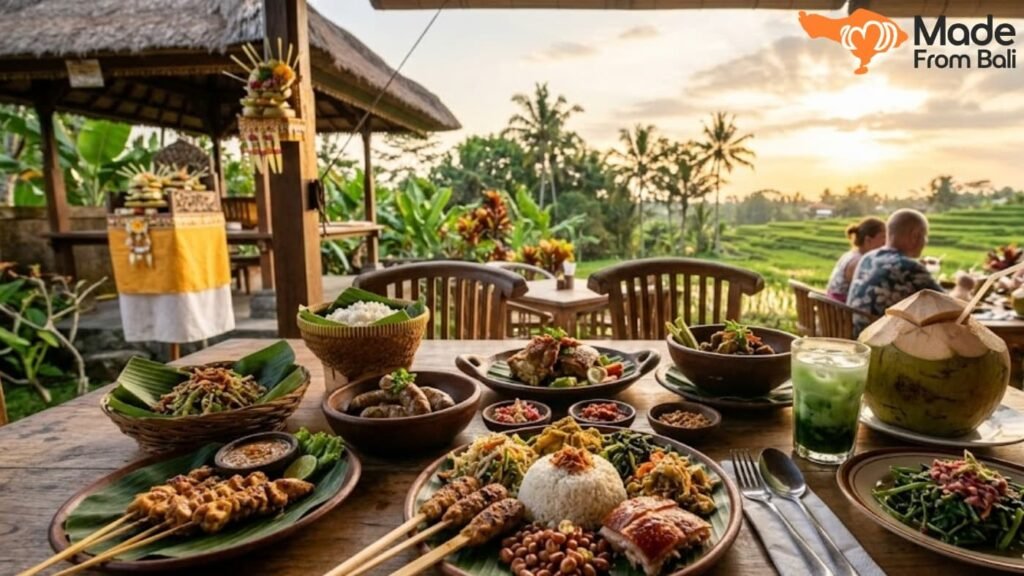
Most people land in Bali expecting beach clubs and rice terraces, then end up talking about the food more than anything else. That tends to catch first-time visitors off guard, because Balinese food rarely shows up in the same conversation as Thai or Vietnamese cuisine, even though it deserves to. The problem is that most online guides hand you a list of ten dishes with no context. You get a name, a photo, and an adjective like “delicious,” and you’re left to figure out the rest once you’re standing at a warung counter with a queue behind you and no idea what you just ordered.
That gap matters more than it sounds. Order the wrong thing on your first day and you might walk away thinking Balinese food is “just spicy pork,” which undersells an entire culinary tradition built around ceremony, family recipe, and region. Worse, if nobody tells you which dishes carry more food-safety risk or which ones fit a halal or vegetarian diet, you end up either playing it too safe (and missing the good stuff) or eating blind (and risking a day lost to stomach trouble).
This guide works differently. Instead of just naming dishes, it explains what each one tastes like compared to something more familiar, where in Bali it’s worth seeking out, roughly what it costs, and what to know if you’re cautious about spice, hygiene, or dietary restrictions. By the end, you should be able to walk into any warung in Ubud, Sanur, or Denpasar and order with confidence instead of pointing at a menu and hoping.
What Actually Makes Balinese Food Different From Indonesian Food in General
It’s easy to lump Balinese food in with Indonesian food generally, since they share rice, chili, and coconut as building blocks. But there’s a real distinction, and understanding it changes how you read a menu in Bali. Indonesia as a whole is majority Muslim, so pork is uncommon in most regional cuisines. Bali is the exception. The island is predominantly Hindu, and that single fact reshapes the entire food culture. Pork shows up constantly, from babi guling to lawar to satay, in a way that would be unusual almost anywhere else in the archipelago.
The other defining feature is the spice base nearly every savory Balinese dish is built on, called base genep. It’s a wet paste pounded from a long list of ingredients: shallots, garlic, ginger, turmeric, galangal, candlenut, coriander, and often kencur and lemongrass, sometimes more than a dozen components depending on the family recipe. This single paste is the reason Balinese food tastes layered rather than simply “spicy.” The heat is there, but it sits behind sweetness, earthiness, and a slight bitterness from the turmeric and galangal. If you’ve had Thai curry paste, base genep is a useful comparison point, though it leans drier and more herbal rather than coconut-forward.
Knowing this before you eat anything changes how you taste it. Instead of registering “spicy pork dish,” you start noticing the layers, and that’s a more satisfying way to experience food you’ve traveled a long way to try.
A Useful Way to Think About Your First Bali Meal
Most food guides organize dishes by category: mains, snacks, desserts. That’s fine for a menu, but it doesn’t help you decide what to actually eat first. A more useful way to think about it is whether a dish is something Balinese people eat constantly as part of daily life, or something tied to ceremony and celebration that warungs now sell to the public. Knowing the difference helps you set expectations and also gives you something genuinely interesting to think about while you eat.
Everyday Warung Food Versus Ceremonial Dishes
Nasi campur, mie goreng, and nasi goreng are everyday food. Balinese families eat versions of these at home, and you’ll find them at every warung, every hour, cooked fast and served without ceremony. They’re reliable, familiar in structure even if the flavors are new to you, and a safe place to start if you want to ease into the cuisine.
Babi guling and lawar sit in a different category. Both have roots in temple ceremonies and life-cycle celebrations, where a whole pig is roasted and the meat distributed among a community as part of a religious offering. Warungs selling these dishes daily essentially took something ceremonial and made it available commercially, which is part of why these dishes feel more significant when you eat them. You’re not just trying a recipe. You’re tasting something that still carries weight in Balinese religious life, even in its commercialized form. This is also why portions and recipes vary so much between warungs. Each one is working from a family or village version, not a standardized formula.
How Spicy Balinese Food Really Is for Most Travelers
This is probably the single most common worry among first-time visitors, and the honest answer is that it depends heavily on which element of the dish you’re talking about. The base genep itself is not blisteringly hot. It has warmth, but the dominant sensation is savory and aromatic rather than fiery. The heat usually comes separately, from sambal, a chili condiment served on the side rather than cooked into the dish.
This separation matters practically. If you tell a warung “tanpa sambal” (without sambal) or simply leave the sambal untouched on your plate, most savory Balinese dishes become genuinely mild. Sambal matah, the most famous Balinese chili condiment made from raw shallots, lemongrass, and chili, is intensely flavorful but you control how much goes on your plate. Travelers who assume Balinese food is uniformly hot are usually responding to sambal, not the dish underneath it. Knowing you can opt out of sambal entirely, or ask for just a small spoon, takes a lot of the anxiety out of ordering.
The Dishes Worth Building Your Bali Food List Around
Rather than listing fifteen dishes you’ll forget by the time you land, it’s more useful to go deep on a shorter list that actually covers the range of what Balinese food does well: ceremonial richness, everyday comfort, raw and fresh flavor, and something sweet to finish.
Babi Guling Is Usually the One Dish Everyone Mentions First
Babi guling is spit-roasted suckling pig, rubbed inside and out with base genep and slow-roasted over coconut husk fire until the skin crackles and the meat falls apart easily. It’s the dish most associated with Bali specifically, partly because of its ceremonial origins and partly because the texture contrast between crisp skin and tender meat is genuinely distinctive. A typical plate includes rice, a portion of the roasted meat, crispy skin, a vegetable side like lawar or urap, and a small bowl of pork broth soup.
Gianyar and Ubud are generally considered the strongest regions for babi guling, partly because the area has a concentration of long-running specialist warungs that focus on this single dish rather than running a full menu. Expect to pay somewhere between IDR 40,000 and IDR 80,000 for a standard plate, with special portions running higher. One practical note: babi guling specialists often sell out by early afternoon, since the pig is prepared once per day and not replenished. If you want it, lunch rather than dinner is usually the safer bet.
If you’re nervous about pork or unfamiliar cuts, ask for “daging” (meat) rather than the mixed special plate, which can include skin, sausage, and offal-based components some travelers find harder to enjoy on a first try.
Nasi Campur Works Differently Than Most Visitors Expect
Nasi campur, sometimes called nasi Bali, translates to “mixed rice,” and the name undersells how personal this dish actually is. Rather than ordering a fixed dish off a menu, you’re usually pointing at a counter of prepared items and building your own plate: a scoop of rice, then a selection from vegetables, shredded chicken or pork, tempeh, egg, and sambal, all priced together or per item depending on the warung.
This catches first-timers off guard because it doesn’t work like ordering at a Western restaurant. You may need to walk up, look, and gesture at what you want rather than wait for a menu to be handed to you. Once you understand that, it becomes one of the most flexible dishes on this list, since you control exactly how much spice and which proteins end up on your plate. It’s also widely considered the most representative “everyday” Balinese dish, the kind of meal a local person might eat for lunch without thinking twice about it. Expect to pay roughly IDR 20,000 to IDR 40,000 depending on the warung and how much you pile on.
Sate Lilit Is Easy to Like Even If You Are Cautious With Spice
Sate lilit looks similar to the satay most travelers already know, but the technique is different in a way that changes the texture entirely. Instead of skewering chunks of meat, Balinese cooks mince fish or chicken and mix it with grated coconut, lime leaf, and spices, then press the mixture around a flattened lemongrass or bamboo stick before grilling. The result is softer than standard satay, with a fragrant, slightly smoky flavor and far less char than skewered meat.
This makes it a good entry point for travelers who want something recognizably “satay-shaped” without committing to a stronger or spicier dish. Sanur is often cited as a strong region for this dish, with smaller beachfront warungs cooking it fresh in batches throughout the day rather than holding pre-cooked skewers under a heat lamp. It’s usually served with a light dip rather than heavy peanut sauce, which keeps the coconut and lemongrass flavor from being masked.
Lawar Tells You a Lot About Balinese Cooking Traditions
Lawar is worth understanding even if you don’t end up ordering it, because it explains something important about how Balinese cooking treats ceremony and everyday food differently. At its base, lawar is a mix of minced meat, grated coconut, and a heavy dose of spices and herbs, often finished with lime. Traditional versions, particularly red lawar, include animal blood, which gives the dish a deeper, more savory color and flavor and ties it directly to its ceremonial roots.
Most warungs serving lawar to the general public today use a milder version, frequently white lawar made without blood, sometimes substituting jackfruit for part or all of the meat to make a vegetarian-friendly version. If you’re curious but cautious, it’s worth asking specifically whether the lawar on offer contains blood (locals will understand “lawar merah” versus “lawar putih”) rather than assuming. This single question avoids the most common surprise travelers report with this dish. Villages around Ubud are a reliable place to find well-made versions, often served as a side rather than a standalone plate.
Ayam Betutu Rewards Travelers Willing to Wait
Betutu is one of the few dishes on this list that genuinely benefits from advance ordering rather than walking in and expecting it immediately. A whole chicken or duck is stuffed and coated with a dense spice mixture, wrapped in banana leaf, and slow-cooked for several hours, sometimes longer for the duck version, until the meat is tender enough to pull apart with a spoon. Legend ties the dish to Balinese royal kitchens, and the long preparation time still reflects that.
Because of the cooking time, many restaurants require betutu to be ordered hours in advance, or they prepare a limited batch each day and sell out early. Gilimanuk, near the ferry crossing to Java, has a strong reputation specifically for the chicken version, often served hot and notably spicier than versions found elsewhere on the island. If you’re planning a day trip through that area, it’s a dish worth timing your stop around rather than hoping to find on the spot.
Sambal Matah Changes How Almost Every Other Dish Tastes
Technically a condiment rather than a dish on its own, sambal matah deserves its own entry because of how much it shapes the experience of everything else on this list. Unlike cooked sambals found elsewhere in Indonesia, sambal matah is raw: finely sliced shallots, lemongrass, bird’s eye chili, lime leaf, and a splash of coconut oil, mixed together without any heat applied. The texture stays crisp and the lemongrass aroma stays bright in a way cooking would dull.
It’s served alongside nearly every savory dish on this list, and how much you add genuinely changes your meal. A small spoon adds brightness without much heat. A generous portion turns even a mild dish noticeably spicy. Because it’s served separately rather than mixed in, sambal matah is one of the easiest ways to control your own spice level without needing to ask the kitchen to adjust anything, which is useful information nobody tends to explain clearly before you arrive.
Gado Gado Is the Easiest Entry Point for Vegetarian Travelers
Gado gado is built from blanched and raw vegetables, typically cabbage, green beans, bean sprouts, and carrots, topped with boiled egg, fried tofu, and tempeh, then finished with a satay-style peanut sauce. It reads as a salad, but the warm peanut sauce and fried components make it feel substantial rather than light, which surprises travelers expecting something closer to a Western salad.
For vegetarian travelers specifically, gado gado is one of the most reliably meat-free dishes on offer without needing to negotiate with kitchen staff, since egg and peanut sauce are typically the only animal-derived components and many warungs can prepare it without egg on request. It’s widely available across Denpasar markets and beyond, usually priced affordably since the ingredients are simple and the preparation is fast.
Pisang Goreng and Es Campur Cover Bali’s Sweeter Side
Most savory Balinese meals end with something simple rather than an elaborate dessert course, and these two cover the range well. Pisang goreng is sliced banana dipped in batter and deep-fried, served plain or topped with honey, palm sugar, or shaved coconut. It’s straightforward, inexpensive, and available everywhere, making it a low-risk way to try something new if you’re easing into local food cautiously.
Es campur is the better choice on a hot afternoon. It’s a mix of shaved ice, coconut milk, grass jelly, tapioca pearls, and assorted fruit, finished with condensed milk drizzled over the top. The combination sounds chaotic on paper but works because the sweetness is balanced across multiple textures rather than concentrated in one note. Both desserts are widely available at markets and casual restaurants, typically costing very little, and neither carries much food-safety concern since they’re either fried fresh or assembled to order in front of you.
Why Some Dishes Are Easier to Find in Certain Parts of Bali
One thing competitors rarely explain clearly is that Balinese food has real regional character, the same way certain dishes are associated with specific cities in other countries. This isn’t just marketing language from a particular warung. It reflects where ingredients are most available, which families have run specialist kitchens for generations, and what local demand has sustained over time.
Here’s a practical breakdown of how this tends to play out across the island:
| Region | Known For | Why It’s Strong There |
|---|---|---|
| Ubud and Gianyar | Babi guling, lawar | Long-running specialist warungs, strong local demand, central to Balinese ceremonial cooking traditions |
| Sanur | Sate lilit | Beachfront warungs cooking smaller batches fresh throughout the day |
| Denpasar | Nasi campur, gado gado | Dense market culture with high turnover, ideal for these fast, assembled dishes |
| Gilimanuk | Ayam betutu | Long-standing specialist kitchens near the ferry crossing, famous for the chicken version specifically |
This matters practically if you’re moving around Bali rather than staying in one area the whole trip. If betutu is high on your list and you’re not passing through the north or west of the island, you may need to seek out a kitchen that prepares it daily in your area rather than assuming every warung does it well. Treating these regional patterns as a loose guide, rather than a strict rule, gives you a better shot at trying each dish at its best.
Eating Safely Without Missing Out on the Good Stuff
The honest version of this conversation is that most travelers worry more about getting sick than about which dish to try, and that anxiety often pushes people toward bland hotel buffets instead of the food they actually traveled to experience. The good news is that the risk is manageable once you understand what actually causes problems, rather than treating every warung as equally risky.
Which Dishes Tend to Be Lower Risk for Sensitive Stomachs
Travelers’ diarrhea, commonly called Bali belly, is usually caused by bacteria or parasites introduced through contaminated water or improperly handled food, not by spice itself. That distinction matters because it means the dishes most likely to cause trouble aren’t necessarily the spiciest ones. They’re the ones involving raw ingredients, unfiltered water, or food that’s been sitting at room temperature.
A few practical patterns worth knowing:
- Freshly grilled or fried dishes like sate lilit, pisang goreng, and freshly cooked nasi goreng carry lower risk because high heat kills most bacteria during cooking.
- Soups served hot, including the broth that comes with babi guling, are generally safer since they’re thoroughly boiled.
- Raw or rare components deserve more caution. If lawar contains raw blood (lawar merah) or if any meat looks undercooked, it’s reasonable to ask the kitchen directly rather than assume.
- Ice and anything water-based matters more than the food itself in many cases, since Bali’s tap water isn’t safe to drink. Busy, reputable restaurants typically use filtered water for ice and sauces, but smaller roadside stalls are a reasonable place to be more selective, particularly on your first few days before your system has adjusted.
A simple, practical habit that doesn’t require overthinking every meal: choose warungs that are visibly busy with a mix of locals and visitors, where food is cooked in front of you rather than held under a heat lamp. High turnover is one of the more reliable informal signals of food safety, since it means ingredients aren’t sitting around for long periods.
What Halal and Vegetarian Travelers Should Know Before Ordering
Pork’s prominence in Balinese cuisine, babi guling and lawar especially, makes this a real consideration rather than a minor footnote, and it’s worth addressing directly rather than assuming travelers will figure it out on arrival.
For halal-conscious travelers, the practical reality is that very few traditional Balinese warungs hold official halal certification, since the cuisine itself is built around pork in many of its signature dishes. That doesn’t mean halal eating in Bali is difficult. Areas like Kuta, Denpasar, and parts of North Bali have a meaningful concentration of Muslim-owned warungs and certified restaurants serving dishes like nasi campur and nasi goreng prepared with chicken or beef instead of pork, and ayam betutu is naturally halal-friendly in its chicken form when prepared without non-halal ingredients. The safest approach is asking directly about ingredients and preparation rather than assuming a dish is automatically halal just because it doesn’t visibly contain pork, since shared cooking surfaces and stock can sometimes be a concern at non-certified kitchens.
For vegetarian travelers, gado gado is the most straightforward option, and white lawar made with jackfruit instead of meat is increasingly available, particularly around Ubud. Nasi campur can usually be adapted by requesting vegetable and tofu or tempeh portions only, though this depends on the specific warung having enough non-meat items prepared that day. As with halal requests, asking directly tends to get better results than guessing from a menu, since many warungs are used to accommodating these requests even without listing a formal vegetarian menu.
What a Realistic Day of Eating in Bali Actually Costs
Cost expectations vary enormously depending on whether you’re eating at local warungs or tourist-oriented restaurants, and most guides either skip this entirely or give vague ranges that don’t reflect real ordering patterns. Here’s a more grounded breakdown based on typical warung pricing:
| Dish | Typical Price Range (IDR) | Approximate USD |
|---|---|---|
| Nasi campur | 20,000 to 40,000 | $1.25 to $2.50 |
| Babi guling (standard plate) | 40,000 to 80,000 | $2.50 to $5.00 |
| Sate lilit (portion) | 25,000 to 45,000 | $1.50 to $2.75 |
| Gado gado | 20,000 to 35,000 | $1.25 to $2.20 |
| Pisang goreng | 10,000 to 20,000 | $0.65 to $1.25 |
| Es campur | 15,000 to 25,000 | $1.00 to $1.50 |
A full day of eating three meals at local warungs, including a dessert or snack, typically lands somewhere between IDR 150,000 and 250,000 per person, roughly $9 to $16. Restaurants aimed more at tourists, particularly in Seminyak or Canggu, can run two to four times higher for the same dishes, which isn’t necessarily bad value given the setting, but it’s worth knowing the difference exists so you’re choosing it deliberately rather than by accident.
Turning This List Into an Actual Plan for Your Trip
Reading a list of dishes is one thing. Actually encountering them in the right place, at the right time of day, without wasting half a travel day searching for a specific warung, is a different problem entirely. This is where it helps to think about food the same way you’d think about temples or waterfalls: as something worth building into your route rather than hoping to stumble across.
If babi guling and betutu are both on your list, for example, they’re realistically found in different parts of the island, which means a single day trip covering Ubud and a separate trip toward Gilimanuk or North Bali makes more sense than trying to chase both in one afternoon. A private driver who already knows which warungs are still running fresh batches at midday, rather than relying on a name from a five-year-old blog post, removes a surprising amount of friction from a trip that otherwise involves a lot of guessing.
That’s really the most practical takeaway here. The dishes themselves aren’t hard to enjoy once you understand what you’re ordering and why. The harder part is timing and location, and that’s usually solved more easily with someone who drives these routes regularly than by piecing it together from search results the night before. Whether you explore independently or build a food stop into a guided day around Ubud, Sanur, or East Bali, going in with this understanding means you’ll spend your time eating the food you actually wanted, rather than whatever happened to be open when you got hungry.