


Search for a private driver in Bali and you will land on quotes that range from around twenty five dollars a day to close to a hundred, all claiming to cover the same thing. That gap alone is enough to make anyone hesitate before booking, because nobody wants to overpay on day one of a trip, and nobody wants to save ten dollars and end up with a driver who cannot speak enough English to understand where the hotel actually is. The confusion is not really about price. It is about not knowing what you are comparing.
Most guides either sell you a service or hand you a generic list of tips that could apply to any country with taxis. Neither actually explains why quotes differ, what a full day really looks like once you are stuck in Denpasar traffic, or what changes when you book through an app versus messaging a driver directly. This guide works through those questions in the order they usually come up when someone is actually planning a Bali trip, starting with the one that causes the most confusion first.
Why The Same Bali Driver Quote Can Range From Twenty Five To A Hundred Dollars
The price spread exists because “private driver in Bali” describes several different business setups, not one standard product. A freelance driver working alone, a pooled driver collective that assigns whoever is available that day, and a small family run team that has worked together for years can all list the exact same route and the exact same car type, yet land on very different numbers. The quote itself rarely explains which of these you are getting.
A useful way to think about it is that the price is really a proxy for three things: how the fuel and wear on the car are covered, how far the driver has to travel just to reach you, and how much of a cut a booking platform or hotel desk takes before the driver sees any of it. Once you separate those three factors, the twenty five dollar quote and the hundred dollar quote start to make sense.
What A Low Quote Usually Leaves Out
A rate around IDR 600,000 (roughly USD 38 to 40) is genuinely common for a standard ten hour day in South Bali, covering areas like Kuta, Seminyak, Canggu, Sanur, and Ubud. That is a fair baseline, not a red flag by itself. Where the very cheap end of the market, closer to USD 25, tends to fall short is in what is quietly excluded once you are already in the car.
The most common exclusions are:
- Parking fees at temples and attractions, which the driver may expect you to cover on the spot rather than folding them into the quoted price
- Fuel for longer detours beyond the original plan, charged as an add on if you decide mid day to visit one more waterfall
- A newer, better maintained vehicle, since the cheapest operators often run older cars with worn air conditioning, which matters a lot on a ten hour day in Bali heat
- Continuity, meaning you may not get the same driver for a second day even if you book what looks like a multi day package, because pooled services rotate whoever is free
None of this means a low quote is a scam. It usually just means the price was built to look competitive on a booking page, with the real cost filled in later through small add ons that add up. Asking directly whether parking, fuel for extra stops, and the same driver for return trips are included will surface these gaps before you commit, and a driver or agency that answers clearly and specifically is telling you something useful about how they operate.
How Regional Distance Quietly Changes The Total
Distance is the other half of the pricing story, and it is often more significant than travelers expect from looking at a map. Bali looks small, but a drive from South Bali up to the north coast around Lovina or Munduk can take four hours each way once you account for the mountain roads through Bedugul, compared to the twenty to forty minutes it takes to move between Seminyak, Canggu, and Kuta.
Several operators build this into published surcharges rather than hiding it. A day trip that stays entirely within South Bali, Ubud, and nearby Gianyar typically sits at the base rate. Add destinations further out, such as Munduk, Sekumpul waterfall, Amed, Tulamben, or Besakih, and you should expect an additional IDR 100,000 to 200,000 on top of the standard day rate, purely because of the extra fuel, the extra hours the driver is working, and the extra wear on the vehicle from mountain roads. This is not upselling. It reflects a real difference in what the day requires from the driver and the car, and a provider who lists these zone based surcharges upfront is usually being more transparent than one who quotes a flat rate regardless of destination and adjusts later.
Deciding Between Self Drive, A Ride App, And A Private Driver
Before getting deeper into pricing and booking mechanics, it is worth stepping back to a more basic question that a lot of travelers skip past too quickly: do you actually need a private driver for the whole trip, or only for part of it. Getting this wrong in either direction either wastes money on days you did not need a driver, or leaves you stranded and stressed on days you clearly did.
When A Grab Or Taxi Genuinely Covers What You Need
If your plan for a given day is a short hop, staying within one area like Seminyak to Canggu, or Ubud center to a nearby cafe, a ride hailing app like Grab is usually cheaper and just as convenient as arranging a private driver. Grab operates reliably across most of South Bali and Ubud, and for single point to point trips under thirty minutes it typically costs a fraction of a private car booking.
The friction shows up in a few predictable situations: certain tourist heavy zones restrict app based pickups to reduce conflict with local taxi drivers, meaning you may need to walk a short distance to a pickup point rather than being collected right outside a hotel gate. Grab also becomes unreliable for trips involving multiple stops, waiting time at each location, or travel outside the main tourist corridors, since drivers are matched trip by trip rather than committing to your full day.
When A Full Day Driver Becomes The Safer And Cheaper Option
A private driver earns its cost back once your day involves three or more stops, waiting time at each one, or any distance outside the immediate South Bali and Ubud corridor. The math is straightforward: three or four separate Grab trips with waiting time built in, plus the uncertainty of finding a return ride from a temple parking lot with patchy signal, often costs close to or more than a single full day charter, without any of the flexibility.
Safety is the other real factor, and it is not exaggerated in most travel advice. Bali’s road conditions combine dense scooter traffic, narrow village roads, and mountain routes with blind curves, and self driving a rental car as a visitor unfamiliar with local driving habits carries a meaningfully higher accident risk than being driven by someone who does this daily. A private driver removes both the navigation stress and the physical driving risk in one move, which is why most experienced Bali travelers default to hiring a driver for any day involving real distance or multiple stops, even if they are comfortable driving at home.
What Actually Changes Depending On Where You Book
Once you have decided a private driver makes sense for your trip, the next real decision is not which driver, but which booking channel. This matters more than most guides suggest, because the channel you choose affects price, flexibility, and whether you get the same driver twice.
| Booking channel | Typical price impact | Flexibility | Driver continuity |
|---|---|---|---|
| Marketplace app (Klook, Viator, GetYourGuide) | Fixed price, moderate markup for platform fees | Fixed cancellation policy, easy to compare reviews before booking | Driver assigned by the platform, often different each booking |
| Hotel concierge desk | Usually the highest markup, sometimes 30 to 50 percent above direct rates | Very easy, no research needed | Depends on the hotel’s regular contractor, can be consistent within one stay |
| Direct booking with a driver or small team (WhatsApp, website) | Closest to the driver’s actual rate, room to negotiate multi day pricing | Requires more upfront research to confirm legitimacy | Usually the most reliable for keeping the same driver across multiple days |
Booking Through Klook, Viator, Or A Hotel Desk
Marketplace platforms solve a real problem for first time visitors: they let you see verified reviews tied to a specific driver before you commit, and your payment is protected because the platform holds funds until the trip is completed. This is genuinely useful if you have no local contact and want a baseline level of trust before your flight even lands.
The tradeoff is that these platforms take a commission, typically reflected in a slightly higher price than what the driver would quote directly, and the “driver” you are matched with is often whoever the local partner agency assigns rather than someone you choose by name. Hotel concierge desks work similarly but usually carry a larger markup, since the hotel is adding its own margin on top of the driver’s rate, and desks are matching you to whichever contracted driver is on standby, not necessarily the best fit for your specific plans.
Why Some Travelers Choose To Book Directly With A Family Run Team
Booking directly, by messaging a driver or a small team on WhatsApp after finding them through reviews or a referral, tends to produce the best combination of price and continuity, but it depends entirely on doing a small amount of homework first. The upside is real: you are usually paying closer to the driver’s actual rate rather than a rate with two layers of commission stacked on top, and if the team is family run rather than a large rotating fleet, you are far more likely to get the same driver for every day of a longer stay.
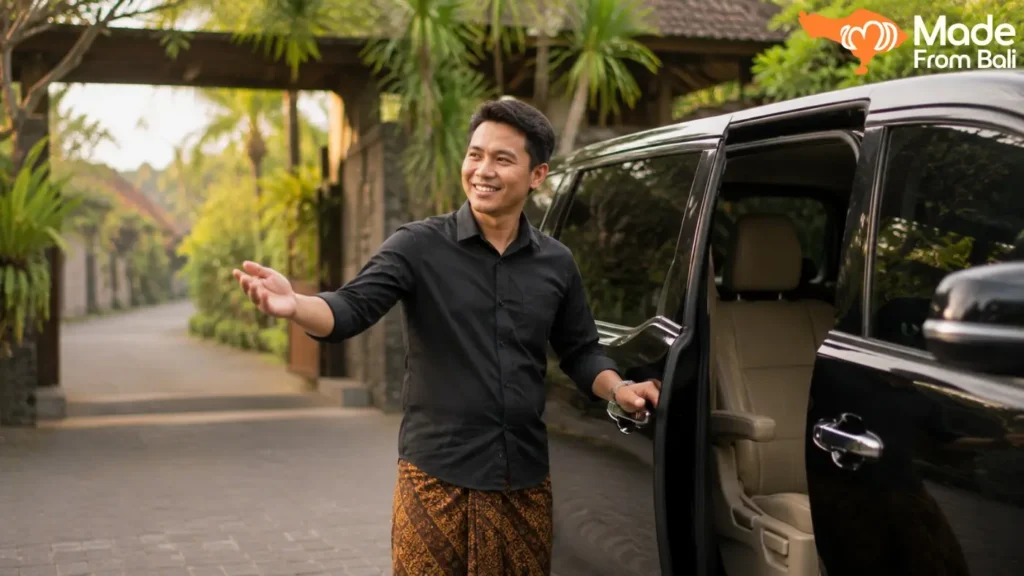
This is the model Made From Bali operates on, built around Made Tirta and a small team of drivers he works with directly rather than a rotating pool assigned by an app. The practical difference shows up on multi day trips in particular: a driver who already knows your pace, your interests, and where you are staying by day two moves faster through planning than starting from scratch with a new driver every morning. Before booking directly with any independent driver, it is worth confirming three things regardless of who you choose: a real phone number that answers before you pay anything, recent reviews you can verify outside the provider’s own website, and a clear written quote covering the specific stops you plan to make, not a vague day rate.
What A Realistic Full Day With A Driver Looks Like Hour By Hour
A lot of frustration on driver days comes down to a mismatch between what people picture and what a day actually involves once real driving time is factored in. Understanding the shape of a typical day before you plan your stops prevents the most common source of disappointment, which is simply trying to fit too much into ten hours.
How Much Of The Day Is Actually Spent Driving
A standard full day charter runs eight to ten hours, and a meaningful share of that time is driving rather than sightseeing, even on a route that looks short on a map. As a concrete example, South Bali to central Ubud typically takes sixty to ninety minutes each way depending on traffic, which on its own consumes a quarter of a ten hour day before you have visited a single attraction. Add a stop at Tegallalang rice terrace, roughly twenty minutes further from Ubud center, and another at a waterfall further into the countryside, and driving time alone can reach three to four hours out of the ten.
This is not a flaw in the service. It reflects the reality of Bali’s geography and traffic patterns, particularly around Denpasar and the Ubud approach roads during midday. A driver who tells you honestly that a plan involving four distant stops will feel rushed is giving you more useful information than one who agrees to anything you propose without comment.
Building In Buffer Time So The Day Does Not Feel Rushed
The travelers who come away happiest from a full day charter tend to plan two to three main stops rather than four or five, leaving room for traffic, a proper lunch stop, and time to actually enjoy each location rather than photographing it and moving on. A workable structure for a South Bali to Ubud day looks like this:
- Early departure, ideally by 8am, to reach Ubud before the mid morning traffic and tour bus crowds build up at the main attractions
- One cultural stop, such as a temple or the rice terrace, allowing sixty to ninety minutes rather than a rushed twenty minute photo stop
- A relaxed lunch, which also gives the driver a break and naturally resets the pace of the day
- One additional stop on the way back, chosen based on how the day is actually running rather than locked in advance
- Return with a buffer of at least an hour before any evening plans, since afternoon traffic heading back into South Bali is often heavier than the morning drive out
Sharing this kind of loose structure with your driver in advance, rather than a rigid list of six locations, gives them room to adjust for traffic and actually deliver a day that feels unhurried instead of a checklist executed under time pressure.
The Small Mistakes That Turn A Good Driver Day Into A Frustrating One
Most disappointing driver experiences trace back to one of two avoidable mistakes rather than a genuinely bad driver. Recognizing these before you plan your own itinerary is one of the more practical things this guide can offer.
Packing Too Many Far Apart Stops Into One Day
The single most common mistake is building an itinerary from a list of Bali’s most photographed spots without checking how far apart they actually are. Tanah Lot, Ubud, and Uluwatu each sit in different corners of the island, and combining all three in one day is technically possible but means spending five or more hours in the car out of a ten hour window, with each stop reduced to a rushed thirty minutes. A driver will usually warn you if you propose this, but not always, particularly if the booking was made through a platform where the driver never spoke with you before pickup day. Grouping destinations by region, South Bali one day, Ubud and its surroundings another, rather than by “must see list,” produces a far more enjoyable pace.
Assuming Every Quote Includes The Same Things
The second recurring mistake connects back to the pricing section earlier in this guide: assuming that because two quotes list the same route, they include the same things. One provider’s day rate might include fuel for the entire route regardless of extra stops, while another calculates fuel separately once you go beyond the originally agreed plan. Confirming three specific details before the day starts, rather than after, prevents almost all of the awkward on the spot cost conversations travelers report: whether parking at attractions is included, whether the price changes if you add or remove a stop, and what happens if the day runs longer than planned, since traffic delays are common and not always the driver’s fault.
Matching Vehicle, Group Size, And Tipping To Your Trip
Two practical details get surprisingly little attention in most guides despite affecting every single booking: whether the vehicle actually fits your group comfortably, and what a reasonable tip looks like given the cost structure already covered above.
What A Fair Tip Actually Looks Like In Context
Tipping is not mandatory in Bali and a driver will never demand it, but it is a meaningful part of many drivers’ income given the local cost of living, where a minimum monthly wage can sit around IDR 2,200,000 or lower. For context, a tip of IDR 50,000 to 100,000 for a solid full day (roughly USD 3 to 6) is a reasonable baseline for a standard day that went smoothly. For a day that included genuinely excellent extras, unexpected local recommendations, help carrying bags, or handling a tricky situation well, IDR 100,000 to 300,000 reflects real appreciation without being excessive. For a multi day booking, these same daily guidelines still apply rather than needing to be multiplied into one large lump sum at the end, since drivers generally appreciate being tipped as the days go rather than waiting until departure.
Choosing Between An Avanza, An Innova, And A Larger Van
Vehicle mismatches are a quieter source of disappointment than pricing confusion, but they affect comfort just as much on a long day. Most standard bookings default to a Toyota Avanza or Suzuki Ertiga, comfortable for two to four passengers with moderate luggage, but genuinely tight for four adults with full sized suitcases on an airport transfer.
| Group size | Recommended vehicle | Practical note |
|---|---|---|
| One to three people, light luggage | Avanza or Ertiga | Standard rate, most widely available |
| Three to five people, or two to three with full suitcases | Toyota Innova | Noticeably more legroom and boot space, usually a modest upgrade in price |
| Six or more people | Toyota Hiace or similar van | Required for larger groups, book in advance since fewer vehicles of this size are available |
Confirming your exact luggage count and passenger number when booking, rather than assuming a driver will adjust the vehicle on arrival, avoids the uncomfortable situation of five people and four large suitcases attempting to fit into a car built for four with carry on bags. This matters even more for airport arrivals immediately after a long flight, when the last thing anyone wants is to solve a logistics problem before even leaving the parking lot.
What Changes During Rainy Season And Peak Season
Timing affects two very different things when hiring a driver in Bali: how comfortable the day itself feels, and how far in advance you actually need to book to get the driver and vehicle you want.
How Rainy Season Affects Route Planning
Bali’s rainy season, running roughly from November through March with the heaviest rainfall typically in January and February, does not usually cancel plans outright, but it does change how a day should be structured. Mountain routes toward Munduk, Kintamani, or Sekumpul waterfall can become slower and less comfortable in heavy rain due to reduced visibility on winding roads, and outdoor stops like rice terraces or waterfalls are simply less enjoyable soaked through. A driver with real local experience will often suggest shifting an itinerary toward indoor or covered attractions during a rainy morning and saving outdoor stops for the afternoon, when short tropical downpours frequently clear. Mentioning that you are flexible on the order of stops, rather than insisting on a fixed sequence, gives your driver room to actually work around the weather instead of just driving through it.
Why July And August Availability Tightens Early
Peak season, concentrated around July and August alongside the December holiday period, brings a genuine availability problem rather than just a price increase. Well reviewed independent drivers and small family run teams often get booked out weeks in advance during these windows, since returning clients and referrals fill their calendars before new inquiries even arrive. Booking a private driver for peak season travel at least two to three weeks ahead, rather than expecting to arrange something after arrival, is the difference between securing a driver you have actually vetted and settling for whoever happens to be free on short notice.
What Changes When The Same Driver Stays With You For Your Whole Trip
Everything covered so far, pricing, booking channels, realistic pacing, vehicle sizing, comes together most clearly on a multi day trip, where the decision to book a single driver for the entire stay rather than arranging transport day by day starts to pay off in ways that are hard to appreciate until you experience it.
A driver who has already spent one or two days with you learns your pace without needing to be told. They start suggesting a slightly later start on a day when the previous evening ran long, or a shorter drive when they notice you are more interested in slowing down than covering ground. This kind of adjustment simply does not happen with a rotating pool of drivers assigned fresh each morning, no matter how professional each individual driver is. It comes from continuity, not from any single driver being more skilled than another.
Negotiating a multi day rate directly, rather than booking single days repeatedly, also tends to work in your favor financially, since most independent drivers and small teams offer a modest discount for guaranteed multi day work compared to the uncertainty of one off bookings. For a trip of four days or longer covering multiple regions of Bali, this combination, one driver, one negotiated rate, and a day by day plan that adjusts as you go, is generally the version of hiring a private driver that produces the fewest surprises and the most genuinely relaxed trip.