

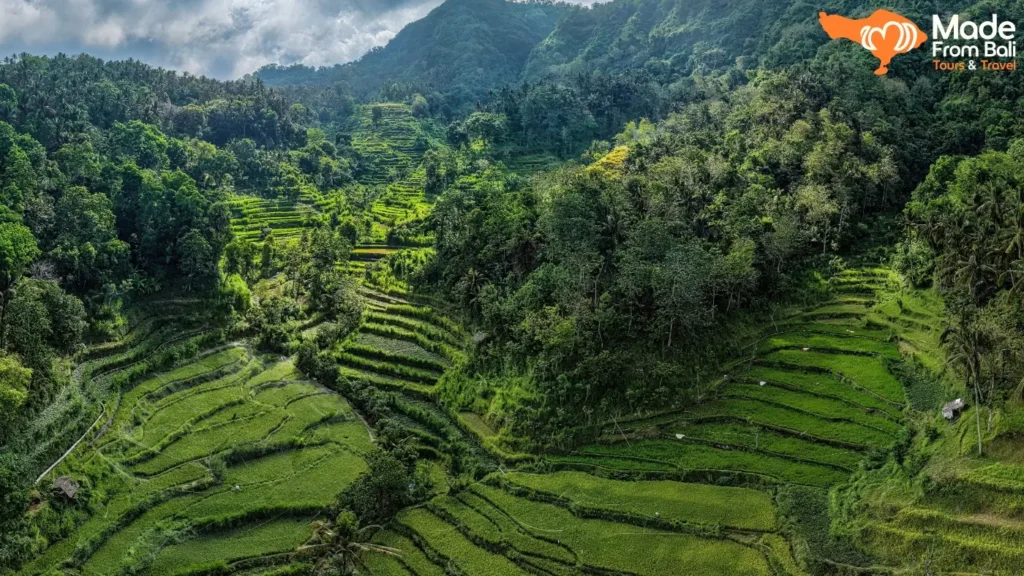
If you have already searched for Tegalalang Rice Terrace, you have probably noticed something strange. One page says the entrance is free. Another says it is 15,000 IDR. A third insists it is 25,000 IDR, cash only. None of them are lying to you, and that is exactly the problem worth understanding before you go.
This inconsistency is not a mistake in reporting. It is a direct result of how the valley is actually managed, and once you understand that structure, every confusing detail about Tegalalang starts to make sense: why you might pay four times in one morning, why two friends who visited a week apart got completely different quotes, and why some travelers leave feeling mildly scammed while others barely notice the cost at all. Skip this part of the planning and you risk showing up with the wrong expectations, the wrong cash, or the wrong entrance for what you actually wanted to see. Understand it first, and the whole visit becomes far more straightforward.
The Reason Tegalalang Rice Terrace Has No Single Entrance Fee
Most travelers assume a famous attraction like this operates like a national park, with one gate, one ticket price, and one authority setting the rules. Tegalalang doesn’t work that way, and knowing this before you arrive changes how you budget for the morning and how you react when you’re asked to pay again ten minutes after your last payment.
How the Valley Is Actually Divided Between Farming Families
The rice terraces along Jalan Raya Tegallalang sit on land that has been farmed by different family groups for generations, long before tourism existed here at all. As visitor numbers grew, landowners near the road began independently building their own paths down into the valley, along with parking areas, viewing platforms, cafes, and eventually swing installations. Each of these developed separately, on separate plots, under separate ownership.
There is no single ticket counter for Tegalalang and no central body setting one official price. Instead, you’ll find several small booths run by different local landowners at different entry points along the same stretch of road, each charging its own admission and each collecting its own donations from farmers whose fields you cross further inside. That is the entire explanation for why every blog post you’ve read quotes a different number. They likely entered through a different gate, on a different day, and simply reported what they were charged at that specific spot.
What This Means for Your Wallet on the Day
In practical terms, expect to pay small amounts more than once rather than one clean fee at a single gate. Here’s a realistic breakdown of what a typical visit costs, combining fees reported across multiple current entrances:
| Fee type | Typical range | Notes |
|---|---|---|
| Main entrance (per person) | 15,000 to 25,000 IDR | Varies by which entry point you use |
| Farmer donation posts along the path | 10,000 to 20,000 IDR each | Optional but customary, may occur more than once |
| Car parking | 5,000 to 15,000 IDR | Some entrances include this, others don’t |
| Scooter parking | 2,000 to 10,000 IDR | Same variation as car parking |
| Photo spot access | 10,000 to 50,000 IDR | Only at specific staged viewpoints, entirely optional |
A realistic total for a straightforward visit, without a swing, usually lands somewhere between 40,000 and 80,000 IDR per person once parking and one or two donation posts are included. It’s worth carrying that amount in small rupiah notes, since none of these booths take cards, and breaking a large bill at a donation post rarely goes smoothly.
What You’re Actually Looking At When You See Tegalalang Online
Almost every photo you’ve seen of Tegalalang was taken from one specific angle, at one specific part of one specific section of this valley. That’s worth knowing before you arrive, because the wider reality on the ground is a working agricultural landscape, not a single curated viewpoint, and it doesn’t always match the picture in your head.
The Subak System Behind Those Green Steps
The terraces exist because of subak, a cooperative water management system Balinese farmers have used to irrigate rice fields for over a thousand years. Water is channeled from volcanic sources through a shared network of canals and bamboo pipes, distributed across the stepped fields according to agreements between farmer groups rather than by any single landowner controlling the flow. Subak’s introduction is traditionally credited to the sage Rsi Markandeya around the 8th or 9th century, and it operates as more than an irrigation method. It’s tied to Tri Hita Karana, a Balinese philosophy centered on maintaining balance between the spiritual world, human relationships, and the natural environment. In 2012, UNESCO recognized this system as a World Heritage cultural landscape, covering several rice terrace regions across Bali including Tegalalang, in acknowledgment of how deeply the farming method is woven into Balinese cultural and religious life rather than treated as agriculture alone.
Understanding this matters practically, not just academically. It’s the reason the fields are actively farmed rather than maintained as a static tourist backdrop, which explains the next thing that surprises a lot of first time visitors.
Why the Fields Don’t Always Look as Green as the Photos
Rice terraces follow a planting and harvest cycle, and the valley looks noticeably different depending on where that cycle stands when you visit. The fields are at their most vivid and photogenic shortly before harvest, typically around March through April and again in September through October. If you visit during or shortly after harvesting season, usually around June and July, you’ll find sections that look brown, stubbled, or freshly cut rather than the lush green you saw online.
Neither state is wrong. It’s simply a working farm, not a manicured park maintained for photography. If travel dates are flexible and the visual impact matters to you, planning around those greener months will noticeably change what you see. If your dates are fixed, it’s worth adjusting expectations rather than assuming something has gone wrong when the fields look different from the images that convinced you to visit.
Choosing Your Entrance Changes the Whole Visit
Because Tegalalang has multiple independent access points rather than one gate, the entrance you choose actually shapes the entire experience, not just the price. Someone who wants a specific swing photo and someone who wants a quiet walk through working fields should not be using the same entrance, even though both will technically say they “visited Tegalalang.”
| Entrance type | What you get | Typical cost | Best suited for |
|---|---|---|---|
| Photo and swing focused entrances | Staged viewpoints, nests, and swing platforms close to the main road | 50,000 to 300,000+ IDR depending on activities added | Visitors specifically chasing swing or nest photos |
| Farmer path entrances | Narrow trails through active rice paddies, fewer facilities | 15,000 to 25,000 IDR plus donation posts | Visitors who want to actually walk the terraces, not just photograph them from above |
| Uma Ceking restaurant and view entrance | Structured package combining a terrace hike, dining, and optional swing | From around 50,000 IDR for entrance and hike | Visitors who want food, coffee, and a view without deep hiking |
Entrances Built Around Photos and Swings
These are usually the entrances closest to the main road, and they’re built specifically around Instagram style moments: bird’s nest platforms, rope swings suspended over the valley edge, and framed lookout points. They also tend to be the busiest and the most expensive of the three types, since the price usually bundles the base entrance with access to one or more of these installations. If a specific swing photo is the actual goal of your visit, this is the right entrance to pick, but it’s worth knowing you’re paying for staged infrastructure rather than for access to more of the terrace itself.
Entrances Built for Quiet Walking Through Working Fields
Further along the road, away from the busiest swing operators, you’ll find simpler entry points that lead directly into the working paddies used by local farmers. These paths are narrower, less developed, and usually cheaper, often just the base entrance fee plus a donation or two as you pass through different farming sections. Areas further north along the valley, sometimes referred to locally as the Abian Desa side, tend to stay noticeably quieter than the entrances directly off the main road, since most day tour groups don’t walk that far. If what actually drew you to Tegalalang was the idea of walking among real rice paddies rather than posing on a platform, this is the entrance style worth seeking out.
The Uma Ceking Restaurant View Option
Uma Ceking and similar restaurant style entrances package the experience differently. A typical structure includes entrance plus a terrace hike for around 50,000 IDR, with add on options like a single swing bundled with entrance for around 200,000 IDR, or a full swing package closer to 300,000 IDR. The appeal here is convenience: you get a clear view over the valley from a seated dining area, a defined hiking trail if you want to walk further, and a fixed, predictable price instead of the layered small fees you’d encounter wandering between independent farmer paths. This suits visitors who want the view and a coffee or meal without spending an hour navigating multiple donation points.
What Sunrise, Midday, and Late Afternoon Each Actually Feel Like Here
Timing changes this visit more than almost anything else on this list, and it’s not just about lighting for photos. Crowd density, heat, and even how many payment points are staffed all shift dramatically depending on when you arrive.
| Time window | Crowd level | Conditions | Best for |
|---|---|---|---|
| 6:00 to 9:00 AM | Low | Cool air, soft light, occasional mist | Photographers, anyone sensitive to heat or crowds |
| 10:00 AM to 3:00 PM | High | Hot, humid, tour buses present | Visitors on a fixed group tour schedule |
| 3:30 to 5:30 PM | Moderate, thinning | Cooler again, golden light | Visitors who aren’t early risers but still want fewer crowds |
Why the 7 to 9 AM Window Keeps Coming Up in Local Advice
This window shows up consistently in local recommendations for a simple, practical reason: tour buses from South Bali and other parts of Ubud typically don’t start arriving until after 10 AM, so anyone on-site before then genuinely has more space to walk, photograph, and simply take in the valley without navigating around groups. Temperatures are also noticeably lower in the early morning, which matters more than it sounds once you’re climbing narrow stone steps in Bali’s daytime humidity.
One detail worth knowing: arriving right at sunrise, before staff have opened the ticket booths, means some visitors technically enter without paying at that particular gate. It’s not something anyone will stop you from doing, but it’s worth treating the fee as something you pay once things open rather than something to actively avoid, since that small admission is a meaningful part of how local farmers maintain these fields.
What Happens to the Valley Once the Tour Buses Arrive
By late morning, the character of the place shifts noticeably. Popular swing platforms develop short queues, narrow viewing areas get crowded enough that clean photos take patience, and the heat becomes a real factor if you’re planning to walk any distance into the valley. None of this makes a midday visit a mistake, especially if you’re on a set group tour itinerary with no control over timing, but it’s worth adjusting your expectations. You’ll still see the terraces clearly. You just won’t get the quiet, uncluttered version that early morning visitors describe.
The Late Afternoon Window Most Visitors Overlook
Most planning advice focuses entirely on sunrise, which means the late afternoon window between roughly 3:30 and 5:30 PM gets far less attention than it deserves. By this point, the day’s tour groups have largely moved on, temperatures start dropping again, and the light takes on a warmer, more golden quality that works well for photography. If getting up before dawn genuinely isn’t realistic for your trip, this window is a solid second choice, offering a meaningfully quieter experience than the midday peak without requiring an early alarm.
Getting There From Ubud Without Losing Half the Morning
Tegalalang sits roughly 9 to 10 kilometers north of central Ubud, along Jalan Raya Tegallalang, which usually translates to a 20 to 30 minute drive depending on traffic and exactly where in Ubud you’re starting from. Given how much timing matters here, how you get there is worth planning as carefully as when you go.
Scooter, Ride App, or Private Driver for This Specific Drive
- Scooter: Offers the most flexibility for an early departure, since you’re not waiting on anyone else’s schedule. It requires confidence riding on Bali roads, which can be narrow and shared with trucks near Tegalalang, and it means managing your own parking and cash at each stop without help.
- Ride app (Grab or Gojek): Usually the cheapest option for a one way trip from Ubud, and reliable enough for getting there. The complication shows up on the way back, which the next section covers in detail.
- Private driver: Costs more than the other two options, but removes the two biggest friction points of this specific trip: getting an early start without worrying about return transport, and having someone who already knows which entrance suits what you actually want to see, rather than guessing based on wherever a map pin happens to drop you.
Why Ride Apps Get Unreliable Once You’re Near the Terraces
Internet connectivity around Tegalalang is noticeably weaker than in central Ubud, and this creates a specific problem that rarely gets mentioned in general travel advice: booking a Grab or Gojek from deep inside the valley for your return trip can be unpredictable, sometimes requiring you to walk back toward the main road before a driver can even see your request. This isn’t a major issue if you’re only visiting the entrances closest to the road, but if you’ve walked further into the quieter farmer paths, factor in extra time, or extra walking, to get a signal strong enough for a ride app to work again.
What Walking Through the Terraces Is Really Like
Photos of Tegalalang are almost always taken from a fixed viewpoint looking across the valley, which means they don’t show what it actually feels like to walk down into it. That gap between the photo and the physical experience catches a fair number of visitors off guard.
The Parts That Look Easier in Photos Than They Are
The pathways into the terraces are narrow, often just carved dirt or stone footholds running along the edges of the paddies, and they involve real elevation change as you move between levels of the valley. Steps can be uneven and, particularly during rainy season, genuinely slippery with mud. None of this is dangerous for a reasonably mobile adult moving carefully, but it’s a meaningfully different physical experience than a flat, paved viewpoint, and it’s worth knowing that in advance if you’re traveling with young children, older relatives, or anyone with mobility concerns.
What to Wear and Carry If You’re Walking the Full Valley
- Footwear: Closed, sturdy shoes with real grip. Flip flops or sandals make the steeper, muddier sections genuinely difficult and increase the chance of slipping.
- Water: The valley floor traps heat and humidity, and shade is limited once you’re away from the road.
- Sun protection: A hat and sunscreen matter even on overcast days, since Bali’s midday sun is intense regardless of cloud cover.
- Small cash: Multiple entrances and donation posts mean you’ll need small rupiah notes on hand rather than one large bill.
- A layer for rainy season: Paths get slick fast once rain starts, and shelter inside the valley is limited.
The Swings and Photo Platforms Are a Separate Decision From the Terrace Itself
It’s easy to assume the swings are part of visiting Tegalalang, but they’re actually a separate add on, run by separate operators, with separate pricing. Treating that as its own decision, rather than something automatically included, will save both money and time.
What a Swing Ticket Actually Includes
| Package | Typical price | What’s usually included |
|---|---|---|
| Uma Ceking single swing plus entrance | Around 200,000 IDR | One swing ride plus valley entrance and hike |
| Uma Ceking full swing package | Around 300,000 IDR | Multiple swing and nest experiences plus entrance |
| Independent swing operators (such as Aloha Ubud or Zen Hideaway) | 300,000 to 600,000 IDR | Varies by operator, often includes staff photography |
Prices vary meaningfully between operators, and most packages include some form of staff assisted photography, since taking a genuinely good swing photo alone is difficult. If a specific swing photo is a priority for your trip, it’s worth deciding on that in advance rather than comparing prices on the spot, since the busiest operators near the road tend to sit at the higher end of this range.
Seeing the Full View Without Paying for a Swing
The classic, widely shared view of Tegalalang, the sweeping shot across the layered valley, doesn’t actually require a swing at all. That view is visible from several cafes and viewpoints along the road itself, often for the cost of a coffee or a basic entrance fee. Swings add a specific elevated angle and a particular kind of photo, but they’re not the only way, or even the primary way, to see the terraces. Travelers on a tighter budget can skip them entirely and still leave with a full sense of the place.
Tegalalang or Jatiluwih When You Only Have Time for One
Tegalalang isn’t the only UNESCO recognized rice terrace in Bali, and if your schedule only allows for one, it’s worth understanding what you’re actually choosing between rather than picking based on name recognition alone.
| Factor | Tegalalang | Jatiluwih |
|---|---|---|
| Distance from Ubud | 20 to 30 minutes | Roughly 2 hours |
| Crowd level | High, especially midmorning | Low to moderate |
| Tourist infrastructure | Swings, cafes, photo platforms | Minimal, mostly open fields |
| Scenery style | Compact, dramatic, jungle backed | Expansive, open, spread across kilometers |
| Best for | Convenience, activities, shorter time windows | Space, quiet, a more working landscape feel |
What You Trade for Convenience
Tegalalang wins on accessibility. It’s close to Ubud, easy to combine with other stops in a single day, and comes with built in activities like swings and cafes if you want more than just a view. The tradeoff is crowding and a more commercial atmosphere, particularly once tour buses arrive.
What You Trade for Space and Quiet
Jatiluwih offers a genuinely different experience: wider, more open terraces with far fewer people and none of the swing and photo platform infrastructure. The tradeoff is time. A visit there realistically consumes most of a day once travel time is factored in, and there’s less to actively do beyond walking and taking in the scenery. If your trip has a spare full day and you want a quieter, more expansive version of this landscape, it’s worth the drive. If you’re working with limited time, Tegalalang remains the more practical choice.
Who This Stop Naturally Fits Into a Bali Itinerary
Not every version of this visit suits every traveler, and being honest about that upfront leads to a better morning than assuming one standard itinerary works for everyone.
Families With Young Kids or Limited Mobility
The restaurant and view style entrances, like Uma Ceking, tend to work better for this group than the deeper farmer path entrances. You get a clear valley view from a stable, seated area without navigating narrow, potentially muddy steps, and food is available on site if timing gets tight around meals or naps. If a short walk still appeals, sticking to the entrance closest to the road avoids the steeper drops further into the valley.
Photographers and Early Risers
The sunrise window, combined with one of the quieter farmer path entrances rather than the busiest swing focused ones, gives the most control over composition and light. Fewer people in frame means less waiting for a clear shot, and the softer early light tends to photograph better than the flatter, harsher light of midday.
Travelers Combining It With Other Ubud Stops in One Day
Tegalalang pairs naturally with other Ubud area highlights in a single day, commonly Tirta Empul temple, Tegenungan Waterfall, and the Ubud Palace or Art Market area. The order matters more than most people plan for. Visiting Tegalalang first, while it’s still cool and before the 10 AM bus window, and then moving on to temples or waterfalls later in the morning tends to produce a noticeably smoother day than the reverse. This is one of the more practical reasons travelers choose a private driver over self driving for this particular route: a driver who regularly runs this loop already knows how to sequence stops around Tegalalang’s crowd pattern, rather than figuring it out through trial and error on the day.
Fitting Tegalalang Into a Day That Still Feels Relaxed
Once you understand that Tegalalang isn’t one attraction with one price, but a valley shared by several independent entrances, the confusing parts of planning this visit mostly disappear. The fee you’re quoted depends on where you enter. The crowd you encounter depends on when you arrive. The physical experience depends on which path you choose, and whether you’re there for a swing photo, a quiet walk, or a relaxed view with coffee in hand.
None of this needs to be complicated on the day itself. Arrive early if photography or quiet matters to you, choose the entrance that matches what you actually came for, carry small cash, and wear shoes you don’t mind getting a little muddy. Whether you’re driving yourself or being guided through it as part of a larger Ubud day, the terraces reward a bit of upfront understanding far more than they reward simply showing up and hoping the first gate you find is the right one.