

Book a Bali cooking class from a photo and you’ll usually get one of two things. Either a small, slightly chaotic kitchen where someone’s grandmother corrects your grip on the mortar, or a large, air conditioned hall where twenty people watch a chef demonstrate a dish they’ll never quite recreate themselves. Both get marketed with the same words. Both show up in the same search results. The difference only becomes obvious once you’re standing in one of them, and by then it’s too late to change your afternoon.
That gap between what’s advertised and what’s delivered is the actual problem most travelers are trying to solve when they search for this. Cost matters, but it’s rarely the deciding factor. What people actually want to know is whether they’ll end up somewhere hands on and personal, or somewhere that feels like a group tour with a cooking theme. Get it wrong and you’ve spent half a day and forty dollars watching someone else cook.
We spend most days driving guests between exactly these kinds of experiences, so the pattern is familiar from the passenger seat as much as from the kitchen. This guide covers what actually determines that difference, what a class realistically costs and includes, and the logistics that other guides tend to skip, since getting to and from the class is where a surprising number of good mornings go sideways.
A Bali Cooking Class Rarely Looks Like What The Photos Promise
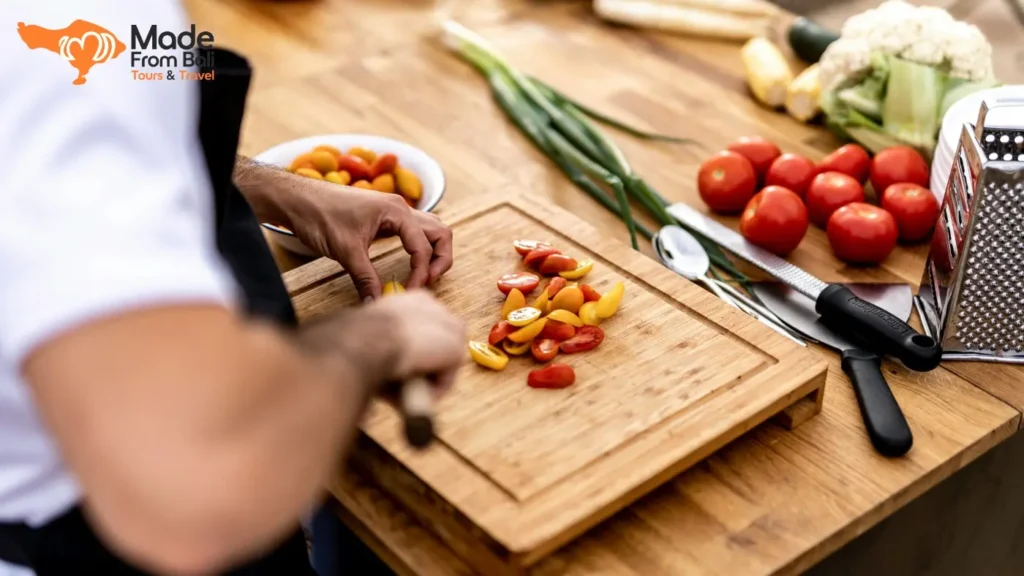
Every listing photo shows the same three things: a chef mid demonstration, a table of finished dishes, and someone smiling while grinding spices in a stone mortar. What the photo can’t show you is the format underneath it, and the format is what actually determines whether you’ll enjoy the next four to six hours.
Almost every legitimate Bali cooking class follows the same basic shape: a market visit, a cooking session, and a shared meal at the end. The details inside that shape, group size, how hands on the cooking actually is, whether the “market visit” is a real morning market or a curated stall set up for tourists, are what separate a genuinely good class from a forgettable one.
The Market Comes Before The Kitchen For A Reason
A market visit isn’t a bonus add-on tacked onto the class description to make it sound more cultural. It’s structurally part of how the day is meant to work. You walk through a working local market, usually for somewhere between 45 minutes and an hour and a half, and the chef points out ingredients most visitors have eaten without ever recognizing: galangal, kencur root, fresh turmeric, candlenuts, and palm sugar sold in discs the size of a fist.
This matters more than it sounds. Balinese cooking makes very little sense as a list of ingredients on a page. It makes sense once you’ve smelled fresh galangal next to dried galangal and understood why one goes into a curry and the other doesn’t. Skipping the market cuts out the part of the experience that actually explains the food, not just the part that photographs well.
If you’ve already done a market walk elsewhere on your trip, a class without one is still fine. But for a first cooking class in Bali, treat the market visit as close to non-negotiable. It’s usually the single detail people remember most clearly weeks later, more than any individual dish.
How Long A Full Class Actually Takes From Pickup To Drop Off
Most people underestimate this by two or three hours. A “cooking class” sounds like a two hour activity. In practice, once you include hotel pickup, the market visit, the cooking itself, the meal, and the drive back, you’re realistically committing five to seven hours from the moment you leave your hotel to the moment you return.
A typical breakdown looks like this:
- Pickup to market arrival: 30 to 60 minutes, depending on where you’re staying relative to the class
- Market visit: 45 to 90 minutes of walking, tasting, and explanation
- Cooking session: 2.5 to 3.5 hours, almost entirely hands on
- The meal: 45 to 60 minutes, usually at a shared table
- Drop off: 30 to 60 minutes back to your accommodation
That’s a genuine half day commitment, not a quick activity to slot between the beach and dinner. Evening classes without a market component run shorter, often closer to three hours total, which is worth knowing if your schedule is tight but you still want the cooking part of the experience.
Group Size Changes The Entire Feel Of The Class
This is the single biggest factor separating a “tour” from a “kitchen,” more than price, more than location, more than the specific dishes on the menu. A class with six to ten guests lets you actually ask questions, get corrected on technique, and cook every dish yourself. A class with fifteen or more tends to split into stations where you’re doing one or two steps while a chef handles the rest, because there simply isn’t time to walk everyone through every stage by hand.
Neither format is wrong exactly, but they’re different products marketed with nearly identical language. If a listing doesn’t state a maximum group size, that’s usually worth asking about directly before you book, since larger commercial operators tend to leave it vague on purpose.
What You’re Actually Paying For Changes More Than The Price Tag Suggests
Prices across Bali cooking classes range from roughly IDR 350,000 up to IDR 2,500,000 or more, and that spread isn’t random. It maps fairly closely onto three distinct formats, and understanding which one you’re paying for matters more than chasing the lowest number.
Family Kitchens, Teaching Schools, And Hotel Classes Are Three Different Experiences
| Format | Typical price (per adult) | What you’re really getting |
|---|---|---|
| Village or family run kitchen | IDR 350,000 to 650,000 (roughly $22 to $40) | Small groups of six to eight, cooking in someone’s actual home kitchen, market visit almost always included |
| Mid range teaching school | IDR 600,000 to 800,000 (roughly $37 to $50) | Purpose built kitchen, larger groups (up to 15 or so), consistent and well organized, market visit included |
| Hotel or resort class | IDR 850,000 to 1,500,000 (roughly $50 to $95) | Polished setting, professional chef, market visit often skipped in favor of pre-prepped ingredients |
| Private class (1 to 4 people) | IDR 1,200,000 to 2,500,000+ (roughly $75 to $155) | Fully customized menu and pace, often in a villa kitchen, market visit arranged on request |
The family run and mid range options tend to deliver the most hands on, memorable experience for the money. Hotel classes are convenient if you’re already staying on property and don’t want to travel, but you’re paying a premium partly for the setting rather than for a more hands on lesson. Private classes make sense mainly for groups of four or more who want full control over timing and menu, or for travelers with dietary needs complex enough to warrant a custom approach.
Where The Extra Cost Usually Goes
It’s tempting to assume the more expensive class is simply “better,” but the cost difference usually reflects overhead rather than teaching quality. Hotel classes carry the cost of hotel infrastructure, professional branding, and often a dedicated events team, none of which necessarily improves how much you actually learn. A family run kitchen charging half the price frequently gives you more individual attention, simply because the person running it has fewer guests to manage and a direct financial stake in you leaving happy.
Where the higher price genuinely earns its keep is in three areas: private classes with real menu flexibility, classes that include premium extras like a rice terrace walk or a spice garden tour, and situations where convenience (not traveling far from your hotel) has real value to you on a tight itinerary. Outside of those cases, the mid range and family run options are usually the smarter choice for someone who wants to actually cook, not just watch someone cook well.
How Far Ahead You Actually Need To Book
During Bali’s high season, roughly June through September and again around December and January, the smaller family run classes with limits of six to ten guests can fill up five to seven days ahead. Larger schools and hotel classes are more flexible and often take bookings the same day or the day before, simply because they have more capacity to fill.
If a small, intimate class is the priority, book it as early in your trip planning as possible rather than leaving it as a “we’ll sort it out once we’re there” activity. If flexibility matters more than intimacy, the larger operators will almost always have room even with short notice.
Getting To The Class Is Often The Part Nobody Plans For
This is the section most cooking class guides skip entirely, and it’s usually the part that actually determines whether the morning goes smoothly. Most classes are based in or around Ubud. Most travelers are not staying in Ubud. That mismatch creates a logistics problem that no amount of research into dish names or price comparisons solves.
Ubud Has The Classes, But Not Everyone Is Staying In Ubud
Ubud has by far the highest concentration of authentic, family run cooking classes on the island, largely because it’s been Bali’s culinary and cultural center since well before Seminyak or Canggu existed as tourist areas. If you’re staying in Ubud, this is straightforward: most classes include local pickup at no extra cost, and travel time to the venue is usually under 20 minutes.
If you’re based in South Bali, Seminyak, Canggu, or the Bukit peninsula, the calculation changes. A private transfer to an Ubud class from Seminyak realistically takes 60 to 90 minutes each way depending on traffic, which effectively turns a five hour commitment into a seven or eight hour one. Some travelers still find this worth it for the quality of Ubud’s classes. Others are better served booking one of the smaller hotel or chef-led classes that have become more common in Seminyak and Canggu, which trade some authenticity for a much shorter day.
Traffic And Rainy Season Can Quietly Reshape A Cooking Class Morning
Bali traffic doesn’t behave the way a Google Maps estimate suggests it will, especially on the Denpasar to Ubud corridor during weekday mornings, when the same road used by tourists is also carrying local commuters and delivery trucks. A trip that maps as 45 minutes can stretch to 75 or more between roughly 7:30 and 9:30 AM, which happens to be exactly when most cooking class pickups are scheduled.
Rainy season, generally November through March, adds a second layer of unpredictability. It rarely rains all day, but a heavy downpour during the market portion of a class can shorten or reroute that part of the morning, since walking a muddy, crowded market in a tropical storm isn’t something most schools attempt. Neither of these should stop you from booking a class during these windows. It just means building in a buffer rather than scheduling something immediately before or after with no margin for delay.
A few practical adjustments make this easier to manage:
- Book the earliest available pickup slot. Classes starting before 8 AM generally beat the worst of the morning traffic entirely.
- Avoid stacking a cooking class directly before a flight or a tightly timed activity. Build at least a two hour buffer either side.
- Ask about the wet weather plan when booking during rainy season. Established schools have one. Newer or smaller operators sometimes don’t.
Fitting A Cooking Class Around The Rest Of A Day
Because a full class realistically eats five to seven hours, it works best as the single main activity of the day rather than one stop among several. The pairing that tends to work well is a lower effort morning followed by the class through lunch, or the class through dinner followed by nothing more demanding than a walk or a quiet evening.
Travelers who try to combine a cooking class with a sunrise trek or a full temple circuit on the same day almost always end up cutting one of the two short. If you’re working with a private driver rather than a fixed shuttle, this is easier to manage since drop off and pickup times can flex around how the morning actually goes rather than a fixed schedule, but it’s still worth planning the day around the class rather than squeezing it into a gap.
The Spice Paste Is The Part That Actually Teaches You Something
If you remember one dish name from a Bali cooking class, it’s usually sate lilit or gado-gado. If you remember one actual skill, it should be base genep, because that’s the part that genuinely transfers to your own kitchen once you’re home.
Why Almost Every Balinese Dish Starts The Same Way
Base genep is the foundational spice paste behind most Balinese savory cooking: shallots, garlic, ginger, galangal, kencur, turmeric, chilies, candlenuts, and coriander seed, pounded by hand in a stone mortar and slow cooked until fragrant. Nearly every curry, satay marinade, and vegetable dish taught in a Bali cooking class starts from a version of this same base.
Once you understand base genep, the rest of the menu stops feeling like a list of unrelated recipes and starts feeling like variations on one technique. That’s the actual value of the class beyond the meal at the end. A good instructor will spend real time on this stage rather than rushing through it to get to the more photogenic dishes, and it’s worth paying attention here even if your arms are tired from grinding by hand, since the same paste is what makes the rest of the day’s cooking make sense.
The Dishes Most Classes Teach, And Why
Menus vary by school, but a typical half day class covers somewhere between four and eight dishes built around that same spice base. The most common lineup looks something like this:
- Sate lilit: minced chicken or fish blended with grated coconut, base genep, and lime leaf, wrapped around a lemongrass stick and grilled. Usually the most popular dish to cook simply because it’s satisfying to shape by hand.
- Gado-gado: blanched vegetables, tofu, and boiled egg with a hand pounded peanut sauce. Often the easiest dish for beginners, and one of the most realistic to recreate at home.
- Sayur urab: long beans and grated coconut tossed with base genep. A good example of how far the same spice paste stretches across very different dishes.
- Nasi kuning: turmeric and coconut milk rice, usually served as the base for everything else on the plate.
- Bubur injin: black rice pudding with palm sugar and coconut cream, almost always the dessert, and the dish most people ask to make again once they’re home.
Some schools also include lawar, a herb and coconut salad traditionally served at Balinese ceremonies, or sambal matah, a raw shallot and lemongrass condiment that takes minutes to make and adds real heat to almost anything. If either appears on the menu, it’s worth prioritizing, since both are harder to find good instruction on outside of Bali.
Balinese And Indonesian Cooking Classes Aren’t Quite The Same Thing
Listings often use “Balinese cooking class” and “Indonesian cooking class” interchangeably, but they’re not identical. A Balinese class focuses specifically on the island’s Hindu-influenced local cuisine: base genep, sate lilit, lawar, and ceremonial dishes that developed within Balinese temple and family traditions. An Indonesian class casts a wider net across the archipelago’s broader repertoire, which might include Sumatran beef rendang or Javanese soto ayam alongside local dishes.
Most schools blend both to some degree, since ingredients and techniques overlap heavily. But if a distinctly local, culturally specific experience is what you’re after rather than a general introduction to Indonesian food, look for classes that explicitly market themselves as Balinese and are run by a Balinese family, rather than a broader “Indonesian cuisine” class aimed at a wider audience.
Heat Level, Allergies, And Other Things Worth Saying Out Loud Before Booking
Two concerns come up constantly with travelers considering a cooking class, and both are more manageable than people assume going in.
Vegetarian, Vegan, And Gluten Free Requests Are Rarely A Problem
Bali handles dietary requests well, largely because plant based cooking is already deeply embedded in Balinese cuisine through dishes like gado-gado, sayur urab, and tempeh preparations that appear on temple offering tables as often as they do on tourist menus. Meat-based dishes like sate lilit or beef rendang typically swap cleanly to tofu, tempeh, or jackfruit without losing much of the dish’s character.
The one rule that actually matters here: flag dietary needs when you book, not on the morning of the class. Most schools handle this without issue given a day or two of notice, since they’re shopping for that day’s ingredients at the market anyway. Showing up unannounced with a strict allergy puts the chef in a position of improvising with whatever’s already been purchased, which rarely goes well for anyone.
Spice Level Is More Negotiable Than People Assume
A surprising number of travelers avoid booking a cooking class entirely because they assume Balinese food will be too spicy to enjoy, or too spicy for children in the group. In practice, heat level in most dishes comes from chili added at the sambal or paste stage, which means it’s almost always adjustable on request. Ask the chef to reduce or hold the chili when you’re building your own portion of the dish, and the rest of the flavor profile (the aromatics, the coconut, the citrus from lime leaf) stays fully intact.
This is worth raising early in the class rather than after tasting something too hot, simply because it’s much easier to add chili back in than to fix an already overloaded dish.
Kids, Couples, Solo Travelers, And Groups Don’t Need The Same Class
Most cooking class listings are written as if every traveler wants the same thing from the experience, when in practice the right format depends heavily on who you’re traveling with.
What Actually Changes When Children Are In The Group
Most schools welcome children from around age six, and pricing usually reflects that: roughly half price for kids between 6 and 12, and free for younger children who are present but not actively cooking. Children typically handle the safer prep work (pounding spice paste, wrapping sate lilit around lemongrass sticks, plating finished dishes) while skipping any open flame or hot oil steps.
The detail that matters more than the age policy is timing. Book the morning session rather than an evening class whenever a family is involved. Kids tend to fatigue quickly in Bali’s afternoon heat, and the concentration required for even simple prep work drops sharply once energy runs low. A morning class followed by lunch and a quiet pool afternoon works far better than an evening class competing with a tired, hungry child.
Why Solo Travelers Often Enjoy Smaller Kitchens More
Solo travelers sometimes assume a cooking class is an odd fit without a companion to share the experience with, but in practice it’s one of the easier group activities to do alone, precisely because everyone else is also focused on the cooking rather than on socializing in pairs. Smaller family run kitchens tend to suit solo travelers particularly well, since the format naturally puts you shoulder to shoulder with other guests at the same station, and conversation tends to happen organically over shared prep work rather than needing to be forced.
Couples and small friend groups generally have more flexibility in format, since a larger class doesn’t dilute the experience the way it might for someone traveling alone. For couples specifically, the shared meal at the end tends to be the highlight, since it’s one of the few activities in Bali that produces a tangible, shared result you both made together.
A Few Small Mistakes Explain Most Of The Disappointed Reviews
Negative reviews of cooking classes rarely mention bad food or unfriendly instructors. They’re almost always about mismatched expectations that could have been avoided with a bit more planning. A handful of patterns show up repeatedly.
- Booking on the first or last day of the trip. Jet lag makes it hard to absorb anything on day one, and a five to seven hour commitment on your last day competes directly with packing and rest. Day three or four of a trip tends to work best, once you’ve had enough Balinese food to recognize what you’re about to cook.
- Choosing the cheapest option without checking group size. A rock bottom price is sometimes a sign of a genuinely good family kitchen, but it’s just as often a sign of a large, bus-style class with minimal individual attention. Always check the stated maximum group size before comparing on price alone.
- Not disclosing allergies or dietary needs until arrival. Even a well run kitchen struggles to safely adapt a menu on the spot. A message sent a day or two ahead solves this completely.
- Wearing the wrong shoes or clothes for a market walk. Traditional markets have uneven, sometimes wet flooring. Closed shoes and clothes you don’t mind getting a bit messy make the experience noticeably more comfortable.
- Skipping breakfast beforehand. Market visits happen before the actual meal, sometimes three or four hours before you eat. Arriving hungry makes the early part of a long morning harder than it needs to be.
- Assuming all classes include the same etiquette expectations. Most family run classes ask that shoes come off before entering the kitchen, and a respectful greeting (often a simple “om suastiastu” or a nod and smile if you’re unsure of the phrase) goes a long way with a host who’s welcoming you into an actual home rather than a commercial venue. It’s a small thing, but it’s noticed and appreciated.
None of these are complicated to avoid. They’re just easy to overlook when you’re comparing listings from a screen rather than thinking through what the actual morning will involve.
What Usually Happens After The Class Ends
Most schools send a recipe PDF within a day or two of the class, and the honest answer to “will you actually cook these again at home” is: partially, and it depends on the dish. Base genep itself is realistic to recreate almost anywhere with a reasonably stocked Asian grocery, since galangal, kencur, and candlenuts are increasingly available outside Indonesia. Dishes built directly on that paste, like sate lilit or sayur urab, tend to make the transition home successfully.
Where it gets harder is with more specific ingredients. Fresh salam leaf and genuine Balinese palm sugar are difficult to source outside the region, which means dishes leaning heavily on those specific flavors are harder to reproduce with full accuracy. Most travelers who’ve taken a class report cooking two or three of the dishes regularly once home, usually the simpler ones, rather than attempting the full menu from memory.
For food-focused travelers wanting more than one class, doing a second one in a different part of the island, say one in Ubud and a smaller village class somewhere further east, gives a genuinely different result rather than a repeat of the same lesson. Ubud’s classes tend toward the more refined, ceremonial end of Balinese cooking. Village kitchens further from the main tourist circuit often lean more rustic and vegetable forward, shaped by whatever’s growing nearby that week rather than a fixed tourist menu.
Making A Cooking Class Part Of A Bali Trip That Actually Flows
The single biggest driver of whether a Bali cooking class ends up being a trip highlight or a forgettable half day isn’t the dishes on the menu. It’s whether the logistics around it were planned with the same care as the class itself: the right group size for what you actually want, a pickup time that accounts for real traffic rather than an optimistic map estimate, and a day built around the class instead of squeezed in beside it.
That’s the part we spend most of our time thinking about as a local driving team, since we’re usually the ones coordinating the pickup window, watching the traffic pattern change through the morning, and adjusting the return trip so it doesn’t collide with whatever comes next on someone’s itinerary. If a cooking class is going into your Bali plans, it’s worth treating the getting there and back with the same attention as picking which school to book. Pair it with a slower morning beforehand or a quiet afternoon after, rather than another activity requiring energy you’ll have already spent pounding spice paste by hand, and it tends to become one of the parts of the trip people bring up again months later.