


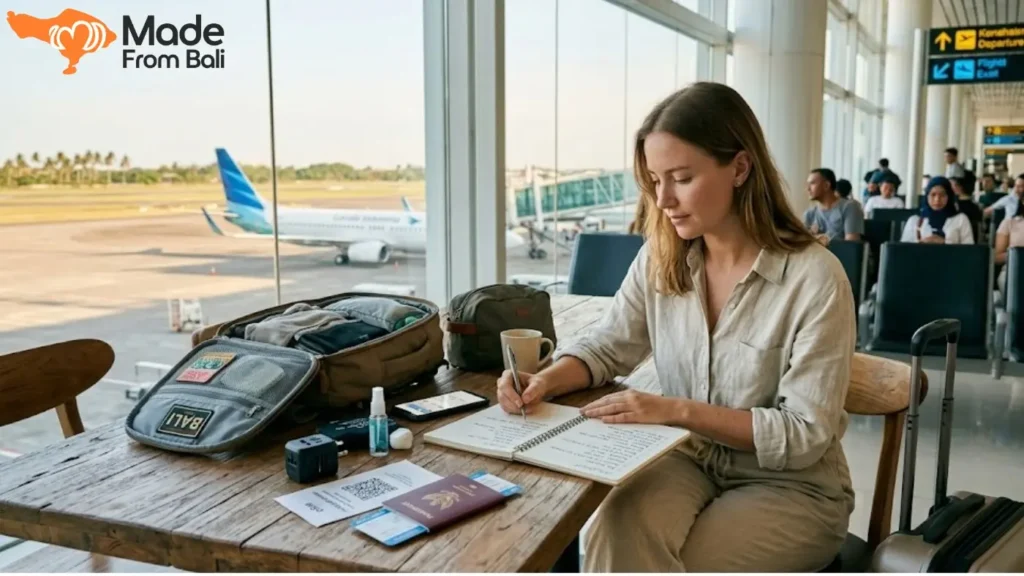
Booking the flight is the easy part. What trips people up is everything between “ticket confirmed” and “stepping off the plane in Denpasar.” Indonesia’s entry rules have changed more in the last two years than in the previous ten, and a lot of travelers still arrive working from outdated information they found in a Facebook group or an old blog post.
The risk isn’t dramatic. Nobody gets stuck in Bali forever because they forgot a form. But a missing document, an unpaid levy, or a passport with too little validity left can turn your first two hours on the island into a stressful scramble instead of the relaxed start you were picturing. Airlines have refused boarding over passport validity. Immigration counters slow down for travelers who show up without their paperwork sorted. None of this is rare.
This checklist is built around a timeline, not a random list of bullet points, because that’s closer to how people actually prepare for a trip. You’ll see what to handle while you still have reliable wifi, what to leave until the last 24 hours, and what to expect the moment you land. By the end, you’ll know exactly what’s required, what’s optional, and what to do if something doesn’t go to plan.
Most Delays at Bali Arrival Happen Before You Even Land
Almost every delay travelers run into at Bali’s airport traces back to something that should have been sorted at home, not at the counter. Immigration officers aren’t slow because the system is broken. They’re slow because a noticeable percentage of arriving passengers are filling out forms for the first time while standing in line, or discovering at the desk that they’re missing something they didn’t know they needed.
The good news is that almost everything required can be finished from your phone or laptop before you leave home, and doing it early removes most of the stress that builds up on travel day itself.
The Three Things Worth Finishing While You Still Have Wifi
Three pieces of paperwork make up nearly all of Bali’s current entry process, and all three can be completed before you fly.
- Your visa (e-VOA or VOA). Most nationalities use the Visa on Arrival, which costs IDR 500,000 (around USD 35) whether you apply online in advance or pay at the airport counter. Applying online turns this into the e-VOA, which lets you skip the visa queue and use the automated gates instead.
- The All Indonesia Arrival Form. This single digital form has replaced the old separate customs and health declarations. It needs to be submitted within three days of your arrival date, not earlier, and not later.
- The Bali Tourism Levy. A separate IDR 150,000 fee (about USD 10) that funds environmental and cultural preservation projects across the island. This is not part of your visa cost. It’s a different system entirely, paid through the official Love Bali platform.
Treat these as three separate tasks rather than one combined “Bali paperwork” chore. They use different websites, different timing windows, and different QR codes, and mixing them up is one of the most common sources of confusion on arrival day.
Why Filling This Out Too Early Can Backfire
There’s a real temptation to get everything done the moment you book your flight, weeks or months out. With the Arrival Form, that backfires. It has a strict three day window before your arrival date, and submitting it too early simply means you’ll need to do it again closer to your travel date because the system won’t accept a submission that falls outside that window.
The visa and the tourism levy don’t have this restriction in the same way, so they’re safe to sort out earlier. A practical approach is to treat the visa and levy as “anytime before you fly” tasks, and treat the Arrival Form specifically as a “three days before landing” task. Set a phone reminder for that window rather than trying to remember it manually, since most people who get this wrong simply forget the timing rather than the requirement itself.
Passport Rules in Bali Leave Very Little Room for Error
Of everything on this list, passport validity is the one rule with genuinely zero flexibility. Indonesian immigration enforces the six month rule strictly, and airlines are required to check it before you’re even allowed to board your flight. This isn’t a Bali specific quirk either. Most Southeast Asian countries follow a similar standard, but Indonesia is known for applying it without exceptions.
What Six Months Validity Actually Means in Practice
The rule is straightforward on paper: your passport must be valid for at least six months from your date of arrival in Indonesia. In practice, the confusion usually comes from people counting from the wrong date.
If you’re flying to Bali on the 10th of a given month, your passport needs to remain valid until at least the 10th of the month six months later, counted from your arrival date, not your departure date from home and not your return date. Travelers occasionally miscalculate this when their passport is due to expire in exactly five and a half months, assuming “close enough” will work. It won’t. Airline check in staff use this calculation specifically to decide whether to let you board, and they have no discretion to make exceptions even if your actual stay in Bali would be well within the six month window.
If your passport is anywhere close to this line, renewing it before you fly removes the risk entirely. A passport with eight or nine months of remaining validity gives you a comfortable buffer with no real downside.
A Worn or Damaged Passport Can Still Get You Pulled Aside
Validity dates get most of the attention, but physical condition matters too. Indonesian immigration officers can flag a passport that’s visibly damaged, water stained, or has pages that are hard to read, even if the expiry date is fine. This is less commonly mentioned in checklists, but it does happen, particularly with passports that have been through a few years of heavy travel.
If your passport has seen rough handling, check that the photo page is still clearly legible and that there’s no significant damage to the cover or spine. This is a five minute check that costs nothing and avoids a conversation at the immigration counter that nobody wants to have after a long flight.
Visa on Arrival or e-VOA, the Choice Changes Your Airport Experience
The cost is identical either way: IDR 500,000, paid in person at the airport or online in advance. What changes is how you spend your first thirty minutes in Bali, and for some travelers that difference matters more than the price.
| Factor | Visa on Arrival (at airport) | e-VOA (applied online) |
|---|---|---|
| Cost | IDR 500,000 | IDR 500,000 plus a small processing fee |
| Where you pay | Counter at the airport | Online, before departure |
| Payment method | Cash or card, card machines can be unreliable during busy periods | Card only, done in advance |
| Airport process | Stand in the VOA queue, then immigration queue | Use the automated e-gates, no VOA queue |
| Best suited for | Travelers who decide late or prefer paying on the spot | Travelers on busy flight schedules or arriving late at night |
When the Online Application Actually Saves You Time
The time saving from an e-VOA isn’t really about the application itself. It’s about which line you stand in once you land. Travelers with an approved e-VOA can usually go straight to the automated gates, bypassing the visa counter queue entirely and moving directly into the immigration line. On a quiet afternoon flight this might save you ten minutes. On a flight that lands at the same time as two or three other international arrivals, which happens constantly at Denpasar’s single international terminal, it can be the difference between a fifteen minute wait and well over an hour.
If you’re landing late at night, this matters even more. Some VOA counters reduce staffing during off peak hours, and there’s nothing worse than landing close to midnight only to wait behind a slow moving queue when you could already be in a car heading to your hotel.
What Happens If You Skip This and Just Wing It
Plenty of travelers still arrive without having applied for anything in advance, and this isn’t a problem in itself. You can complete the VOA process entirely at the airport, pay the fee, and go through the standard immigration line. What you need to actually plan for is having a working method of payment ready. Card machines at the counter occasionally have connectivity issues, particularly during peak arrival periods, so carrying enough cash in a widely accepted currency (Indonesian Rupiah, US Dollars, or Euros, for example) as a backup avoids being stuck at the counter if the card reader isn’t cooperating.
The Tourism Levy Trips Up More Travelers Than the Visa Does
This is the one piece of the checklist that consistently catches people off guard, mostly because it’s relatively new and easy to confuse with the visa fee. The levy is a separate IDR 150,000 charge that goes toward environmental and cultural preservation projects across Bali, and it applies to every international visitor regardless of age, including children.
Paying Early Sounds Simple Until the Website Has a Bad Day
The official process is simple in theory. Visit the Love Bali website or app, enter your details exactly as they appear on your passport, pay the fee, and receive a QR code by email. The complication is that the Love Bali platform has had stretches of instability, particularly during high traffic periods when a large volume of travelers are trying to pay at once.
A few habits make this far less stressful:
- Pay several days before you fly, not the night before. This gives you time to retry if the site is slow or unresponsive, rather than discovering a problem when you’re already packing.
- Save an offline screenshot of your QR code, not just the email. Airport wifi and mobile signal can be patchy in the arrival hall, and relying entirely on opening an email isn’t a great plan when you’ve just landed.
- Double check that your name and passport number match exactly. A small typo here can cause your QR code to fail scanning at the checkpoint, which then requires manual verification and slows you down.
What to Do If You Land Without a Levy Voucher
If you arrive without having paid, or your payment failed and you didn’t notice in time, you haven’t missed anything irreversible. There are payment counters at the airport where the levy can be paid in person, usually accepting cash or card. The catch is that these counters tend to have longer queues than the online system, especially right after a wave of international arrivals lands at the same time.
If the Love Bali site simply won’t load while you’re trying to pay in the days before your flight, don’t panic and don’t pay through a third party site claiming to offer the same service for a “convenience fee.” Stick with the official channel and try again later, or plan to pay at the airport counter as your backup. Either path gets you the same valid voucher.
Packing for Bali Matters Less Than Most Lists Suggest
Most generic packing advice for Bali treats clothing and toiletries as the main event, when in practice the climate makes packing fairly forgiving. Bali is warm and humid year round, most accommodation supplies basics like shampoo and towels, and lightweight clothing covers almost every situation you’ll encounter. The genuine friction points are narrower and more specific than a typical packing list suggests.
The Items That Actually Cause Problems at Indonesian Customs
A small number of items consistently cause delays or confusion at customs, and they’re rarely the ones travelers worry about.
- Prescription medication without documentation. Carrying medication in its original packaging and bringing a doctor’s note or prescription copy avoids questions, particularly for anything that could be mistaken for a controlled substance.
- Drones, without checking current regulations. Indonesia’s rules around drone use and import have shifted periodically, and bringing one without checking current requirements can lead to it being held at customs.
- Large amounts of undeclared cash. Carrying significant sums in cash is legal but needs to be declared above certain thresholds, and travelers sometimes overlook this entirely.
What Locals Notice Tourists Overpacking For
Ask anyone who’s spent real time around Bali’s tourist areas what visitors consistently overpack, and the same items come up. Heavy rain gear beyond a simple light poncho, since most rain showers are short and intense rather than prolonged. Excess sunscreen, when reef safe sunscreen is now widely sold in convenience stores across tourist areas, even if it costs a bit more than at home. Multiple pairs of formal shoes, when sandals and one pair of comfortable walking shoes realistically cover almost every itinerary, temples included, since most temples require covering shoulders and knees rather than specific footwear.
The pattern worth noticing is that overpacking tends to happen around things that feel important in theory but rarely matter in practice, while the genuinely important items (documents, medication, a basic understanding of what customs cares about) get far less attention than they deserve.
The First Two Hours After Landing Decide How Your Trip Starts
This is the part almost no checklist actually walks you through, and it’s where a well prepared traveler and an unprepared one have visibly different experiences. Denpasar’s international terminal handles a high volume of arrivals, often with several wide body flights landing close together, and the arrival hall reflects that.
Why the Arrival Hall Feels Chaotic Even When You’re Prepared
Even travelers who’ve done every step correctly often describe their first ten minutes off the plane as overwhelming. You’re moving through immigration, then baggage claim, then a levy checkpoint, then customs, then out into an arrival hall full of drivers holding signs, families reuniting, and people trying to find their transport in a space that’s louder and more crowded than they expected.
None of this means something has gone wrong. It’s simply the normal rhythm of a busy international arrivals area, and knowing that in advance takes a surprising amount of pressure off. The travelers who find this most stressful are usually the ones who expected a quiet, orderly process and weren’t mentally prepared for the noise and crowd density.
Taxi Queue, Ride App, or Pre-Arranged Pickup, the Real Tradeoffs
How you get from the terminal to your hotel shapes your entire first impression of Bali, and the three common options genuinely differ in ways worth understanding before you land.
| Option | What it’s actually like | Best for |
|---|---|---|
| Official airport taxi queue | Regulated and safe, but queues can be long during peak arrival times, and pricing is fixed but not always the cheapest | Travelers with flexible timing and no strong preference on cost |
| Ride hailing apps (Grab, Gojek) | Often cheaper, but pickup zones at the airport are a separate area from where you exit, requiring a short walk and clear coordination with the driver | Travelers comfortable navigating apps and walking to a designated pickup point |
| Pre-arranged private pickup | A driver waits in the arrival hall holding a sign with your name, tracks your flight for delays, and helps with luggage straight away | Travelers landing late, traveling with family, or who simply want zero decision making after a long flight |
The detail that matters most here, and the one that most checklists skip entirely, is flight delay coordination. If your flight is delayed and you’ve booked an airport taxi or are planning to use a ride hailing app, you’re managing that adjustment yourself, often with limited data or a phone that’s about to die. A pre-arranged pickup that tracks your actual flight status removes that entire problem. The driver simply adjusts and is there when you land, whether that’s on time or three hours late.
This is also where a service like Made From Bali’s airport transfer fits naturally into the picture. The value isn’t really about the ride itself, since any of the three options gets you to your hotel eventually. It’s about removing one more decision point at the exact moment you have the least mental energy to make decisions, right after a long haul flight.
Rainy Season Changes the Travel Day, Not Just the Itinerary
Most Bali content treats rainy season (roughly November through March) as something that only affects which beach days you’ll get. It actually affects your actual travel day in ways worth planning around, particularly the transition from airport to accommodation.
How Weather Delays Ripple Into Airport Pickup Plans
Rainy season in Bali brings short, intense downpours rather than constant drizzle, but those downpours can genuinely slow down traffic around the airport corridor, particularly in Kuta and South Denpasar where congestion builds quickly even in dry conditions. A heavy afternoon shower can add thirty minutes or more to what’s normally a quick transfer.
The practical implication is timing your arrival expectations loosely if you’re traveling during wet season, and not booking anything immediately after landing that depends on a tight transfer window. If you’ve pre-arranged pickup, this is one more reason it helps. A driver who already knows the roads and current conditions can choose a better route in real time, rather than you trying to figure out an unfamiliar ride hailing app while sitting in unexpected traffic.
A Simple Way to Walk Into Bali Already Feeling Ready
None of this requires obsessive planning. It comes down to three documents handled with the right timing, a passport that meets a strict but simple rule, and a realistic picture of what the first two hours on the ground actually feel like.
Get your visa sorted in whichever way suits your travel style, pay the tourism levy a few days early through the official channel, and submit your Arrival Form inside that three day window before you land. Check your passport validity properly, counting from your arrival date. Pack light, knowing the climate does most of the work for you, and keep medication and anything customs sensitive properly documented.
The last piece, getting from the plane to your first night’s accommodation, is the one part of the trip you don’t have to navigate alone. If you’d rather skip the queue calculations and let someone who tracks flights and knows the roads handle that first stretch, Made From Bali’s airport transfer service is built exactly for that moment, so your holiday actually starts the second you land, not an hour later once you’ve finally found a ride.