

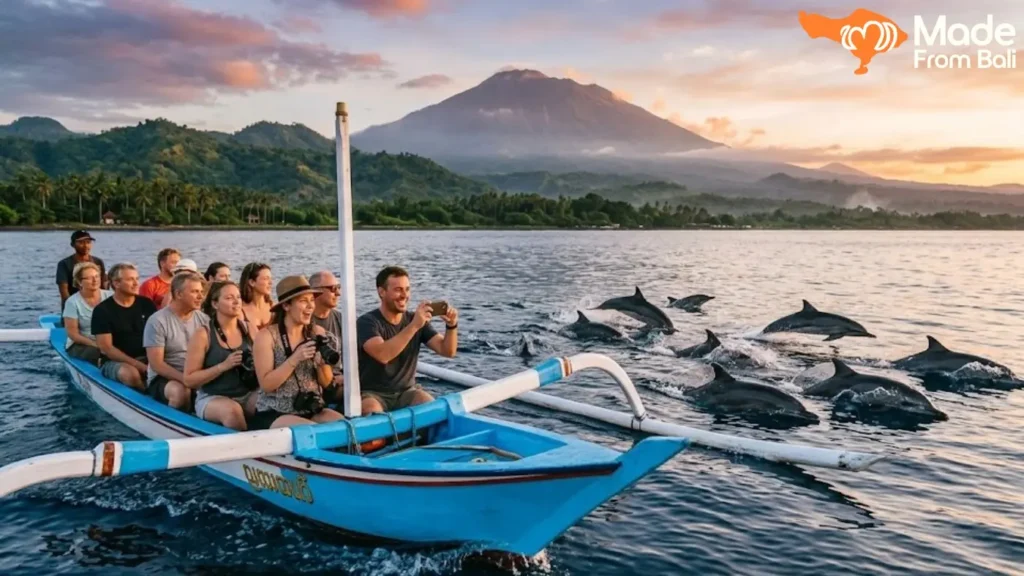
There is a version of the Bali dolphin tour that exists almost entirely in marketing photographs. In those images, a slender wooden boat glides across a glassy sea, and a pod of dolphins leaps in perfect synchrony just off the bow while the sky burns orange behind them. The image is beautiful. It is also the best possible version of what might happen on any given morning.
The real experience is more interesting than the photograph, and more honest. It involves waking before 4am, boarding a narrow traditional outrigger in the dark, sitting quietly on open water while the horizon turns pale, and watching for dorsal fins in the half-light. When dolphins appear, it is genuinely exciting. When the sea is rougher than expected, or the dolphins move in a direction the boats cannot follow, the morning is still striking just in a different way.
Most dolphin tour guides in Bali skip all of this. They describe an activity, quote a price, and send you to a booking page. What they do not do is prepare you for what you will actually experience, help you understand why the timing works the way it does, or answer the ethical questions that many travellers are quietly carrying when they search for this activity.
This guide does all of that. By the time you finish reading, you will know exactly what a Bali dolphin tour involves, how to set realistic expectations, what makes one operator meaningfully different from another, and whether this experience suits your group and your values.
Why Lovina Became Bali’s Home for Dolphin Watching
When people search for dolphin tours in Bali, they are almost always looking at Lovina, whether they know it yet or not. The activity is so strongly associated with this small coastal strip in north Bali that the two have become nearly synonymous in travel conversations. Understanding why Lovina became the centre of dolphin watching in Bali helps you understand what the experience actually involves and why it works the way it does.
The Marine Geography Behind the Sightings
Lovina sits on Bali’s north coast, facing the Bali Sea rather than the Indian Ocean. The waters here are calmer, warmer, and shallower than the surf-facing south coast, and the coastal shelf drops gradually into deeper water just offshore. This particular combination of nearshore depth profile, water temperature, and food availability creates conditions that spinner dolphins use consistently.
The dolphins do not live at Lovina in any permanent sense. They move through the area as part of their natural pattern, and the Lovina coastline happens to sit in the path of pods that travel through the Bali Sea between feeding areas. The nearshore waters in the early morning, before boat traffic and the heat of the day increase, align with the dolphins’ natural surfacing and socialising behaviour. This is why every legitimate dolphin tour departs before sunrise. It is not a tourism gimmick. It reflects the genuine behavioural window during which sightings are most probable.
Spinner Dolphins and Why Dawn Is the Only Real Window
The species consistently seen off Lovina is the spinner dolphin, known scientifically as Stenella longirostris. Spinner dolphins are named for their acrobatic spinning leaps, which they perform during socialising and resting transitions. They typically spend the night in deeper offshore water, then move toward shallower coastal areas in the early morning hours as part of their daily pattern.
By mid-morning, once the sun is fully up and surface temperatures begin to climb, the dolphins move back into deeper water to rest. This behaviour is well documented in Indo-Pacific spinner dolphin populations, and it explains with precision why dolphin tours that depart at 5:30am or later have meaningfully lower sighting frequency than those that are on the water before sunrise. The viewing window is genuinely narrow, not a fabrication designed to get tourists up early for dramatic light.
Understanding this also reframes the experience. You are not visiting an aquarium or a trained show. You are positioning yourself within the natural movement pattern of wild animals at the specific time of day when their behaviour makes sighting most probable. That framing changes how the experience feels.
How the Lovina Coastline Shapes the Experience
The stretch of coastline associated with dolphin watching runs roughly between the villages of Kalibukbuk and Anturan, the area collectively known as Lovina. The beach here is black volcanic sand, the water is typically calm in the early morning, and the horizon to the north is open sea with no major landmass interrupting it. Boats depart directly from the beach rather than from a harbour or pier, which means the transition from shore to open water is rapid.
The landscape at dawn is genuinely beautiful in a way that has nothing to do with dolphins. The sky lightens from behind the mountains to the east. The volcanic profile of the Balinese highlands is visible to the south. The water in the pre-dawn period is often still enough to reflect the emerging light. Arriving at the beach at 5am and launching in the dark is an experience worth having regardless of what the dolphins do.
How Likely Are You to Actually See Dolphins
This is the question that no booking platform will answer honestly, because the honest answer requires acknowledging uncertainty. Dolphin sightings at Lovina are common but not guaranteed. Understanding what that means in practice is more useful than false reassurance.
Honest Sighting Frequency Throughout the Year
Across the dolphin watching operations at Lovina, sighting frequency during the dry season months from April through October is high. Experienced local guides estimate sighting rates during these months at roughly 80 to 90 percent of morning departures under good conditions. During the wet season from November through March, particularly in January and February when weather patterns are most variable, sighting frequency drops, and some mornings the sea conditions make departure impractical.
These figures are not published by operators because they introduce uncertainty into a commercial booking decision. They are, however, the kind of information that helps a traveller set realistic expectations and choose the right time to go. Arriving in Lovina during May, June, or September with a flexible morning schedule gives you the best combination of calm sea conditions, high sighting probability, and a relatively uncrowded experience.
What the statistics cannot tell you is what any specific morning will produce. Wildlife operates on its own schedule, and individual variation on any given day is real. A pod of forty or fifty dolphins surfacing close to the boats, spinning and leaping in the morning light, is a sight that people describe for years afterward. A morning where the dolphins are visible only at distance, moving away from the boat area, is still a morning on the water at dawn in north Bali.
What Affects Visibility and Dolphin Presence on Any Given Morning
Several factors influence what you will encounter on a given morning, and understanding them gives you better tools for evaluating conditions before you commit to an early departure.
The primary variables are:
- Sea conditions: calm, flat water allows boats to move quietly and position near dolphin pods without disturbing them. Choppy conditions make positioning harder and create more surface noise that can cause dolphins to move away
- Wind direction: offshore wind from the south keeps the Lovina surface flat. Onshore wind from the north, more common during the wet season, creates surface chop that affects both sighting ease and boat comfort
- Moon phase: spinner dolphin behaviour shows variation across the lunar cycle, with feeding and movement patterns shifting in ways that affect nearshore presence in the early morning
- Time of departure: boats on the water before 5:30am catch the narrowest and most productive part of the viewing window. Later departures reduce the probability meaningfully
- Boat density: on peak season mornings, a large number of boats operating simultaneously can push dolphins away from concentrated areas. Operators who manage their group positioning thoughtfully tend to produce better sighting outcomes
A good guide will assess conditions the evening before your tour and communicate honestly about what the following morning looks likely to offer. If an operator does not engage with these factors at all, that is worth noting as a signal of their overall approach.
What Happens During the Tour If Dolphins Do Not Appear
This question almost never appears in competitor content, which leaves travellers poorly prepared. On mornings when the dolphins do not come close, or do not appear at all, the experience is still an early morning boat ride on open water off the Bali coast. That sentence sounds like consolation, but it is more than that.
The north coast at dawn is genuinely beautiful. The mountains behind Lovina, lit gradually as the sky lightens, produce a landscape that is worth the early morning alone. The water, the quiet, the absence of the tourist infrastructure that defines most of Bali’s mornings, all of this has value. Travellers who arrive expecting only dolphins and nothing else are the ones who feel disappointed. Travellers who arrive understanding that they are participating in early morning life on the north Bali sea, with the possibility of dolphins as the highlight, tend to find the experience rewarding regardless of specific outcomes.
Most operators do not offer refunds for low sighting mornings, and this is standard across the industry. Choosing a time of year with high sighting probability, and selecting an operator who deploys good positioning practices, is the best available mitigation.
What the Boat and the Experience Actually Look Like
Booking platforms describe the dolphin tour as a “boat ride” and leave the reader to imagine something from their prior experience. What actually awaits most first-time visitors is something quite specific to Balinese coastal culture, and understanding it in advance removes the surprise that some travellers experience at the beach.
The Jukung Outrigger and What to Expect From It
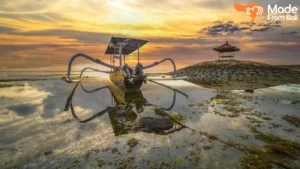
The vessel used for dolphin watching at Lovina is the jukung, a traditional Balinese outrigger canoe. The jukung is narrow and elongated, with two bamboo outrigger arms extending on each side that terminate in float runners sitting just above the waterline. This design provides lateral stability without the weight of a wider hull, which allows the boat to be launched directly from the beach through shallow surf.
A typical jukung used for dolphin tours holds two to four passengers plus the operator. The seating is low, close to the waterline, and the experience of sitting in one is considerably more intimate with the sea than a standard tourist boat would be. You feel the water movement directly. You are close enough to the surface that dolphins passing nearby are genuinely close rather than seen from an elevated deck.
The outrigger design is stable in calm conditions but noticeably reactive in swell or chop. Travellers who are sensitive to motion on water should understand this before booking a wet season departure. In dry season calm conditions, the jukung is a comfortable and surprisingly steady platform for an hour or more on the water.
The engine is a small outboard motor, typically a single cylinder, and the sound is characteristic of small working boats throughout coastal Southeast Asia. The boats are not silent, and this matters in the context of dolphin approach, which is why skilled operators cut the engine and paddle or drift when positioning near a pod.
The Full Morning From Before Dawn to After Breakfast
The complete arc of a Lovina dolphin tour day is something no booking page maps out, and the logistics matter when you are deciding how to structure the rest of your time in Bali.
- Pre-dawn assembly (4:45 to 5:15am): You arrive at the beach in the dark, usually after a short walk from your accommodation if staying in Lovina, or after a two to three hour drive from south Bali if doing the tour as a day trip. The beach at this hour is active, with multiple operators preparing their boats and passengers gathering by lamplight.
- Departure (5:00 to 5:30am): Boats launch through the small shore break and move out to the operating area, typically between one and three kilometres offshore. The early departure, before full light, is the foundation of the experience.
- On the water (5:30 to 7:00am): This is the core viewing window. Guides scan the surface for fins and breath spray, position the boat near pods when located, and manage approach distance. The atmosphere in this period is genuinely different from anything that happens later in the day in Bali.
- Return to shore (7:00 to 7:30am): Boats return to the beach as the sun is fully up. The return journey is typically faster than the outward passage.
- Post-tour breakfast (7:30 to 8:30am): Most package operators include breakfast at a local restaurant near the beach. This is usually a simple but satisfying meal served at tables with a sea view while the morning light is at its best.
- Return transfer (if applicable): For travellers based in south Bali, the return drive to Ubud or Seminyak typically takes two to three hours, placing you back at your accommodation by mid-morning.
What You Hear, Feel, and See on the Water
The sensory experience of the Lovina dolphin tour is something that travel content almost never describes, which is why travellers are consistently more moved by it than they expected. Before sunrise, the sea at Lovina carries a particular quality of quiet. The engine cuts when the guide spots fins. The boat drifts. The only sounds are water movement, distant birds along the coast, and occasionally the breath sound of dolphins surfacing nearby.
When spinner dolphins surface close to the boats, often in groups of fifteen to forty individuals, the experience is immediate and physical. You can hear them breathe. You can see the subtle colour differentiation on their flanks and the characteristic dark stripe through the eye. The spinning leaps for which the species is named, when they happen, are fast, athletic, and genuinely surprising even when you are watching for them.
The cold of the pre-dawn sea air at the boat level is another detail worth noting. North Bali mornings are warm compared to highland areas, but the sea air on open water before sunrise is consistently cooler than it appears from the shore. A light layer worn over beachwear makes the experience considerably more comfortable during the waiting period.
Is This Tour Right for Your Group
Understanding who the Lovina dolphin tour suits well, and who might find it less comfortable than expected, helps different traveller types make a more informed decision.
Families With Young Children and Motion Sensitive Travellers
The dolphin tour is a genuinely enjoyable experience for children who are comfortable with early mornings, open water, and the possibility of not seeing dramatic wildlife on any given day. Children who are adventurous, patient, and not prone to motion sickness typically love it. The low, open boat, the proximity to the water, and the excitement of scanning for fins tends to keep engaged children very present in the experience.
Children under five or six may find the early hour and the waiting period harder to manage, particularly if the first dolphin sighting is not immediate. Parents should think honestly about how their children respond to early mornings, unfamiliar environments, and extended waiting before committing.
Motion sensitivity deserves direct attention. The jukung in calm dry season conditions is stable enough for most travellers who experience mild motion sensitivity. The same boat in wet season chop or following swell is a different experience. If motion sickness on boats is a consistent issue, booking a dry season morning and taking standard motion sickness medication the evening before is a reasonable approach. Booking during variable conditions without any preparation is a risk worth understanding.
Couples, Solo Travellers, and Small Groups
The Lovina dolphin tour is consistently rated among the most memorable experiences by couples visiting Bali, and the reason is not difficult to understand. The pre-dawn departure, the quiet of the open water, the shared experience of watching for animals in the half-light, and the intimacy of the small traditional boat create conditions that most tourist activities do not. The experience is active, shared, and has genuine emotional range built into it.
Solo travellers are well accommodated at Lovina. The booking model typically pairs individual travellers with other small groups, and the beach community at this hour has a pleasant, purposeful atmosphere. Private jukung arrangements for solo travellers who want a fully independent experience are available through most operators for a modest premium.
Small groups of three to five work particularly well in the jukung format. Larger groups are split across multiple boats, which is operationally fine but means the shared experience is less unified. Groups planning to book eight or more people together should confirm in advance how the operator handles multi-boat arrangements and whether group positioning during the tour is coordinated.
Physical Comfort and Who Should Think Twice
The primary physical consideration for the Lovina dolphin tour is the seating position in the jukung. The boat sits low and the passenger seating, usually a simple plank or cushioned board, does not provide back support in the conventional sense. Extended periods of sitting in this position during the on-water phase, typically sixty to ninety minutes, can be uncomfortable for people with significant lower back issues or hip conditions that make unsupported sitting difficult.
Travellers with these considerations should ask operators about cushioning options and how long the active on-water period typically runs on their tours. Most operators are willing to accommodate comfort requests when asked in advance.
Pregnancy is a clear reason to reconsider. The motion of the jukung, the pre-dawn cold, and the unpredictability of sea conditions make the dolphin tour unsuitable for pregnant travellers at any stage.
The Ethical Side of Dolphin Tourism in Lovina
This section exists because a meaningful number of people searching for dolphin tours in Bali are not just looking for logistics. They are trying to decide whether this is something they can feel good about doing, and they are not finding useful answers in the content currently available. Addressing this directly and honestly is both the right thing to do and what this type of traveller genuinely needs.
Why This Question Matters
Lovina’s dolphin tourism has attracted criticism from marine conservation organisations over the years, primarily around the behaviour of some operators in how they approach dolphin pods. Aggressive chasing, encircling pods with multiple boats, and following retreating dolphins are practices that research suggests can elevate dolphin stress responses, interrupt natural feeding and resting cycles, and in chronic form affect the health of pod members. These practices exist in Lovina, and they are the reason the activity appears in articles and reports about harmful dolphin tourism.
Acknowledging this is not a reason to avoid the experience entirely. It is a reason to make an informed choice about who you book with.
The Difference Between Responsible and Harmful Practices
Responsible dolphin watching involves passive observation from a respectful distance, without chasing or encircling pods. Boats position themselves along the likely path of a moving pod and allow the dolphins to approach or pass naturally. Engines are cut before the boat is within close proximity of animals. Guides do not drive directly at surfacing dolphins to shorten the distance. When dolphins move away, responsible operators do not follow.
Harmful practices look different. Multiple boats racing toward a surfacing pod, boats circling dolphins to prevent them from moving away, operators pursuing retreating animals, engine noise maintained at close range, all of these are observable behaviours that you can assess from the boat during the tour itself.
The distinction matters practically. Operators whose guides exhibit responsible approach behaviour typically produce better sighting outcomes, not worse ones. Dolphins that are not chased do not flee. Pods that associate the boats with disturbance rather than neutral presence move offshore earlier and stay further away. The ethical approach and the quality approach are, in this case, the same approach.
How to Recognise an Operator Whose Approach You Can Support
Assessing an operator’s practices before you are on the water requires asking specific questions at the booking stage, then observing actual behaviour once the tour begins. The following framework helps structure that assessment.
Before booking, ask:
- How close does your guide approach dolphin pods?
- What does your guide do when a pod moves away from the boat?
- How many boats do you operate simultaneously, and how do they coordinate positioning?
During the tour, observe:
- Whether the guide cuts the engine when approaching animals or maintains speed to close distance
- Whether the boat positions passively or drives directly at surfacing dolphins
- Whether retreating dolphins are followed or released
Operators who answer the pre-booking questions with specificity and who demonstrate passive positioning on the water are operating at the standard the activity should be held to. Operators who deflect the questions or whose guides chase and encircle animals are not, regardless of how their listing photographs look.
Seasonal Timing and the Best Conditions for a Dolphin Tour
Getting the timing right for a Lovina dolphin tour involves understanding both the annual seasonal pattern specific to north Bali’s coast and how that pattern interacts with sighting frequency. The general advice to visit in the dry season is correct but not specific enough to be maximally useful.
Dry Season Mornings on the North Bali Coast
North Bali’s dry season runs from approximately April through October, with the most reliably calm morning sea conditions occurring in May, June, July, August, and September. During these months, the prevailing wind is typically from the south or southeast, which keeps the Lovina surface flat in the early morning hours before the sea breeze develops. This is the window when the jukung is most stable, sightings are most frequent, and the overall experience is most consistent with the version described in travel photographs.
July and August bring the highest visitor volumes to Lovina, which means more boats on the water simultaneously. The impact on sighting quality is real on heavily booked mornings. May, June, and September offer the best combination of favourable sea conditions and a less congested operating area.
What the Wet Season Means for Sea Conditions and Visibility
From November through March, north Bali experiences increased rainfall, higher humidity, and more variable wind patterns. Morning sea conditions during this period can range from acceptable to genuinely rough, depending on overnight weather. The north coast swell during the wet season is not dramatic by ocean standards, but in a jukung it is felt directly, and passengers with any motion sensitivity will notice it.
Dolphin sighting frequency during the wet season is lower not primarily because the dolphins move away, but because boat operators cancel or modify departures on mornings when sea conditions make safe operation difficult. On calm wet season mornings, sightings can still be excellent. The problem is the unpredictability: a clear evening in January does not reliably predict a calm dawn the following morning.
Travellers who visit Bali specifically during the wet season and want to include the Lovina dolphin tour should build flexibility into their schedule, ideally allowing for two potential morning slots rather than one.
Which Months Offer the Quietest and Most Rewarding Experience
For travellers with flexibility in their Bali dates, the months that consistently offer the best overall Lovina dolphin experience across multiple variables are May and September. May sits in the early dry season when the sea is settling into its calm pattern, visitor volumes have not yet reached peak levels, and the morning light quality is particularly good. September occupies a similar position at the other end of the peak season, with the same combination of favourable conditions and lower crowd density.
April and October are the shoulder months on either side and are worth considering if May and September are not available. June, July, and August are excellent for conditions but busier. December through February carries meaningful weather uncertainty.
Choosing a Dolphin Tour Operator in Lovina
The quality gap between operators in Lovina is real and affects the experience significantly. This is one area where spending a small amount of additional time on evaluation before booking produces a disproportionate return.
What to Look For Before You Book
A trustworthy Lovina dolphin tour operator demonstrates several characteristics that are visible during the booking process before you commit any money or time.
Look for the following:
- Clear and specific communication: an operator who answers practical questions about conditions, boat type, group size, and approach practices with specificity rather than marketing language
- Transparent inclusion list: breakfast, beach transfer (if relevant), and guide service should be clearly stated as included rather than implied and added later
- Reasonable pricing: significantly below-market pricing often indicates reduced inclusions, older boats, or less experienced guides rather than a genuine value advantage
- Evidence of genuine operation: recent reviews that describe the actual experience in specific terms, rather than generic positive statements, indicate a real and active operation
- Local knowledge currency: an operator who can tell you current conditions and what recent mornings have looked like is demonstrating operational awareness that generic booking platforms cannot provide
Questions Worth Asking Any Operator Directly
Direct questions reveal operator quality faster than listing descriptions. The following questions are worth putting to any operator before finalising a booking.
- What were sighting conditions like on the last three or four mornings?
- How many passengers does each boat carry?
- What does your guide do when dolphins move away from the group?
- Is the breakfast included and where is it served?
- What is your cancellation or rescheduling policy if sea conditions are poor on my booked morning?
An operator who engages with these questions fully and specifically is worth booking with. An operator who deflects, gives generic answers, or cannot answer the conditions question is worth reconsidering.
Red Flags That Suggest a Low-Quality Operation
Certain patterns in how operators present and communicate consistently predict a lower quality experience.
Be cautious when you encounter:
- Guaranteed sightings in any marketing material: dolphin sightings cannot be guaranteed by any honest operator, and the claim indicates a willingness to mislead
- No clarity on boat type or passenger numbers: vague descriptions suggest the operator has not thought carefully about the product they are delivering
- Inability to answer current conditions questions: this signals either no active operation or no genuine engagement with the activity beyond booking administration
- Significantly below-market pricing with no explanation: the cost of operating a jukung with a guide and including breakfast sits at a real floor, and prices well below that floor indicate missing inclusions or quality compromise
- Pressure to book immediately without time to ask questions: this is a general red flag in any tourism booking context and applies here
Pricing, Packages, and What Should Be Included
Price confusion around Lovina dolphin tours is common and stems from the wide range of what is included across different operators and booking channels.
Typical Price Ranges for 2025 and 2026
Dolphin tour prices at Lovina in 2025 and 2026 fall broadly into the following ranges:
| Package Type | Inclusions | Approx. Price Per Person (USD) |
|---|---|---|
| Basic Boat Only | Jukung and guide, no transfer or breakfast | $12 to $20 |
| Standard Package | Boat, guide, and post-tour breakfast | $20 to $35 |
| Full Package | Boat, guide, breakfast, and Lovina hotel pickup | $30 to $45 |
| Day Trip from South Bali | Round transfer, boat, guide, breakfast | $55 to $85 |
| Private Tour | Exclusive jukung, guide, breakfast | $45 to $70 |
Prices through international booking platforms typically carry a fifteen to twenty-five percent premium above direct booking rates. The underlying operator and experience are often identical. What changes with the platform is the price paid and the ease of the booking interface.
What a Good Package Covers
A complete and fairly priced dolphin tour package should include the jukung and operator for the full tour duration, a guide with genuine local knowledge who manages the approach and positioning, post-tour breakfast at a nearby restaurant, and hotel pick-up if you are staying within the Lovina area. Beach entry fees where applicable should also be included rather than added at the point of departure.
Items that are legitimately optional and priced separately include transfers from south Bali accommodation, upgraded private boat arrangements, and combination packages that add north Bali waterfall or hot spring visits to the same day itinerary.
Booking Through Platforms Versus Booking With a Local Provider
International booking platforms offer familiarity, accumulated reviews, and a payment system that many travellers trust for financial security. They are a reasonable choice for travellers who prioritise simplicity and do not have specific questions to ask before committing.
Booking directly with a Bali-based travel provider or local operator offers genuine advantages for this particular activity: access to current conditions information, the ability to ask specific questions about approach practices and operator quality, more flexibility around rescheduling if conditions change, and typically better pricing for the same experience. For travellers who are concerned about the ethical dimensions of the activity, direct communication with a provider allows for a more specific conversation about practices than any platform listing enables.
What to Bring and How to Prepare
Preparation for the Lovina dolphin tour is simple but specific. Arriving with the right items makes the morning noticeably more comfortable, and arriving without certain things is avoidable.
The practical packing list for this activity covers several categories:
For warmth and comfort on the water:
- A light jacket, fleece, or long-sleeve layer: the open sea before dawn is cooler than expected and the boat provides no wind protection
- A buff or light scarf: useful for the neck and lower face during the outward boat journey
- Comfortable clothing that you do not mind getting lightly salt-sprayed
For photography and observation:
- A camera with a fast lens or good low-light capability: the best dolphin moments happen in low light and smartphone cameras often struggle with the speed and distance involved
- A dry bag or ziplock protection for electronics: salt spray is a real risk in the jukung at any speed
- Binoculars if you have them: useful during the scanning phase before pods are located close by
For comfort and health:
- Motion sickness medication taken the evening before if you have any history of sea motion sensitivity
- Sunscreen to apply after the tour, not before: the pre-dawn sea does not require it but the return journey and breakfast period in morning sun do
- Small cash for any beach fees, drinks, or tips not covered by the package
For practical logistics:
- A charged phone or camera with enough battery for two to three hours of use, since charging on the boat is not available
- Lightweight sandals or shoes you can remove quickly at the beach launch point
Building a North Bali Day Around the Dolphin Tour
The dolphin tour ends by 8am at the latest, and Lovina sits at the gateway to north Bali’s most rewarding attractions. Treating the dolphin tour as the opening chapter of a full north Bali day produces one of the most satisfying single-day itineraries available in Bali, particularly for travellers based in the south who are making the drive.
After breakfast following the tour, the natural next stop is Banjar Hot Springs, located about 12 kilometres west of Lovina. The natural hot spring pools, set in dense tropical garden, are at their best in the mid-morning before the day-tripper crowds arrive. The contrast between the cool open water of the pre-dawn boat ride and the warm mineralised pools at Banjar is particularly satisfying.
From Banjar, the route east toward Singaraja passes Pura Beji in Sangsit, a beautiful and undervisited temple with exceptional pink sandstone carvings that represent north Balinese architectural style at its finest. This is a short stop that adds meaningful cultural depth to the day without requiring extended time.
For travellers with more time, the drive south from Lovina into the Munduk highlands offers waterfalls, coffee plantation walks, and views over the north coast that provide a completely different register of north Bali’s landscape. Git Git Waterfall near Singaraja is the most accessible waterfall option for a day trip that needs to return to south Bali by early evening.
The full north Bali day built around a dolphin tour departure produces a travel day with more genuine variety, more visual contrast, and more memorable moments than most full-day tours offered anywhere in Bali.
Making the Decision With Clear Eyes
The Lovina dolphin tour is a genuinely worthwhile experience for travellers who approach it with accurate expectations and choose their operator thoughtfully. It is not a guaranteed wildlife spectacle. It is not an ethical minefield that right-minded travellers should avoid. It is a specific, early morning wildlife encounter that is more complex, more honest, and more interesting than the version presented in most booking platforms and travel blogs.
The spinner dolphins of the Bali Sea move through the waters off Lovina’s coast as part of their natural pattern. The jukung operators who have worked this coastline for generations know where to position and when to hold still. When conditions align, the experience of watching a pod of wild dolphins surface close to a traditional wooden outrigger in the first light of a north Bali morning is the kind of thing that stays with people in the way that most organised activities do not.
The practical preparation is straightforward: book during the dry season, choose an operator whose approach practices you can assess and respect, arrive expecting the full experience rather than only the highlight, and give yourself a north Bali day to make the journey worthwhile. The rest takes care of itself on the water.