

Most first-time visitors to Bali arrive with a clear image in mind: busy beach clubs, crowded surf breaks, and a nightlife scene that keeps going until morning. Sanur does not fit that image, and that surprises a lot of people. Some are relieved immediately. Others need a day to understand what they actually have in front of them.
The challenge for first-timers is that Sanur rewards a specific kind of engagement. If you arrive expecting the frantic energy of Kuta or the polished social scene of Seminyak and try to replicate that experience here, the area will feel underwhelming. But if you understand how Sanur actually works, what time of day to be on the beach, which experiences are genuinely worth your morning, and how to use the town as a base for exploring beyond Bali’s south, it becomes one of the most satisfying places on the island to spend several days.
This guide is written for people planning their first time in Sanur. It covers what the area is really like, how to structure your days, what the Nusa Islands trip actually involves, and some practical realities that most travel lists skip entirely.
Why Sanur Feels Different From the Bali Most People Picture
Sanur developed differently from the rest of south Bali, and that history shows in the way the area feels today. While Kuta and Seminyak grew quickly around surf tourism and nightlife infrastructure, Sanur retained a slower, more residential character. Long-term expats, Balinese families, and older travelers settled here in significant numbers, which shaped the street culture, the dining scene, and the general pace of daily life in ways that loud tourism never quite managed to overwrite.
What this means practically is that Sanur does not perform relaxation the way some resort towns do. It actually is relaxed. You can walk along the promenade at 7am and encounter local residents exercising, fishermen returning with their catch, and a handful of early-rising tourists quietly watching the water. Nobody is trying to sell you anything. The beach vendors here are far less persistent than in Kuta, and the overall atmosphere leans closer to what Bali felt like before mass tourism fully arrived in the south.
This matters for first-timers because it changes how you should plan your time. Sanur is not a town you explore by ticking off a list of sights. It is a town you experience by moving through it at the right pace, at the right time of day, with some idea of what you are actually looking for.
Mornings Here Work in Your Favor
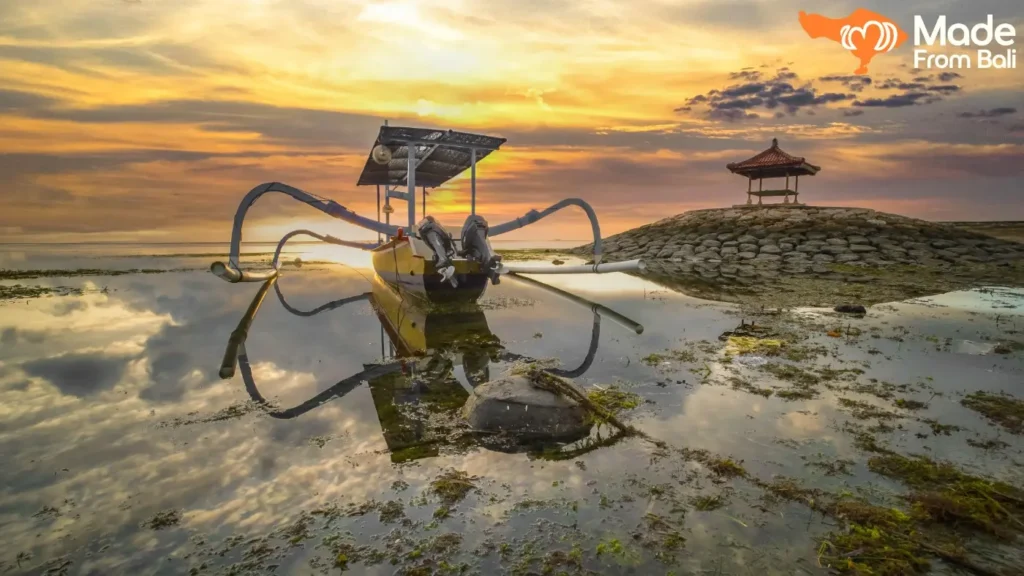
Sanur faces east, which makes it one of the only areas in south Bali where sunrise is both visible and genuinely spectacular. This is not a small detail. Nearly every other popular beach area in south Bali faces west, which means morning light arrives from behind you and the dramatic colors happen at the end of the day. In Sanur, the situation is reversed, and it changes everything about how a morning here should be spent.
The Sunrise Is Early, But Not Difficult to Catch
The sun typically rises between 6am and 6:30am depending on the time of year, and the best light, the orange and pink gradients that turn the water’s surface into something worth waking up for, happens in the 20 to 30 minutes before and immediately after the sun clears the horizon. Being on the beach by 6am is not extreme. It is simply the price of seeing Sanur at its best.
What you will find at that hour is a beach that feels genuinely quiet. A few other visitors, some local fishermen checking their jukung boats, the occasional dog trotting along the shoreline. The water in front of you is calm because Sanur’s coastline sits behind a natural reef that breaks the open ocean swells before they reach the shore. This is why families with young children often choose Sanur specifically: the water is gentle enough to stand in comfortably without worrying about sudden sets or strong currents pulling anyone off their feet.
If you arrive at 7:30am expecting sunrise, you have already missed the best of it. The sky is bright, the moment is gone, and what remains is a pleasant beach morning rather than something memorable. Set the alarm earlier than feels comfortable. You will not regret it.
The Beachfront Promenade at Its Best
The promenade running along Sanur’s coastline stretches for roughly five kilometers from the northern end near Mertasari Beach down to the southern end near the mangrove border. It is paved, shaded in sections by mature trees, and wide enough to accommodate walkers, joggers, and cyclists moving in both directions without anyone getting in anyone else’s way.
At 6am to 8am on a weekday, the promenade is at its best. Local residents use it for morning exercise, the light is soft, and the overall atmosphere has a quiet, communal energy that feels nothing like a tourist attraction. As the morning progresses toward 10am and beyond, more visitors appear, vendors set up along the beach sections, and the promenade gradually shifts from local morning ritual to tourist activity. Both versions are enjoyable, but they are different experiences, and the early morning version is harder to replicate anywhere else in south Bali.
Bicycle rentals are available at several points along the promenade and in the streets just inland. Renting one for a morning costs very little, typically between 30,000 and 50,000 rupiah, and it lets you cover the full length of the promenade comfortably without overheating. Walking the full five kilometers is possible, but a bicycle gives you the freedom to stop wherever you want, double back, or extend further north toward the quieter beach sections without committing to a long return walk in the rising heat.
Which Part of Sanur Beach to Go to First
Sanur Beach is not a single uniform stretch. It is a connected series of beach sections, each with a slightly different character, and knowing this saves first-timers from the frustration of ending up in a busier spot when a quieter one is ten minutes away.
The central section, near the main beach road and the older resort hotels, is the most developed and most visited. It has beach chairs, warungs, and a steady presence of visitors throughout the day. This is a fine place to spend an afternoon, but it is not the most memorable part of Sanur’s coastline.
Pantai Matahari Terbit, which translates loosely as Sunrise Beach, sits toward the northern end of the main stretch and is a strong choice for watching the morning light arrive. It is less crowded than the central section, accessible by walking or cycling from most accommodation in the area, and has a natural viewing angle that faces open ocean rather than other resorts.
Mertasari Beach, at the far northern end, is the quietest of the main sections and particularly good if you are traveling with children or prefer a beach that feels closer to local life than tourist infrastructure. It is also the closest beach section to Sanur Harbour, which is useful if you are planning an early morning departure to the Nusa Islands.
Activities That Reward You If You Know When to Do Them
Sanur offers a range of activities beyond beach time, and most of them work best when approached with some timing awareness. The common mistake first-timers make is treating the entire day as equally good for everything. Sanur’s heat builds significantly between 10am and 2pm, which affects how enjoyable outdoor activities feel and how crowded certain spots become.
Water Sports, Kayaking, and Reef Swimming
The calm, reef-protected water along Sanur’s coast is well suited to beginner-friendly water sports. Kayaking is available at multiple points along the beach, and paddling out toward the reef in the morning, before the sun is directly overhead and before the tourist boat traffic increases, is a genuinely pleasant way to spend an hour. The water is clear in the morning, the reef is visible below, and the physical effort is low enough that most people can manage it comfortably without prior experience.
Snorkeling directly from Sanur’s beach is possible but underwhelming. The reef close to shore has seen significant visitor traffic over the years, and the coral and fish diversity here is not comparable to what you would find around the Nusa Islands. Snorkeling at the reef in Sanur is worth doing if you are curious and already on the beach, but it should not be the primary reason for a dive or snorkel trip. For that, the boat trip to Nusa Penida or Nusa Lembongan is a far better investment of time and money.
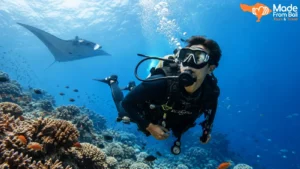
Scuba diving instruction and dive trips are offered by several operators along the beach, including well-regarded options like Crystal Divers. The local reef dives are best suited to complete beginners doing their first open water dives in calm, forgiving conditions. More experienced divers will find the Sanur reef underwhelming compared to sites around the Nusa Islands or farther east toward Amed.
Cycling the Promenade Versus Walking It
This question comes up often enough that it is worth addressing directly. Both options are genuinely enjoyable, but they suit different plans and different times of day.
Cycling works better for:
- Covering the full promenade length in a single morning
- Traveling between the southern and northern beach sections without losing energy to heat
- Riders who want to explore the streets behind the beach as well as the promenade itself
- Morning visits when the full five kilometers can be completed comfortably before the heat builds
Walking works better for:
- Shorter, more leisurely beach sections without a fixed endpoint
- Early morning sunrise walks where pace matters less than presence
- Visitors who prefer to stop frequently, sit down, and observe rather than move continuously
- Evenings when the promenade cools down and the atmosphere shifts
If you have only one morning in Sanur, renting a bicycle and cycling the full promenade before 9am is one of the most memorable ways to experience the area without spending any significant money.
Balinese Cooking Classes and Why They Work Well From Sanur
Cooking classes in Sanur tend to start with a visit to a local market to source ingredients, followed by a hands-on session preparing traditional Balinese dishes in a home or dedicated kitchen space. The format varies by provider, but the market component is often what visitors remember most. Browsing a fresh Balinese market in the early morning, before the produce is picked over and the heat has built, is a sensory experience in itself.
Sanur works well as a base for this activity because the local market culture here is more intact than in heavily commercialized tourist areas. The morning market near Jalan Segara Ayu and the surrounding streets draws genuine local shoppers rather than existing purely for tourism, which changes the feel of the experience significantly.
Most cooking class sessions run for approximately three to four hours and conclude with eating everything that was prepared. They work particularly well for couples or small groups and are a good midmorning activity when scheduled to start around 8am and finish by noon, before the heat of the afternoon sets in.
Getting to Nusa Penida and Nusa Lembongan From Sanur
This is the question most first-timers in Sanur have, and it is one that most travel guides answer too briefly. Sanur is the main departure point for fast boats heading to the Nusa Islands, and for many visitors, this is the single biggest reason for being based in Sanur rather than elsewhere in south Bali. Understanding how the harbor actually works before you arrive makes the whole experience significantly less stressful.
What the Harbor Experience Actually Looks Like
Sanur Harbour, officially known as Pelabuhan Sanur and now centered around the upgraded terminal near Mertasari Beach in the north of Sanur, is a busy, fast-moving port. It is not a serene beachfront departure. The area has multiple boat company ticketing booths, a crowd of travelers checking in, porters moving luggage, and a general sense of organized chaos that can feel overwhelming if you have never been before.
A few things are worth knowing before you go:
- Arrive early. Most boat departures to Nusa Penida begin between 7am and 9am. Arriving at the harbor 30 to 45 minutes before your departure gives you enough time to locate your ticketing booth, check in, and reach the boarding area without rushing.
- Book through a reputable operator. Several established companies operate the Sanur to Nusa Penida route. Booking in advance through your accommodation or a trusted local operator avoids the confusion of being approached by multiple sellers at the harbor itself.
- The boat ride is 30 to 45 minutes. The open ocean crossing between Sanur and Nusa Penida can be rough depending on weather and season. If you are prone to seasickness, sitting toward the middle of the boat and keeping your eyes on the horizon helps. Bring a light layer as the air conditioning inside the speedboats can be quite cold.
- Getting off the boat requires wading. At Nusa Penida’s main port in Toyapakeh, the boat will pull toward shore but passengers typically step off into shallow water. Wearing shoes you do not mind getting wet, or sandals that can be quickly removed, makes this much easier.
Day Trip or Overnight? What Makes Sense for First-Timers
A day trip to Nusa Penida from Sanur is entirely feasible and very popular. The typical pattern is to catch a morning boat, spend the day on the island with a hired driver, and return on an afternoon boat to arrive back in Sanur before sunset. This works well if your time in Bali is limited, but it also means a long, physically demanding day. Nusa Penida’s roads are rough, the main attractions require some walking on uneven terrain, and combining multiple sites in a single day can feel rushed.
For first-time visitors who want to see Nusa Penida properly without feeling like they raced through it, spending one night on the island gives a different experience entirely. You get the late afternoon light when the crowds thin out, a Penida sunrise that rivals Sanur’s, and a more relaxed pace of exploration on the second day before returning.
Nusa Lembongan is smaller, gentler, and more suitable for a relaxed day trip. The roads are manageable, the main areas are closer together, and the overall pace of the island suits a single day without the pressure of Nusa Penida’s more demanding terrain.
Which Island Fits Your Trip Better
The two islands appeal to different travel styles, and understanding the difference helps you decide where to spend your time.
| Nusa Penida | Nusa Lembongan | |
|---|---|---|
| Landscape | Dramatic cliffs, wild terrain, iconic viewpoints like Kelingking | Calmer, flatter, more accessible beaches |
| Physical effort | Moderate to high, some sites require steep walking | Low to moderate, much easier to navigate |
| Best for | Travelers wanting dramatic scenery and iconic photos | Couples, families, or travelers who prefer a relaxed day |
| Day trip suitability | Yes, but tiring | Yes, and very manageable |
| Snorkeling quality | Excellent, especially around Manta Point and Crystal Bay | Good, particularly around the mangrove areas |
| Crowd level | Higher at main viewpoints | Generally quieter |
If you are only going to one island and it is your first time in the area, Nusa Penida offers the more visually memorable experience. If you are traveling with young children or prefer a gentler pace, Nusa Lembongan fits better.
Culture and History That Go Deeper Than Temple Photos
Sanur’s cultural layer is easy to miss if you spend all your time on the beach and promenade. The town has genuine historical depth, and a few hours spent exploring it adds a dimension to your visit that most package itineraries entirely skip.
Le Mayeur Museum and the Story Behind It
The Le Mayeur Museum sits directly on the beachfront near the northern end of the main beach area and is one of the most interesting cultural sites in south Bali, though it sees far fewer visitors than its quality deserves. The museum is the former home and studio of Belgian painter Adrien-Jean Le Mayeur, who arrived in Bali in the 1930s and eventually married Ni Pollok, a renowned Legong dancer who became both his muse and the subject of much of his work.
Walking through the compound gives you something unusual: a preserved example of how foreign artists engaged with Balinese culture during the colonial period, told through architecture, paintings, and personal objects still in their original context. The compound itself is a beautiful blend of Belgian and Balinese design, and the garden setting, with the beach just visible through the trees, is genuinely lovely. Entry is inexpensive, the site is never crowded, and a visit takes about 45 minutes to an hour.
Pura Blanjong and Bali’s Oldest Written Record
Located in the southern section of Sanur, Pura Blanjong is a functioning temple complex that contains the Blanjong Pillar, an inscribed stone pillar dating back to 914 CE. The inscription, written in both Sanskrit and Old Balinese, is considered the oldest documented artifact in Bali and records the rule of Sri Kesari Warmadewa, the first documented Balinese king.
The temple is a working religious site, so visitors need to dress appropriately (sarong and sash, which are available at the entrance) and enter with respect for ongoing ceremony activity. The pillar itself is housed in a small structure within the compound and is not dramatically displayed, which adds to its authenticity. This is not a staged tourist attraction. It is a genuinely ancient artifact in continuous religious use, and that context makes it far more interesting than a similar object behind museum glass would be.
What Visitors Encounter Every Day Without Realizing It
One of the most immediate but often overlooked aspects of Sanur is the daily offering culture visible throughout the streets, temples, gateways, and even on footpaths and car hoods. The small woven palm leaf trays containing flowers, incense, and small food offerings are called canang sari, and Balinese Hindus place fresh ones multiple times daily as expressions of gratitude to the divine and the spirits of place.
First-time visitors often walk past hundreds of these without knowing what they are looking at. Understanding canang sari enriches the entire experience of moving through Sanur, because you begin to see the town not just as a beach resort but as a genuinely spiritual community where religious practice is woven into daily movement and routine. Stepping over rather than on the offerings is the correct behavior, and taking a moment to observe without interfering is always appreciated by locals.
During major Balinese Hindu festivals like Galungan and Kuningan, which occur roughly every 210 days on the Balinese calendar, the streets of Sanur are transformed by tall bamboo poles decorated with offerings and palm leaf ornaments. If your visit coincides with Galungan, the visual experience of the town shifts dramatically and adds a cultural dimension that cannot be planned for in advance, only appreciated in the moment.
Evenings in Sanur Have a Different Energy Than You Expect
The evening atmosphere in Sanur tends to surprise people who arrive expecting the sunset beach clubs and bar scenes common in other parts of south Bali. What you find instead is something more genuinely local: families out for evening walks, local restaurants filling with both Balinese residents and long-term visitors, and a general sense of a town winding down rather than ramping up. For many visitors, this is exactly what a Bali evening should feel like.
The Night Market at Sindhu Beach
The Sindhu Night Market, located near Jalan Danau Tamblingan in the heart of Sanur, is one of the most accessible and authentic local food markets in south Bali. It opens in the early evening, usually around 5pm, and runs until late. The format is simple: rows of small vendors selling Balinese and Indonesian street food, grilled satay, nasi campur, lawar, martabak, and various sweets, at prices that reflect local rather than tourist economics.
The market is genuinely local in character. While visitors do attend, the majority of customers are Sanur residents and Balinese people from the surrounding area, which keeps the atmosphere honest and the prices reasonable. Expecting a curated food hall experience will lead to disappointment. Expecting an authentic, slightly chaotic, delicious evening at a local market will lead to satisfaction.
Arriving between 6pm and 7pm is a good window. The market is active, the food is fresh, and the evening light is pleasant. Bringing cash in small denominations makes transactions easier, as many stalls do not have change for large bills.
Beachfront Dining and What to Order
Sanur has a mature and diverse dining scene that spans everything from beachfront warungs serving straightforward Indonesian food to more established restaurants offering full Balinese menus with careful presentation. The Jalan Danau Tamblingan and Jalan Kesuma Sari corridors contain most of the town’s restaurant concentration and are easy to explore on foot in the evening.
For first-timers specifically, a few ordering decisions are worth understanding:
- Nasi campur is the most complete introduction to Balinese food available in a single dish. A base of steamed rice with small portions of multiple accompaniments, typically including lawar (spiced meat and vegetables), shredded chicken or duck, tempe, and sambal. The version specific to Bali differs noticeably from nasi campur served elsewhere in Indonesia.
- Bebek or ayam betutu is slow-cooked duck or chicken in a deeply spiced Balinese paste, wrapped and steamed for hours. It is one of Bali’s most distinctive dishes and appears on most traditional Balinese restaurant menus in Sanur.
- Fresh seafood is widely available along the beachfront, particularly in the restaurants clustered near the central beach area. The quality varies, but ordering grilled fish or prawns at a beachfront table in the early evening is one of the more reliably pleasant dining experiences Sanur offers.
Planning Your Sanur Days Without Over-Scheduling
One of the most consistent mistakes first-timers make in Sanur is bringing the same activity-per-hour planning mentality that works in cities or heavily structured tourist destinations. Sanur does not reward that approach. The town’s character is built on unhurried movement, and trying to compress too much into each day tends to produce a trip that feels tiring rather than restorative.
How Many Days in Sanur Is Actually Enough
The right answer depends on what you intend to use Sanur for. As a standalone destination, two full days gives you enough time to experience the promenade properly, visit the cultural sites, explore the night market, and have one afternoon at the beach without feeling rushed. Three days allows you to add a day trip to one of the Nusa Islands without that trip dominating the entire visit.
If Sanur is functioning primarily as your base for exploring other parts of Bali (Ubud, East Bali, the Nusa Islands), then three to five nights makes sense. The town is geographically well-positioned for this purpose. Ubud is 40 to 50 minutes by car, East Bali and sites like Tirta Gangga are accessible on a long day trip, the airport is 30 to 40 minutes away, and the Nusa Islands are just a short boat ride from the harbor.
One night is not enough to understand Sanur. You will arrive, have a pleasant morning, and leave before you have had a chance to find the rhythm that makes the town what it is.
Trips That Pair Naturally With a Sanur Base
Sanur’s location in southeastern Bali gives it good access to destinations that are harder to reach from the western coastal areas. A few day trips that work particularly well from a Sanur base:
- Nusa Penida or Nusa Lembongan via fast boat from Sanur Harbour (30 to 45 minutes each way)
- Ubud for cultural sites, the Tegallalang rice terraces, and the Sacred Monkey Forest (40 to 50 minutes by car)
- Tirta Gangga and the royal water palace in East Bali, combined with Lempuyang Temple for the Gates of Heaven viewpoint (around 90 minutes from Sanur, best done with a private driver for a full day)
- Uluwatu in the late afternoon for the clifftop Kecak fire dance at sunset (around 60 minutes by car, best as an evening trip)
- Denpasar city for the Pasar Badung traditional market and a more local urban Bali experience (15 minutes by car)
Using a private driver for these day trips is the most practical approach. Grab and Gojek ride-share apps work well within Sanur itself, but for longer routes into the hills or east Bali, arranging a driver through your accommodation gives you a fixed price, flexibility on timing, and a local guide who knows the roads.
Who Sanur Works For, and When Another Area Might Fit Better
Sanur suits certain travel styles very well and genuinely does not suit others. Being honest about this helps first-timers make better planning decisions.
Sanur works particularly well for:
- Families with young children who need calm water and manageable daily logistics
- Couples looking for a quieter base that still has good dining and beach access
- Travelers who are using Bali as a jumping-off point for the Nusa Islands
- Older travelers and those who prefer walking and cycling over motorized exploration
- First-time Bali visitors who find the intensity of Kuta or Canggu immediately overwhelming
- Anyone staying longer than a week who wants a sustainable daily rhythm
Sanur is probably not the best fit for:
- Travelers whose primary interest is nightlife and late-night social scenes
- Surfers looking for consistent breaks within walking distance (Sanur’s reef protects the water from the swells that create surf)
- Visitors on short trips who want maximum variety within a single area and prefer the concentrated restaurant and bar density of Seminyak or Canggu
This is not a negative judgment on Sanur. It is simply the reality that different parts of Bali serve different travel personalities, and knowing where you fall on that spectrum before you book accommodation saves significant frustration.
Practical Things Worth Knowing Before You Arrive in Sanur
A few on-the-ground realities that do not always make it into general Bali travel guides but matter specifically for Sanur visitors.
The town is genuinely walkable in its core area. The streets between Jalan Danau Tamblingan, the promenade, and the central beach section can all be navigated on foot without needing transport, and most mid-range and boutique accommodation in Sanur sits within a 10 to 15 minute walk of the beach. This makes Sanur unusual by Bali standards, where reliance on taxis or scooters is taken for granted almost everywhere else.
Tap water in Sanur, as throughout Bali, is not safe to drink. Bottled water is inexpensive and universally available. Most accommodation provides drinking water dispensers, and bringing a refillable bottle to use with these reduces plastic waste without any inconvenience.
Sanur does experience rain, particularly between November and March. Because the coastline faces east, morning weather here often clears earlier than on west-facing beaches, but afternoon rain during the wet season is common and can arrive quickly. Planning outdoor activities for the morning and leaving afternoons flexible during rainy season travel is the most practical approach.
Street vendors operate along the beach and promenade, but the volume and persistence in Sanur is noticeably lower than in Kuta or Legian. A simple polite decline (“no thank you” or a gentle wave) is almost always sufficient. The vendor culture here tends toward brief engagement rather than extended pursuit, which makes beach time in Sanur noticeably more relaxed for visitors who find aggressive selling exhausting.
Finally, the currency situation in Sanur is the same as the rest of Bali. Paying in Indonesian rupiah is standard, ATMs are widely available along the main commercial streets, and some restaurants and larger shops accept card. At markets, smaller warungs, and beach vendors, cash in small denominations is expected and makes everything smoother.