

If you have been searching for Blue Lagoon in Bali, there is a good chance you have already run into two completely different places sharing the same name, and half-formed reviews that do novt tell you which one they are actually describing. That mix-up alone sends people to the wrong side of the island, or makes them assume a cliff-jumping spot on Nusa Ceningan is the same calm, beginner-friendly bay in Padang Bai. Get the wrong picture in your head and you either overpack for a swim that never happens or underestimate a two-hour drive that eats half your day.
This matters because Blue Lagoon Padang Bai is genuinely one of the easier snorkeling spots to build a Bali day around, but only if you know what you are actually walking into: the access, the water conditions at different times of day, whether it is smarter to arrange your own gear or book a guide, and how it stacks up against Nusa Penida if you are choosing between the two. Made From Bali’s drivers run this stretch of East Bali regularly, so the details here come from people who have actually watched how the tide, the port traffic, and the boat operators behave on an ordinary Tuesday, not just from a listing page. Here is what you need to know before you commit a day to it.
Bali Has Two Places Called Blue Lagoon And They Are Nothing Alike
Type “Blue Lagoon Bali” into a search engine and you will get results for two unrelated destinations. One is Blue Lagoon Beach near Padang Bai, on the Bali mainland, in the Manggis area of Karangasem regency. It is a calm, sheltered bay known for snorkeling and swimming. The other is Blue Lagoon on Nusa Ceningan, a small island connected to Nusa Lembongan by a narrow yellow bridge, known for cliff jumping into open, choppier water. They are separated by a boat crossing, a completely different mood, and a completely different level of physical intensity.
This confusion is not trivial. If you are picturing swimmers calmly floating over coral and you end up planning a trip to the cliff-jumping version, you have booked the wrong day entirely. The reverse is also true: travelers hoping for an adrenaline jump sometimes arrive at the Padang Bai bay and find a quiet beach with a staircase down to the sand instead. Before anything else, confirm which Blue Lagoon is actually in your itinerary. This guide covers the Padang Bai side, the one built around snorkeling, not jumping.
Padang Bai itself is a small port town on Bali’s east coast, mostly known to travelers as the departure point for fast boats to Nusa Penida, Nusa Lembongan, and the Gili Islands, plus the public ferry to Lombok. Blue Lagoon Beach sits just outside that harbor area, close enough that you will pass through some port activity on your way in.
Getting From The Parking Area To The Water Is Part Of The Experience
Most snorkeling write-ups skip straight from “you arrive” to “you’re in the water,” which leaves out a detail that actually affects who should go. Blue Lagoon Beach is not a beach you simply step onto from a parking lot. There is a walk involved, and it is one of those small physical details that changes the experience depending on your mobility, your gear load, or whether you are traveling with young kids or elderly relatives.
The Walk Down Is Steeper Than Photos Suggest
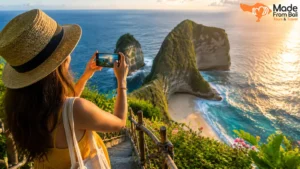
From the parking area, you take a set of stairs and a rocky path down to the sand, usually taking a couple of minutes on foot. It is not a long walk, but it is a noticeably steep one, and the surface is uneven in places rather than a smooth boardwalk. Carrying a cooler, a stroller, or a heavy dry bag down that path is more awkward than most listings let on, so it is worth packing light and wearing shoes with real grip rather than flip-flops. If anyone in your group has knee or balance concerns, factor this walk into the decision the same way you would factor in a hike, because functionally, that is closer to what it is.
Once you are down, the beach itself is small, with coarse white sand rather than the finer sand you might find at nearby Bias Tugel. On the far left side of the beach, there is a natural channel with less coral, and that is generally the easiest place to walk straight into the water without stepping on reef.
The Water Is Calmer Than Most Snorkeling Spots In Bali, And That Is The Whole Point
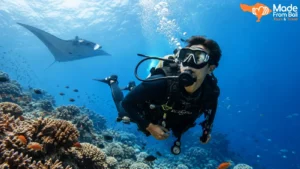
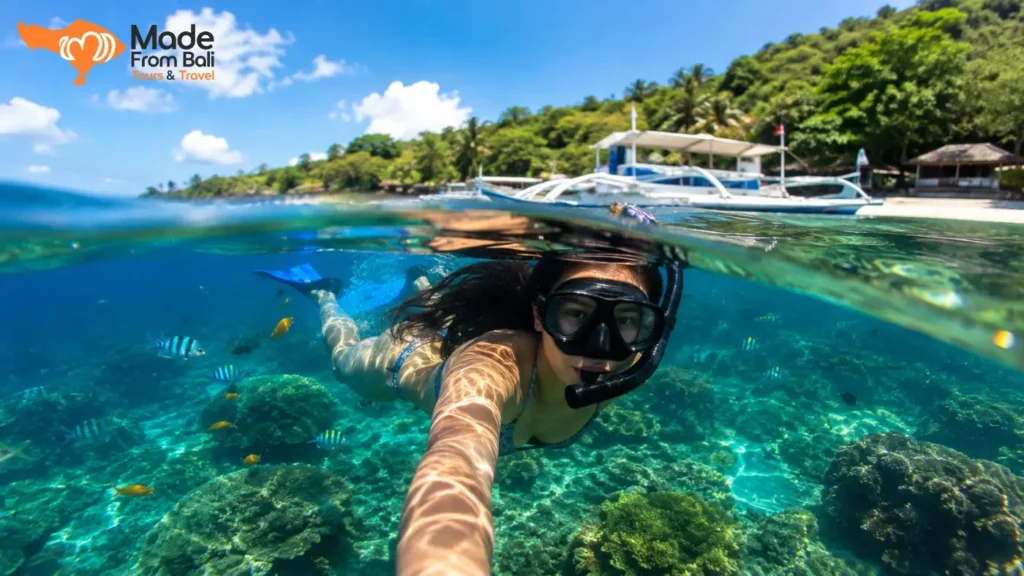
The reason Blue Lagoon keeps coming up in beginner and family recommendations is not the coral variety, since it is genuinely more modest than what you would see in the Nusa Penida area or in Amed further north. The real draw is the water itself. Blue Lagoon sits in a sheltered bay, protected from the open ocean swell that hits more exposed sites nearby, so the surface tends to stay calm and the sandy slope into the water is gentle rather than a sudden drop-off. That combination, calm water plus easy entry, is exactly what makes it workable for someone who has never snorkeled before, or for kids who are still building confidence in open water.
That sheltered geography is also why local dive operators treat it differently from nearby sites. Blue Lagoon and Tanjung Jepun are generally considered the easier, more protected spots in the area, while sites closer to the Ferry Channel or Shark Point deal with stronger current and surge, which is why those are usually reserved for more experienced divers rather than casual snorkelers.
Marine Life You Are Likely And Unlikely To See
Most articles list every fish species ever spotted here as if you are guaranteed to see all of them on one trip, which sets people up for disappointment. It is more useful to separate what you will probably see from what would count as a lucky sighting.
Commonly seen on most visits:
- Angelfish, butterfly fish, and parrot fish moving around the shallower reef sections
- Clownfish and small anemone residents near the coral clusters
- Moray eels tucked into rock crevices, usually visible if you look closely rather than swim past quickly
- Nudibranchs on the sandy and coral edges, easy to miss if you are not looking down
Occasional or lucky sightings:
- Sea turtles, which show up often enough that guides mention them regularly, but are not guaranteed every single trip
- Reef sharks and blue-spotted rays, more likely if you swim a bit further from the immediate shoreline
- Squid, sometimes visible changing color, more commonly spotted on calmer, clearer days
Setting expectations this way matters because reviews are genuinely mixed. Some visitors describe it as one of their favorite Bali snorkeling memories, largely because of a turtle encounter, while others find the reef underwhelming compared to what they pictured. Both reactions are honest. The coral here will not compete with world-class reef destinations, and treating it as a calm, easy, photogenic swim rather than a deep-sea spectacle will match reality much more closely.
Choosing Between Blue Lagoon And Nusa Penida Depends On What You Actually Want
This is the comparison most people are quietly running in their head before they book anything, and it deserves a direct answer instead of a vague “both are great” response.
| Blue Lagoon Padang Bai | Nusa Penida | Amed | |
|---|---|---|---|
| Water conditions | Calm, sheltered bay, easy entry | Can be rough, with real currents that have caught out inexperienced swimmers | Generally calm, shore-accessible |
| Marine life | Solid but modest, occasional turtles | Bigger draws like manta rays, more dramatic scenery | Strong coral and shipwreck sites, good for serious snorkelers |
| Crowd level | Moderate, busier midday | Can feel heavily touristed at popular points, plus long lines for boats | Quieter, less commercialized |
| Travel time from South Bali | Roughly 1 to 2 hours by car | Requires a boat crossing on top of the drive to the harbor | Around 2 to 2.5 hours by car |
| Best suited for | Beginners, families, first-time snorkelers, short time budgets | Travelers chasing manta rays or dramatic cliffside views who are comfortable with rougher water | Snorkelers wanting less crowded, richer reef without a boat crossing |
The honest version of this decision: if you want calm water, an easier logistics day, and you are traveling with beginners or kids, Blue Lagoon is the safer, less stressful choice. If bigger marine life and dramatic scenery matter more to you than convenience, and you are comfortable with a boat crossing and potentially choppier conditions, Nusa Penida delivers something Blue Lagoon cannot. Amed sits in between, offering richer reef than Blue Lagoon without Nusa Penida’s crowd and current concerns, at the cost of a longer drive. None of these is objectively “better.” They solve different trip priorities.
Snorkeling Alone Or Booking A Guide Changes The Experience More Than People Expect
There are two real paths here, and the difference between them is bigger than most listings suggest.
Going the DIY route means renting a mask, snorkel, and sometimes a life jacket directly from the small shops right at the beach, generally for a modest daily fee, plus a small parking charge since there is usually no formal entrance ticket for the beach itself. You can then swim from the shore using the sandy channel on the left side of the bay. This path is cheaper and gives you full control of your timing, but it also means you are relying entirely on your own judgment about where it is safe to swim, especially if the water feels choppier than usual that day.
Booking a guided boat trip, whether independently through a local operator or as part of a private tour, adds a few things DIY snorkeling does not: a boat ride out to slightly deeper water where visibility and coral density are usually better than what you find right off the shore, a guide who knows the current conditions that day and where the recent turtle sightings have been, and often a second stop at Tanjung Jepun or Bias Tugel included in the same trip. Guided packages vary widely in price depending on group size, inclusions, and whether transport from South Bali is included.
A mistake worth naming directly: assuming “guided” automatically means “safer” regardless of who you book with. Reviews of independent local operators are mixed, occasionally describing rushed schedules, older equipment, or guides who feel more focused on moving groups through quickly than on safety briefings. If you are booking a guide, the operator’s consistency matters as much as the price. This is exactly the gap a private, all-inclusive arrangement is built to close, since a private driver and operator relationship removes the guesswork of picking an unfamiliar local boat operator on the spot.
Why Some Boats Head Straight To Jepun Instead Of Staying At Blue Lagoon
If you book a guided trip, you will likely notice the boat does not stay at Blue Lagoon the whole time. Tanjung Jepun sits just to one side of the main bay, marked by a small cliffside temple, Pura Jepun, and it offers a different kind of reef environment than Blue Lagoon’s sandy-bottomed bay.
The practical reason operators split time between the two is coral density. Blue Lagoon’s underwater landscape is mostly scattered rock and sand with pockets of coral, which is exactly what keeps entry easy and the water calm. Jepun’s reef is denser and more colorful, better for photography and for spotting a wider range of small reef fish, but it sits slightly further out and involves a short boat ride to reach comfortably. Bias Tugel, on the other side of the headland, sometimes gets added as a third stop, particularly on quieter days when operators want to avoid the busiest section of Blue Lagoon during peak hours.
Understanding this pattern helps set expectations correctly. If a tour description mentions “two snorkeling sites,” it is very likely describing Blue Lagoon plus Jepun, not two unrelated locations, and that combination is usually intentional rather than filler.
Morning High Tide Changes What You Can See Underwater
Timing affects this spot more than most travelers assume before they arrive. Visibility at Blue Lagoon is noticeably better during high tide, and mornings tend to bring calmer conditions before afternoon boat traffic and wind pick up. Arriving early, ideally before the midday rush of tour groups, generally means clearer water and fewer people sharing the same stretch of reef.
Season plays a role too. The dry season, roughly April through October, brings calmer seas and clearer water across most of East Bali’s snorkeling spots, Blue Lagoon included. The wet season does not make snorkeling impossible, since the water stays warm year-round, but it does raise the odds of murkier conditions on any given day.
What Happens To Visibility After Heavy Rain
This is a detail that gets skipped over constantly, and it causes real disappointment when it happens. After a heavy rain, runoff can cloud the water at Blue Lagoon, sometimes for a day or two afterward, cutting visibility significantly compared to normal conditions. If it has rained heavily the night before or that same morning, it is worth checking with a local operator or your driver before committing to the trip, since a cloudy day underwater turns an otherwise good spot into a frustrating one. This is not a reason to avoid the wet season entirely, but it is a reason to build a little flexibility into your schedule rather than locking in a fixed date months in advance without a backup plan.
Who Blue Lagoon Actually Suits, And Who Might Be Happier Elsewhere
Being honest about fit here saves people a wasted afternoon more than any list of fish ever could.
- Families with young kids: A strong match. Calm water, a gentle sandy entry point, and shorter swimming distances make this one of the more manageable snorkeling spots in Bali for children, as long as someone accounts for the staircase access when planning gear and timing.
- First-time snorkelers of any age: A strong match. The lack of strong current and the shallow, sandy areas near the shore make this a low-pressure place to get comfortable with a mask and snorkel before attempting something more demanding.
- Couples wanting a relaxed half-day: A good match, particularly paired with a wider East Bali itinerary rather than as a full-day destination on its own, since the beach itself is small and the main activity, once you have swum the reef, tends to wind down.
- Solo travelers on a tight schedule: A reasonable match if joining a shared boat tour, since it keeps costs down and adds a social element, though solo travelers wanting a bigger, more social snorkeling scene might find Nusa Penida’s tour circuit livelier.
- Experienced snorkelers and divers chasing coral variety: A weaker match. If you have snorkeled at reef-dense destinations before, Blue Lagoon’s coral coverage will likely feel modest. Amed or a dedicated Nusa Penida trip will reward that expectation more directly.
- Anyone with limited mobility: Worth extra thought. The staircase and rocky path down to the beach are real physical factors, not a minor footnote, and should be weighed seriously before committing.
The Drive From South Bali Is Longer Than It Looks On A Map
Padang Bai sits on the opposite side of the island from where most visitors stay, and the drive is genuinely one of the most underestimated parts of planning this trip.
| Starting point | Approximate drive time | Approximate distance |
|---|---|---|
| Ubud | 1 to 1.5 hours | Around 35 to 38 km |
| Sanur | Around 1 to 1.25 hours | Around 40 km |
| Kuta or Seminyak | 1.5 to 2 hours | Around 50 to 57 km |
| Nusa Dua or Uluwatu | 2 to 2.75 hours | Around 65 to 74 km |
These are normal daytime traffic estimates. South Bali’s coastal strip in particular tends to run slower than the map distance suggests, especially during the 8 to 10am and 5 to 7pm windows, and Friday afternoons heading toward Ubud add extra delay. If you are staying in Uluwatu or Nusa Dua, treat this realistically as most of a day trip rather than a quick add-on, since the round trip alone can take four to five and a half hours before you have spent a minute in the water.
Ferry Traffic Near The Port Can Add Unexpected Delay
One detail that rarely makes it into standard guides: the final stretch into Blue Lagoon passes directly by Padang Bai’s harbor, where fast boats depart regularly for Nusa Penida, Nusa Lembongan, and the Gilis, alongside the public Lombok ferry. During morning and afternoon departure windows, this area sees a noticeable uptick in foot and vehicle traffic as travelers move between boats, taxis, and shuttle pickups. It is usually a minor delay rather than a major one, but arriving with a buffer, or having a driver who already knows to time the approach around the busier boat departure windows, avoids the small frustration of sitting in unexpected port congestion right before you were hoping to relax on the sand.
This is exactly the kind of friction that is easy to miss when planning from a listing page and much easier to route around when someone who drives this stretch regularly is handling the timing for you.
Fitting Blue Lagoon Into A Longer Day Around East Bali
On its own, Blue Lagoon typically fills two to three hours of actual swimming and beach time, which leaves a real question: is a two-hour drive each way worth it for a half-day activity? For most travelers, the answer depends on what else gets built around it.
Given how far East Bali sits from South Bali’s hotel zones, Blue Lagoon works best as one stop within a longer day rather than a standalone outing. Common pairings include Tirta Gangga’s water palace, the Lempuyang temple area, or one of the East Bali waterfalls like Tibumana or Kanto Lampo, depending on how much driving time you want to spend versus time actually doing things. Sidemen’s rice terrace scenery is also close enough to fold in in the same direction.
This is also where arranging a private driver for the day changes the math. Instead of treating the long drive as dead time, a private, all-inclusive arrangement, like the Blue Lagoon snorkeling day trip Made From Bali runs with private transfer included, turns the same distance into one flexible day covering the snorkel session plus one or two additional East Bali stops, timed around tide conditions and port traffic rather than a fixed group tour schedule. If Blue Lagoon is going to take a chunk of your day either way, building the rest of that day around it, rather than driving out and back for the beach alone, is usually what makes the distance feel worthwhile.