


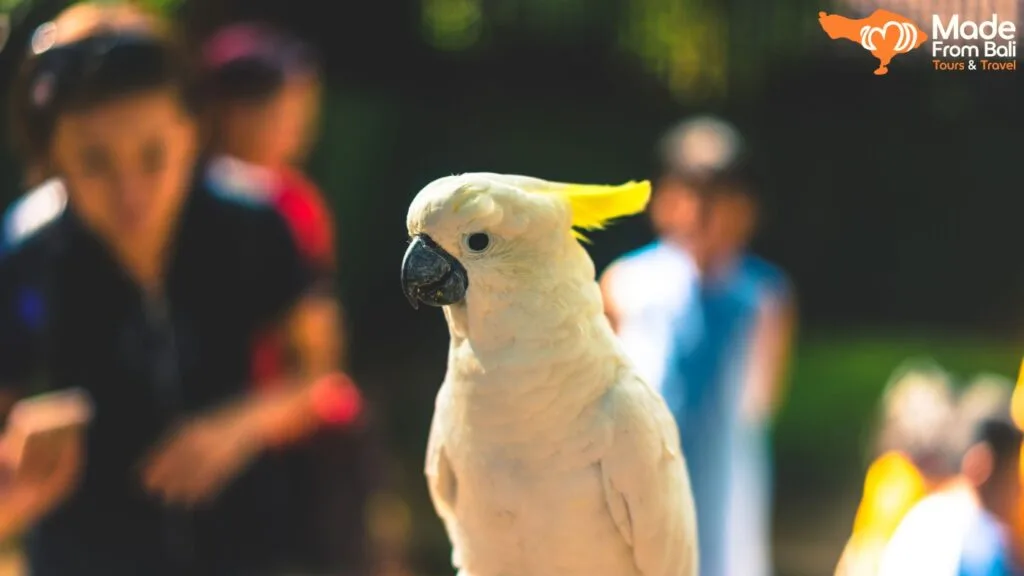
Search “Bali Bird Park and Zoo” and you’ll notice something odd. Half the results talk about one park. The other half sell combo tickets without explaining what you’re actually combining. Neither tells you what most travelers actually need to know before they leave their hotel: whether these are even the same place, whether one day is enough for both, and what happens to your afternoon if you get the order wrong.
That confusion has a real cost. Guests who show up expecting one attraction and find two separate gates, two separate entry fees, and a fifteen-minute drive between them often end up rushing through whichever park they visit second. Families with young kids sometimes miss the one activity they actually booked the trip for, like the orangutan breakfast, because it closes earlier in the day than anyone expected. None of this is complicated once you understand how the two parks actually relate to each other. It just isn’t explained anywhere clearly, so this guide does that first, then walks through the planning decisions that actually matter: which park suits your group, how to fit both into a single day without exhausting everyone, what the tickets really cost, and how the drive from South Bali changes the math.
Bali Bird Park And Bali Zoo Are Two Different Places, Not One Combined Attraction
Bali Bird Park and Bali Zoo are two separate, independently run attractions located a short drive from each other in the Gianyar area, not one combined wildlife park with a shared entrance. This matters because a lot of first-time visitors assume the name refers to a single site with both birds and animals under one roof, and that assumption shapes bad planning decisions before the trip even starts.
Bali Bird Park sits in Batubulan, a village just off the main road between Denpasar and Ubud. It opened in 1995 and is built around roughly 1,000 to 1,300 birds across around 250 species, arranged into seven zones that loosely follow where the birds originate from: Papua, Sumatra, Kalimantan, Java, Africa, South America, and Bali itself. It also happens to house a small Komodo dragon exhibit, which surprises most first-time visitors since dragons have nothing to do with birds.
Bali Zoo is a few kilometers away in Singapadu, also in Gianyar Regency. It opened in 2002 as the first privately owned zoo built by Balinese founders, and it’s a different kind of experience: around 350 to 450 animals including elephants, orangutans, Sumatran tigers, and capybaras, with a much stronger emphasis on hands-on interaction than passive viewing.
The two parks are separately ticketed, separately run, and require their own drive, their own entrance fee (unless you buy a combo), and their own time budget. Understanding that upfront is what makes the rest of the planning make sense.
Why Some Travelers End Up Choosing Only One Of Them
A lot of guests arrive in Bali with a single wildlife activity already penciled into their itinerary, and once they realize there are actually two separate parks nearby, they have to decide fast whether it’s worth adding the second one. The honest answer depends less on which park is “better” and more on what kind of experience each one is actually built around, since they’re not really competing for the same kind of visitor.
What Bali Bird Park Actually Offers Beyond Walking Past Cages
Bali Bird Park is a walking park first and a bird collection second. The paths wind through landscaped tropical gardens with three small lakes, and most of the birds are either free-flying within their zone or perched close enough to the walkway that you don’t need binoculars to see them properly. The park runs scheduled shows throughout the day, including a bird-of-prey demonstration and a rainforest-themed show, plus a 4D cinema experience that’s more of a rest stop than a highlight.
The part that tends to stay with people is the lorikeet feeding area, where dozens of small, brightly colored lories will land directly on your hand or shoulder if you’re holding the nectar cup the park provides. It’s genuinely close contact, not a photo-op behind glass. Visitors interested in birds specifically, or in slower, quieter walking experiences, tend to rate this park higher than visitors who came expecting a broader zoo-style day out.
Because it’s a smaller site (about 2 hectares) with a clear walking loop, most people move through it in three to four hours, including time for at least two of the scheduled shows.
What Makes Bali Zoo Feel More Like An Interactive Day Out
Bali Zoo covers considerably more ground, somewhere between 12 and 22 acres depending on the source, and the experience is built around direct contact rather than observation. Standard entry gets you access to the daily bird and animal shows, but the experiences that actually define a Bali Zoo visit are the paid add-ons: Breakfast with Orangutans, Elephant Mud Fun, and a capybara interaction session that’s become one of the most photographed activities in the park in the last year or two.
There’s also a Jungle Splash water play area, which matters more than it sounds like it should if you’re traveling with kids under ten, since it gives them somewhere to cool off partway through a hot, humid walking day. Most visitors spend two to three hours here on a standard visit, longer if they’ve booked one of the interactive add-ons.
If your group leans toward wanting to touch, feed, and photograph animals up close rather than walk quietly past aviaries, Bali Zoo is usually the stronger fit. If your group is more interested in birds specifically, or wants a calmer, less activity-driven pace, Bali Bird Park tends to land better.
Deciding Between Bird Park And Zoo When Your Time Is Short
If you only have a half day free in your Bali itinerary, picking one park over the other usually comes down to three practical factors: who’s in your group, what kind of experience they actually enjoy, and how much walking everyone is realistically up for that day.
| If you’re traveling as… | Bali Bird Park tends to suit you if… | Bali Zoo tends to suit you if… |
|---|---|---|
| A couple with limited time | You want a quieter, photography-friendly walk without paid add-ons | You want a hands-on activity together, like the orangutan breakfast |
| A family with young kids | Your kids enjoy calm animal watching and hand-feeding lorikeets | Your kids want to touch, feed, and interact, and you need a water play break |
| A solo traveler interested in wildlife | You’re specifically drawn to birds and conservation stories | You want a broader mix of species and a livelier atmosphere |
| A group with mixed interests | Not everyone is genuinely into birds | Zoo’s variety of activities usually satisfies more people at once |
Neither park is objectively better than the other. What actually determines satisfaction is whether the experience matches what your group wanted going in. A bird enthusiast dragged to Bali Zoo for the elephant activities will still enjoy it, but they’ll leave feeling like they missed the park they actually wanted. The reverse is just as true for a group of kids who wanted to touch animals and instead spent three hours walking past aviaries.
Fitting Both Into One Day Without Rushing Either One
Combining both parks in a single day is realistic, but only if you go in with an honest sense of the time each one needs. Based on typical visit lengths, Bali Bird Park needs three to four hours to see properly, including at least one scheduled show, and Bali Zoo needs another two to three hours, more if you’ve booked a paid interactive experience. Add travel time between the two sites and to and from your accommodation, and a combined visit realistically fills a full day, not a leisurely half day with time to spare.
Here’s what a workable full-day sequence usually looks like:
- Start at whichever park has an earlier time-sensitive activity. If anyone in your group wants Breakfast with Orangutans at Bali Zoo, that session runs from 8:00 to 10:00 AM with an 8:00 AM check-in cutoff, so it has to come first regardless of which park you’d otherwise prefer to visit first.
- Move to the second park by early afternoon. The drive between the two is only about 15 to 20 minutes since both sit within a few kilometers of each other in the Singapadu and Batubulan area, so the transition itself isn’t the bottleneck. Timing is.
- Build in a real lunch stop between the two. Both parks have on-site food, but a sit-down break somewhere along the Singapadu road gives everyone a chance to cool off before the second park, which matters more than it sounds like on a hot day.
- Treat the second park as the shorter, calmer half of the day. By mid-afternoon, energy and patience are usually lower, especially with kids, so it’s worth accepting that you may not see everything at the second stop and that’s fine.
The mistake most people make isn’t the distance between the parks, it’s underestimating how long each one actually takes and trying to squeeze both into a half day meant for one.
Morning At One Park Changes What You Can Still Catch Later In The Day
The order you visit these two parks in isn’t just a logistics detail, it actually determines which specific experiences are still available to you later in the day. A few time-sensitive details are worth knowing before you decide which park comes first.
Breakfast with Orangutans at Bali Zoo has a hard cutoff. Check-in closes at 8:00 AM and the last seating is 8:30 AM, so if this is something your group wants, it has to be the very first thing on your schedule, before either park’s general opening hours even begin for most visitors. Miss that window and it’s simply not available for the rest of the day, no matter how early you still arrive.
Bali Bird Park’s scheduled shows run at fixed times through the morning and into early afternoon, and the park itself gets noticeably busier between roughly 9:00 and 1:00 PM. Visiting after 2:00 PM generally means smaller crowds and shorter waits at the feeding stations, though by then the heat of the day is also at its peak, which affects how long younger kids or older travelers want to keep walking.
Bali Zoo’s animal shows follow a similar late-morning and early-afternoon pattern, and its water play area becomes genuinely useful heat relief specifically in the early-to-mid afternoon slot, which is often when energy starts dropping anyway.
Putting this together, a workable rule of thumb is: if orangutan breakfast matters to your group, start at Bali Zoo before 8:00 AM and treat Bali Bird Park as your calmer afternoon stop. If it doesn’t matter to you, starting at Bali Bird Park in the cooler morning hours and finishing at Bali Zoo, where the water play area gives kids a mid-afternoon reset, tends to feel less exhausting overall.
The Fifteen Minute Drive Between Them Is Easy, Getting There From South Bali Is Not
The distance between Bali Bird Park and Bali Zoo genuinely isn’t the hard part of this trip. Both sit close together off Jalan Raya Singapadu, and the drive between them is short and straightforward on local roads. The part that catches South Bali-based travelers off guard is the drive to get to this area in the first place.
If you’re staying around Ubud, both parks are close, generally 15 to 20 minutes away, which makes a combined visit easy to fit into a normal day. But most international travelers in Bali are actually based further south, in areas like Kuta, Seminyak, Jimbaran, Canggu, or Nusa Dua, and from any of those areas the drive to Singapadu typically runs 45 minutes to well over an hour each way, depending heavily on time of day. Bali’s main south-to-central roads see serious congestion during the late morning and again in the late afternoon, and a trip that Google Maps estimates at 50 minutes can easily stretch past 90 in real traffic.
That has a direct effect on your day plan. If you’re coming from South Bali, an 8:00 AM orangutan breakfast check-in means leaving your hotel by roughly 6:30 to 7:00 AM to account for traffic, not the 30 to 45 minutes a straight-line distance would suggest. It also means a combined visit to both parks, plus the drive there and back, realistically consumes most of a full day once you factor in South Bali’s traffic patterns on both ends.
A private driver who already knows which route avoids the worst of the Sunset Road and Sanur bypass congestion at a given hour makes a bigger difference here than most people expect. It’s less about comfort and more about protecting the actual hours you have available at the parks themselves.
Ticket Prices Look Inconsistent Until You Understand The Two Pricing Tiers
If you’ve compared prices across a few booking sites for these parks, you’ve probably noticed numbers that don’t match at all, sometimes by a factor of three. That’s not inconsistent pricing or a scam risk. Indonesian attractions, including both of these parks, commonly run two separate pricing tiers: one for Indonesian residents and one for foreign visitors, along with a further split between gate price and pre-booked online promo price.
A foreign adult ticket to Bali Bird Park, for example, typically runs in the range of IDR 300,000 to 385,000 depending on whether you book online in advance or pay at the gate, while domestic pricing sits considerably lower. Bali Zoo’s foreign adult admission generally falls somewhere in the IDR 400,000 to 500,000 range for standard entry. If you’ve seen a price quoted well below that on a comparison site, it’s almost certainly the domestic rate, the child rate, or an older listing, not a price you should expect to pay as a foreign tourist.
What A Combo Ticket Actually Saves You
Combined Bali Bird Park and Bali Zoo tickets are widely sold through booking platforms, usually advertised at around 20 percent off the combined price of buying both separately at the gate. In practical terms, that discount is real and worth taking if you’re already committed to visiting both parks in the same trip, since you’re paying one transaction fee instead of two and locking in online promo pricing rather than gate pricing at either park.
The combo ticket isn’t worth buying just because it’s discounted, though, if you’re genuinely unsure whether you’ll have time for both parks. A discounted ticket you don’t fully use isn’t a saving. It’s still worth deciding your itinerary first and choosing the ticket format second.
The Extra Experiences That Cost More Than The Entry Ticket Itself
Standard admission at both parks covers the walking areas, the scheduled shows, and basic feeding stations, but the experiences that tend to define a visit, especially at Bali Zoo, are booked and paid separately, and they often cost more than the base entry fee.
- Breakfast with Orangutans is a separate add-on booked in advance, priced above standard admission, and limited to the 8:00 to 10:00 AM window.
- Elephant Mud Fun and other elephant encounters at Bali Zoo are ticketed individually and typically need to be booked ahead during busier travel months.
- Night at the Zoo, offered on select evenings, runs 6:00 to 9:00 PM and is a completely separate ticket from daytime entry.
- The 4D cinema and Komodo dragon feeding sessions at Bali Bird Park are usually included in standard admission, unlike most of Bali Zoo’s signature experiences.
The practical takeaway is that a family planning to do the orangutan breakfast plus a standard Bali Zoo visit plus Bali Bird Park in the same day should budget noticeably more than the two base entry tickets suggest, and should book the time-limited add-ons in advance rather than assuming they can walk up and add them on the day.
What A Family With Young Kids Notices That A Couple Might Not
Both parks are genuinely family-friendly, but they present different practical challenges once you’re actually there with young children, and these are the details that rarely make it into general tourism copy.
Bali Bird Park’s paths are stroller-friendly and the loop is compact enough that a tired toddler doesn’t mean the trip is over, but shade is inconsistent in a few of the open-air zones, and there’s no dedicated nursing room based on recent visitor reports, which matters if you’re traveling with an infant.
Bali Zoo covers considerably more ground, with visitors typically walking around a 2 kilometer loop across the full site, which is a real consideration for kids who tire easily or for anyone managing a stroller over the longer distance between exhibits. The Jungle Splash water play area helps offset this by giving kids a genuine break partway through, but it also means packing swimwear and a towel if you want them to use it, something easy to forget if you weren’t expecting a water feature at a zoo.
A couple without kids will barely notice either of these details. For a family, they’re the difference between a smooth afternoon and a meltdown an hour before you’d planned to leave.
Rainy Season Changes What A Day At Two Outdoor Parks Feels Like
Bali’s dry season runs roughly April through October, and the wet season covers November through March, with the heaviest rainfall typically concentrated in January and February. Both Bali Bird Park and Bali Zoo are almost entirely outdoor attractions, which means rain doesn’t just add an inconvenience, it changes how much of either park is actually walkable that day.
During dry season, the bigger issue is heat and crowding rather than weather disruption, particularly between late morning and early afternoon when both parks see their highest visitor numbers. During wet season, Bali’s rain tends to arrive in short, heavy bursts rather than all-day drizzle, which means a visit is rarely canceled outright, but paths can turn genuinely uncomfortable underfoot, and outdoor shows are sometimes shortened or moved depending on conditions.
Combining both parks in one day during wet season adds a layer of risk that dry season doesn’t: if you get caught in a downpour partway through Bali Bird Park, you’ve lost time you were counting on for Bali Zoo afterward, since neither park realistically lets you speed through the second half of a rushed visit. If you’re traveling in the wet season, it’s worth building in a buffer, either by starting earlier than you think you need to, or by treating the combined two-park day as something you attempt only if the forecast looks reasonably dry.
The Itinerary Mistake That Turns This Into A Rushed, Tiring Day
The most common planning mistake isn’t choosing the wrong park. It’s stacking too much around both parks in the same day. A frequent pattern looks something like this: Bali Bird Park in the morning, Bali Zoo in the early afternoon, then an attempt to also fit in the Ubud Monkey Forest, Tegenungan Waterfall, and the Ubud town center before heading back to a South Bali hotel by evening.
On paper, all of these are close together, and technically they are, within a 20 to 30 minute radius of each other. In practice, each stop needs its own walking time, its own bathroom and food breaks, and its own transition time in the car, and those minutes compound fast. A day that looks like five manageable stops on a map often turns into a day where you spend more total time in the car and rushing through gift shops than actually enjoying any single place.
The parks themselves aren’t the problem here. The problem is treating a two-park wildlife day as something that also has room for two or three additional major stops, when in reality Bali Bird Park and Bali Zoo alone are enough content for a full, satisfying day, especially once you factor in the drive from South Bali and back. Travelers who protect this day for just the two parks, without stacking extra attractions on top, consistently report a more relaxed, more memorable experience than those who tried to fit everything in.
Making The Wildlife Day Work Without Losing Half Your Trip To Traffic
None of the planning above is complicated on its own. What makes a Bali Bird Park and Bali Zoo day genuinely work is getting the sequence right for your group, respecting the time each park actually needs, and being honest about how much of your day South Bali traffic is going to take before you’ve even reached Singapadu.
That last part is where most independent travelers lose the most time without realizing it. Self-driving or relying on ride-hailing apps through unfamiliar traffic patterns often means arriving later than planned, missing the orangutan breakfast window, or cutting the second park shorter than intended just to make it back before dark. A private driver who already knows the day’s traffic rhythm on the Sunset Road and Sanur bypass corridor, and who can adjust the order of the two parks on the fly if one is running longer than expected, removes most of the friction this guide has walked through.
Made From Bali arranges exactly this kind of day, private, English-speaking drivers who plan the route and timing around your group rather than a fixed tour schedule, so the hours you’ve set aside for Bali Bird Park and Bali Zoo actually go toward the parks themselves instead of sitting in traffic figuring it out as you go.