

Most people arrive in Bali with a loose plan: see a temple or two, catch a sunset at Uluwatu, maybe do a rice terrace walk somewhere near Ubud. And those things are genuinely worth doing. But a lot of travelers finish their trip with the quiet feeling that they only scratched the surface, that something deeper was happening all around them and they were not quite sure how to reach it.
That feeling is not unfounded. Bali holds one of the most intact living cultures in Southeast Asia, and the word “living” is important here. This is not a culture preserved in museums or performed exclusively for visitors. It exists on the street, in household compounds, at the edge of rice fields, and in the rhythm of a calendar most tourists never learn about. The gap between a standard Bali trip and a genuinely cultural one is not about finding secret places. It is about knowing what to look for, when to show up, and what you are actually witnessing when you get there.
This guide covers the experiences worth building a trip around, including what each one actually involves, who tends to get the most from it, and how to plan without overloading your itinerary.
Why Balinese Culture Feels Different From Anything Else in Southeast Asia
Visitors who travel across several countries in Asia often say Bali catches them off guard. The temples in Thailand and Cambodia are ancient and impressive, but you observe them. The spiritual life of Bali has a different quality. It is participatory in a way that feels immediate rather than historical.
A Living Culture, Not a Preserved One
Walk through any residential neighborhood in Bali early in the morning and you will see small woven palm-leaf trays placed at doorsteps, on the ground near parked motorcycles, at the base of trees, and along the edges of shop entrances. These are canang sari, daily offerings made and placed by Balinese women as part of a morning ritual that takes place every single day. Not during festivals. Not for tourists. Every day.
This is what makes Balinese culture feel different. The rituals are not organized around your visit. They are organized around a belief system that has structured daily life on the island for centuries. What visitors experience as “cultural tourism” in Bali is often just ordinary Balinese life, which happens to be extraordinarily rich.
The ceremonies are frequent because the Balinese calendar is dense with observance. Odalan, a temple anniversary festival, takes place on a rotating cycle throughout the year at the island’s estimated 20,000 temples. On any given day in Bali, somewhere on the island, a ceremony is happening.
What Tri Hita Karana Means for How Balinese People Actually Live
Understanding one concept will make almost every cultural experience in Bali feel more coherent. Tri Hita Karana is a Balinese Hindu philosophy that translates roughly to “three causes of well-being.” It describes the three relationships that must be kept in harmony: the relationship between people and the divine, between people and other people, and between people and the natural world.
You will see this philosophy expressed everywhere, often without realizing it. The family compound oriented toward the sacred mountain. The offerings placed at the base of a banyan tree. The subak irrigation system, which coordinates rice farming across villages not just as agriculture but as a spiritual practice (it is a UNESCO World Heritage system for this reason). When you visit a temple, watch a ceremony, or walk through a village, you are witnessing Tri Hita Karana in practice. Knowing this transforms what might look like routine activity into something you can actually understand.
The Experiences Most Travelers Book vs. the Ones That Tend to Stay With Them
There is a version of Bali cultural tourism that is comfortable, air-conditioned, and slightly disappointing. And there is a version that is occasionally awkward, logistically imperfect, and genuinely memorable. Understanding the difference is not about rejecting popular experiences. It is about knowing what you are choosing.
Barong Dance and Kecak Fire Dance: What to Expect at Each
Both the Barong dance and the Kecak fire dance are worth watching. The distinction worth making is between the tourist-performance version and the version embedded in actual ritual context.
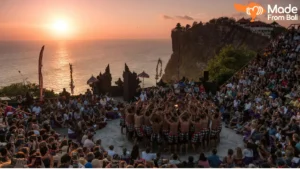
The Kecak at Uluwatu is the most famous version in Bali. It takes place at sunset on a cliff stage above the Indian Ocean, with the waves visible behind the performers. The fire elements, the rhythmic chanting of dozens of men, and the dramatic light make for a powerful visual experience. It is explicitly a performance staged for visitors, which is worth knowing, but this does not make it hollow. The choreography, costumes, and narrative all draw from the Ramayana epic with genuine intention.
The Barong dance performances in Batubulan run in the mornings and are similarly staged for visitors. Barong is a mythical lion-like creature representing good, locked in eternal conflict with Rangda, the demon queen. The narrative carries real spiritual weight in Balinese belief, and the costumes are elaborate enough that watching the performance is worthwhile on its own terms.
What genuinely differs from both is attending a village ceremony where these performances appear within their ritual context rather than as the main event. In that setting, the audience is Balinese, the timing is determined by the temple calendar rather than tourism schedules, and the atmosphere is entirely different.
The Difference Between a Staged Performance and a Village Ceremony
A common question travelers ask is whether it is acceptable to attend a Balinese ceremony as an outsider. The answer, in most cases, is yes, with the understanding that you are a quiet observer rather than a participant, and that dress code matters.
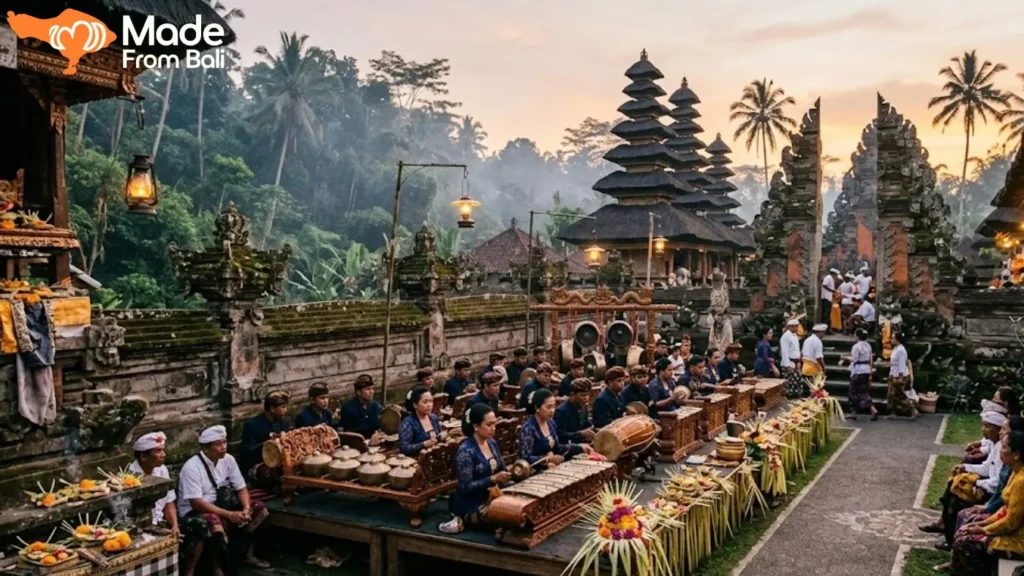
Village ceremonies are not advertised. They happen when they happen according to the Balinese Hindu calendar. A local driver who knows the area well can be one of the most reliable ways to find out when and where a ceremony is taking place during your travel dates. The ceremonies involve gamelan music (an ensemble of percussion instruments producing layered, hypnotic sound), processions carrying offerings, priests conducting rituals with holy water, and community members in traditional dress. The scale ranges from intimate family compound ceremonies to large temple festivals that fill the surrounding streets.
The difference in atmosphere compared to a ticketed performance is significant. You are not watching culture from a seat. You are standing at the edge of something that would be happening whether or not you were there.
Offerings, Rituals, and the Daily Rhythm of Balinese Spiritual Life
Some cultural experiences in Bali involve going somewhere. Others involve learning to see what is already everywhere. The offering-making tradition belongs to the second category, and it rewards visitors who are willing to slow down and pay attention.
Canang Sari Workshops: Making an Offering With Actual Meaning Behind It
Canang sari workshops are one of the most widely available cultural activities in Bali, and also one of the most variable in quality. The difference between a good one and a generic one comes down to whether the instructor explains the meaning behind what you are making, or simply guides your hands through the weaving.
A quality workshop walks you through the structure of the offering and what each element represents. The base is typically woven from young coconut leaves. Inside, flowers are placed in specific directions corresponding to Hindu deities: white to the east for Iswara, red to the south for Brahma, yellow to the west for Mahadewa, blue or green to the north for Vishnu. Incense, betel nut, and sometimes rice are added. The completed offering is placed with a short prayer.
Making one yourself, understanding what each element represents rather than just following a template, changes how you see the thousands of offerings placed around Bali during your trip. Every one of them was made by hand that morning. That context does something to the experience.
Look for workshops run by local families or community organizations rather than hotel activity desks. These sessions tend to be smaller, more conversational, and more willing to answer questions about daily spiritual life. Duration is typically ninety minutes to two hours.
Tirta Empul Water Purification: What the Experience Actually Involves
Tirta Empul is one of Bali’s most visited temples, and one of the most misunderstood. Many visitors arrive expecting a scenic pool for photos. What they find is an active place of worship where Balinese Hindus come specifically to purify themselves under a series of sacred spring-fed fountains. The distinction matters because how you behave and what you are witnessing changes completely depending on whether you understand what is happening.
The temple is located in Tampaksiring, in central Bali, about forty minutes from Ubud. The spring inside is believed to have been created by the god Indra and has been flowing continuously for over a thousand years. Balinese visitors queue at specific fountains (tirtha) as part of a melukat ritual, moving through them in sequence while praying. Each spout has a specific purpose within the ritual sequence, and Balinese visitors know which to skip and which carry particular meaning.
Tourists may participate in the water purification ritual, and many do. If you choose to, wear a sarong (available to borrow or rent at the entrance), leave time to wait rather than push, and follow the pace and behavior of the Balinese visitors around you. Do not photograph people who appear to be in prayer without consideration. The experience of standing under the cold spring water, in a thousand-year-old stone temple, surrounded by people for whom this is a sincere act of faith, is quietly powerful even without a spiritual framework of your own.
Practical note: arrive before 9am if possible. By mid-morning, the site is significantly more crowded, and the atmosphere shifts from contemplative to chaotic.
Artisan Villages That Are Still Actively Practicing Their Craft
One of the easiest ways to spend a day in Bali that feels culturally rich without feeling forced is to move through the artisan villages of the Ubud corridor. Each village has historically specialized in a specific craft, and while tourism has changed the economics, the craft traditions in many of these villages remain genuine and active.
Celuk, Mas, and Batuan: Three Villages, Three Completely Different Traditions
Understanding what each village specializes in helps you decide where to spend more time and prevents the experience from blurring into a series of souvenir shops.
Celuk is the center of Bali’s silversmithing and goldsmithing tradition. Family workshops here have been producing intricate jewelry for generations, using techniques passed down through training that begins young. The work is detailed and time-consuming: filigree patterns, granulation, and stone-setting done by hand with small tools. You can watch artisans working in open workshops, which is genuinely interesting independent of whether you intend to purchase anything.
Mas is a woodcarving village. The carvings here range from highly decorative figures used in temple contexts to more contemporary sculpture. The carvers work with a range of woods including hibiscus and albesia, and the skill difference between a piece made for tourist markets and one made with care is visible if you take time to look. Ask which pieces are workshop-made and which are carved by the person you are speaking to.
Batuan is one of Bali’s oldest painting villages. The Batuan style is distinctive: dense, detailed compositions with black ink on white paper or canvas, typically depicting scenes from mythology, ceremony, and daily life. The style developed in the 1930s partly through contact with Western artists who settled in Bali, and it remains one of the most recognizable visual traditions on the island.
A route that covers all three in one morning is manageable, especially with a driver who can wait while you spend time in workshops rather than rushing between stops.
How to Visit Without It Feeling Like a Shopping Detour
The most common frustration with artisan village visits is the pressure to buy. It is real, particularly in larger showrooms that cater to tour groups. A few adjustments make the experience more comfortable.
Start early, before the tour buses arrive. Many family workshops are more relaxed in the morning hours and more willing to show you the process rather than redirect you toward a display case. If a showroom has a car park designed for coaches, it is probably oriented toward sales rather than craft demonstration. Look for the smaller family workshops on the side streets. Engage with the process genuinely and you are more likely to have an actual conversation.
You are not obligated to purchase, but if something genuinely interests you, buying directly from the artisan rather than a large showroom ensures the money reaches the right person.
Penglipuran and Tenganan: When Village Life Is the Experience
Not all cultural experiences in Bali involve a specific activity. Some of the most valuable simply involve being in a place where traditional community structure is still intact and observable.
What Makes Penglipuran Worth a Half-Day Visit
Penglipuran village in Bangli regency is often described as one of the most well-preserved traditional villages in Bali, and this is accurate in a meaningful way. The village layout follows a strict north-south axis oriented toward the sacred volcano, Gunung Batur. Each family compound is built according to traditional spatial rules, with the same gate design repeated along the main path. The uniformity is not a reconstruction. It reflects the village’s active commitment to its adat (customary law), which includes building regulations that prevent modern construction styles from altering the streetscape.
Walking the main path through Penglipuran takes about thirty minutes at a relaxed pace. What makes it worth extending to a half-day is the surrounding bamboo forest, which is one of the largest in Bali and protected by the village itself as a sacred grove. The combination of the traditional village and the forest makes for a genuinely quiet experience, particularly in the early morning before the day-tour groups arrive.
The village entrance has a small fee. Locals live and work here, so treat it as a neighborhood you are a guest in rather than an attraction.
Tenganan and the Geringsing Weaving Tradition Few Travelers Know About
Tenganan Pegringsingan is a different kind of village entirely, and far fewer travelers make the effort to reach it. Located in east Bali near Candidasa, about two hours from Ubud, Tenganan is one of the Bali Aga villages, meaning it predates the arrival of Javanese Hindu influence on the island. The Bali Aga people have maintained distinct customs, architecture, and practices that differ from the majority Balinese culture most visitors encounter.
The village is famous for producing geringsing, a type of double ikat textile that is among the most technically complex traditional fabrics in the world. Double ikat means that both the warp and weft threads are resist-dyed before weaving, requiring both sets of threads to align perfectly during the weaving process to produce the intended pattern. Tenganan is one of only three places in the world where double ikat is produced, and it is the only place in Bali.
The weaving is slow. A single piece can take years to complete. The completed textiles are used in ceremonies and are believed to hold protective and healing properties. You can observe weavers working in open pavilions, and pieces are available for purchase at prices that reflect the labor involved.
Tenganan also hosts the annual Perang Pandan festival, a ritual battle where young men compete by scratching each other with thorny pandan leaves. It is a sacred ritual tied to the worship of the god Indra, and watching it during the right season (typically June) is one of the more genuinely unusual cultural experiences available anywhere in Bali.
Cooking Classes in Bali: What Separates the Useful Ones From the Generic
A Balinese cooking class sounds like a fairly standard tourist activity, and some of them are. The better ones teach you something that actually changes how you understand food, and the gap between the two is wider than most travelers expect.
Market Visits Before the Kitchen Session Change the Whole Experience
The cooking classes worth choosing almost always begin at a traditional wet market rather than a hotel kitchen. This is not just an itinerary detail. The market visit is where the actual cultural learning happens.
Balinese cooking depends on fresh ingredients prepared each morning. Base genep, the complex spice paste that forms the foundation of many Balinese dishes, includes shallots, garlic, galangal, ginger, turmeric, lesser galangal, candlenut, coriander, and several other aromatics combined in specific proportions. The variations in these proportions define regional differences within Balinese cuisine that rarely appear in any tourist-facing explanation.
At a good market, a knowledgeable instructor will show you how to select ingredients, explain which varieties are preferred for specific uses, and introduce you to things you would not recognize on sight. The sensory experience of a traditional market, the sounds, the organization of produce by color and use, the interactions between vendors and regular customers, is itself a cultural education that the kitchen session builds on.
What Dishes Are Worth Learning and Why They Are Hard to Replicate Elsewhere
Balinese cuisine is not the same as Indonesian cuisine in general, and even within Bali, the food varies significantly between regions. A few dishes are worth learning specifically because they are genuinely difficult to replicate outside the island.
Lawar is a mixture of finely chopped vegetables, coconut, and spices, sometimes with minced meat, bound with a spice paste. The balance of flavors is complex: saline, herbaceous, faintly bitter, slightly smoky. Getting it right requires ingredients that do not travel well, which is part of why it tastes different in Bali than anywhere you might try to recreate it.
Sate lilit is minced fish or chicken combined with spiced coconut and grated coconut, wrapped around a skewer of lemongrass or bamboo rather than pressed onto a straight stick. The lemongrass imparts flavor during cooking, and the texture of the minced mixture is specific to this preparation style.
Jukut ares is a banana trunk soup with spiced broth, an ingredient that most visitors have never cooked with and that requires specific knowledge to prepare properly.
Learning these dishes in a class gives you both the technique and enough understanding of the flavor logic to appreciate what you are eating for the rest of your trip.
Timing a Cultural Trip in Bali Makes a Bigger Difference Than Most Guides Admit
The cultural experience of Bali changes significantly depending on when you visit, not just in terms of weather, but in terms of what you can witness. Planning around the Balinese calendar is one of the most underused tools available to a culturally curious traveler.
Galungan, Nyepi, and the Bali Arts Festival: How to Plan Around Them
Galungan is one of the most important celebrations in the Balinese Hindu calendar. It marks the time when ancestral spirits are believed to return to earth and visit their families. In the days before Galungan, villages erect penjor, tall bamboo poles adorned with woven coconut leaves, offerings, and sometimes fruit, which line every road in Bali. The effect of driving or walking through Bali during this period is visually unlike anything else the island offers. Galungan lasts ten days and is followed by Kuningan, when the spirits are believed to return to the spirit world.
Galungan occurs on the 210-day Balinese Pawukon calendar, meaning it falls roughly twice per year on the Gregorian calendar. It is worth checking the dates when planning your trip.
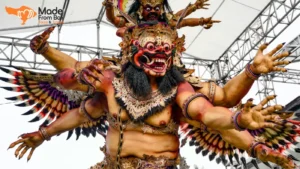
Nyepi, the Balinese Day of Silence, falls on the Saka new year and is unlike any public observance you are likely to encounter anywhere else. The entire island observes a complete day of silence. No vehicles on the roads, no lights visible from outside buildings, no noise, no activity. The airport closes. Even international flights do not land. The night before Nyepi, the Ogoh-ogoh parade takes place: enormous papier-mache demons paraded through the streets with fire and gamelan music before being symbolically destroyed. Experiencing both the parade and the silence the following day is one of the more remarkable things Bali offers. Tourists staying in Bali during Nyepi are asked to remain inside their accommodation for the duration of the day.
The Bali Arts Festival (Pesta Kesenian Bali) runs for approximately one month between June and July at the Taman Werdhi Budaya arts center in Denpasar. It includes performances, exhibitions, and demonstrations across the full spectrum of Balinese performing and visual arts. The opening parade alone, which moves through central Denpasar with hundreds of performers in traditional dress, is worth attending.
Morning vs. Afternoon Visits at Major Cultural Sites
Timing within the day matters as much as timing within the year. Most of Bali’s major cultural sites are significantly less crowded before 9am. This is not just about avoiding queues. At many temples, the early morning hours are when Balinese worshippers are most present, and the atmosphere reflects this.
| Site | Best Time | Why |
|---|---|---|
| Tirta Empul | 7:00 – 9:00 am | Fewer tourists, more Balinese worshippers, quieter atmosphere |
| Tegalalang Rice Terrace | 7:00 – 8:30 am | Soft morning light, before swing operators set up |
| Uluwatu (Kecak) | 6:00 pm | Sunset timing is the point; performance starts around 6pm |
| Besakih Temple | 8:00 – 10:00 am | Before tour groups, cooler temperature at elevation |
| Penglipuran Village | 8:00 – 9:30 am | Before day tour buses; quieter, more genuine atmosphere |
| Traditional Markets | 6:00 – 8:00 am | Peak activity; vendors present, freshest produce |
Afternoon visits to outdoor sites often coincide with heat and crowds simultaneously, which affects both comfort and the quality of what you experience.
What to Keep in Mind Before Entering Temples or Joining Ceremonies
Practical preparation prevents the most common moments of awkwardness that visitors experience at Balinese temples. Most of these situations are avoidable with basic information that is easy to act on.
Clothing, Behavior, and Photography: The Practical Side
The dress code at Balinese temples is not a formality. It is a sincere requirement rooted in the belief that the sacred space must be respected through appropriate appearance. The requirements are:
- Sarong: A wraparound cloth covering the lower body. Most temples provide them to borrow at the entrance for a small fee, or you can purchase one in any market.
- Sash or selendang: A fabric tied around the waist, worn over the sarong. Also usually available at temple entrances.
- Covered shoulders: Not always strictly enforced, but appropriate and appreciated, particularly at smaller or more active ceremonial sites.
Women who are menstruating are traditionally asked not to enter certain temple areas, as Balinese Hinduism considers this a period of natural impurity. Signs at many temples communicate this, and it is worth understanding the reasoning rather than treating it as an inconvenience.
Photography at temples and ceremonies is a genuinely sensitive topic. At tourist-facing sites like Uluwatu, cameras are accepted everywhere. At a village ceremony you happen to be observing, the situation is different. Ask someone nearby if it is acceptable, or follow what other respectful observers are doing. Photographing priests during active rituals, or pointing a camera directly at someone in prayer, is inappropriate regardless of how visually striking the scene is.
At temples and ceremonies:
- Walk clockwise around sacred structures (following the direction of ritual movement)
- Do not touch or step over offerings on the ground
- Keep your head lower than the highest point of a shrine when passing in front of it
- Speak quietly and do not turn your back to sacred spaces while walking away
When Tourists Are Welcome and When to Simply Observe From a Distance
Most ceremonies in Bali that occur in public spaces, along streets or in open temple courtyards, are observable by respectful visitors. You are generally welcome to stand at the edge and watch, provided you dress appropriately and behave with obvious respect.
Cremation ceremonies (ngaben) are sometimes attended by tourists, and in many cases this is acceptable, as Balinese cremations are festive rather than somber events. The body is carried in a tall ceremonial tower through the streets to the cremation site. If you witness one unexpectedly, it is generally fine to observe quietly from a respectful distance.
Where caution is more appropriate: small family compound ceremonies, inner temple sanctuaries during active rituals, and any ceremony where it is clear that your presence is conspicuous. If you are not sure, wait and observe before entering.
Matching Cultural Experiences to the Kind of Trip You Are Taking
Not every experience suits every traveler, and pretending otherwise is one of the ways travel content fails people. The honest answer is that some cultural activities in Bali require physical ease, patience, or tolerance for sensory intensity that not everyone has in equal measure.
For Couples Looking for Something More Meaningful Than a Spa Day
Couples who want shared experiences that go beyond standard relaxation tend to respond best to activities that involve some degree of learning or participation together. Cooking classes are a reliable choice partly because they are social by nature: working alongside each other in a market and kitchen environment creates genuine interaction rather than parallel quiet.
Sunset at Uluwatu with the Kecak performance offers obvious visual appeal and works well for couples as an evening anchor. For something quieter and less crowded, a late afternoon visit to Tirta Empul, followed by dinner in Ubud, tends to be more atmospheric.
An evening walk through a Balinese village during Galungan, when the streets are lit and the penjor are up, is consistently described by visitors as one of the most memorable moments of their trip. It requires no booking and no ticket. Just being present in the right place at the right time.
Solo Travelers and Small Groups: Experiences That Work Better With Flexibility
Solo travelers in Bali often have the easiest time finding genuine cultural connection because they are less conspicuous and more available for spontaneous interactions. Smaller groups also tend to access more interesting spaces than large tour groups.
Canang sari workshops, particularly those run by small local operators or individual families, tend to be more intimate and conversational with smaller numbers. The instructor is more likely to answer genuine questions when there are three people in the room rather than fifteen.
For solo travelers, joining a shared cultural day tour can be worthwhile for the social dimension as well as the logistics. Made From Bali arranges private tours that can be shaped around a traveler’s specific interests: purely cultural, mixed cultural and natural, or centered on a particular area like east Bali’s villages or the artisan corridor near Ubud. Private arrangements allow the timing flexibility that makes early morning temple visits or spontaneous ceremony attendance possible in a way that fixed group schedules cannot accommodate.
Small groups of four to eight people often find that splitting between two cultural anchors per day, one morning experience and one late afternoon or evening experience, produces a more satisfying pace than trying to cover five or six sites. Bali’s traffic, particularly around Ubud and South Bali between 10am and 6pm, should factor into any multi-stop day.
Planning the Cultural Side of a Bali Trip Without Overloading the Itinerary
The most common planning mistake for culturally curious visitors to Bali is trying to cover everything and experiencing nothing fully. A week in Bali is enough to understand the cultural landscape if the days are organized well. It is not enough to do everything.
A useful frame: think about your trip in terms of cultural categories rather than individual sites. One village experience (Penglipuran or Tenganan), one ceremony or performance (Kecak at Uluwatu or a village ceremony), one craft activity (cooking class or artisan village morning), and one spiritual site (Tirta Empul or Besakih) gives you a genuinely broad picture of what Balinese culture offers without creating a schedule that feels like a checklist.
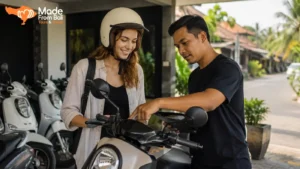
The other practical consideration is transport. Bali is not a walkable destination outside of specific neighborhoods in Ubud. Cultural sites in the Ubud corridor, east Bali, and north Bali require reliable transport, and the quality of the experience often depends on whether your driver can provide context rather than just navigation. A knowledgeable local driver who speaks comfortably about what you are seeing, knows which ceremonies are happening during your dates, and can adjust the route based on real conditions is one of the most undervalued parts of a cultural trip in Bali.
Checking the Balinese calendar before finalizing travel dates is worth doing even briefly. If your dates overlap with Galungan, Nyepi, or the Bali Arts Festival, shape your itinerary around that. If they do not, you will still find plenty. But if they do, let the calendar drive some of your planning rather than fighting it.
Bali’s cultural depth is not something you exhaust. Travelers who have visited five or six times still encounter ceremonies they have never seen, villages they have not walked through, and rituals whose meaning they are still learning. That is not a failure of planning. It is the nature of a culture that is still genuinely, actively alive.