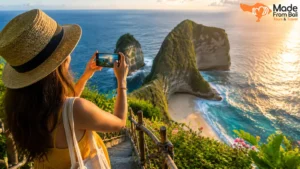


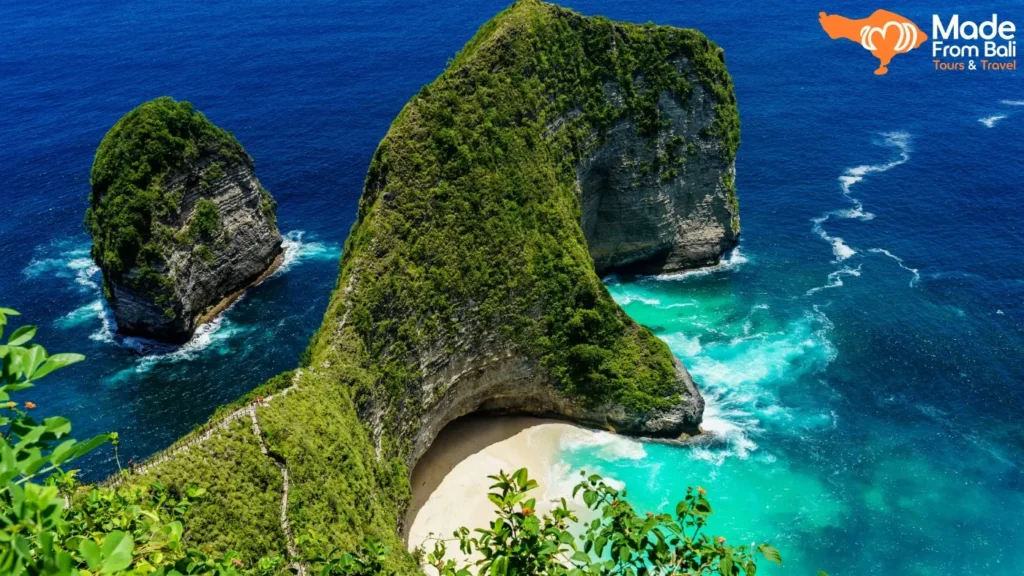
Open Instagram and search “Bali beach” long enough, and eventually the same cliff shows up. A jagged headland curling out into turquoise water, shaped so precisely like a dinosaur that everyone calls it T-Rex Bay. That photo is Kelingking Beach, on the island of Nusa Penida, and it has probably shaped more Bali itineraries than any other single beach in Indonesia.
What the photo doesn’t show is everything that happens before and after the camera clicks. It doesn’t show the boat crossing and scooter ride needed just to reach the clifftop, the unfinished glass elevator still standing behind the viewpoint, the sign warning that swimming below is banned, or the line of people waiting their turn on a narrow set of stairs. None of that makes Kelingking any less worth visiting. It just means the day works out better when you know what you’re walking into before you get there, not after.
This guide covers what a visit to Kelingking Beach actually involves in 2026, from the boat crossing to the descent, the ongoing dispute over the cliffside lift project, and the practical decisions that separate a smooth day from a rushed, confusing one.
Why Kelingking Beach Photos Rarely Match the Real Visit
The gap between the photo and the place itself catches almost every first-time visitor off guard. It isn’t that the photos are fake. It’s that they’re taken from angles, heights, and moments that most visitors never actually stand in, and knowing that in advance changes how you experience the first five minutes at the top of the cliff.
The T-Rex Shape Is Real, But the Angle in Photos Isn’t Where You’ll Be Standing
The dinosaur silhouette that made Kelingking famous is genuine. The headland really does curve into a shape that reads as a head, a spine, and a tail when seen from the right position. The problem is that the most iconic version of that shot, the one showing the full creature outline against the water, is usually taken by drone or from a position further along the ridge trail than most visitors realize exists.
Standing at the main viewing platform near the parking area gives a dramatic but partial view. To get closer to the classic wide shot, you need to walk a few minutes along the marked ridge path that runs along the top edge of the cliff, which is flat and safe but often skipped by visitors who assume the platform is the only vantage point. If the shape looks less obviously “T-Rex” from where you’re standing, walking that extra stretch usually solves it.
What the Viewpoint Looks Like on a Normal Morning
In practice, the viewpoint area is a cleared clifftop lot with parking space, a row of warungs selling coconuts and snacks, a fenced overlook, and a set of stairs leading down toward the spine of the headland. Macaques are often seen along the fence line, curious about food but generally not aggressive if left alone. On a typical morning, there will be a queue for the single most photogenic spot on the railing, groups negotiating photo turns, and fee collectors near the parking area.
None of this shows up in the polished shots circulating online, which is exactly why arriving with realistic expectations matters more than arriving with the “right” camera settings. The view itself is not exaggerated. The empty, quiet version of it in most photos usually is.
Getting to Nusa Penida Before You Even Reach Kelingking
A surprising amount of a Kelingking day is spent simply getting to the island, and underestimating this part is one of the most common reasons visitors feel rushed once they finally reach the cliff.
Sanur to Nusa Penida by Fast Boat and What the Crossing Feels Like
Most visitors depart from Sanur Harbor in southeast Bali, where several fast boat operators run crossings to Nusa Penida throughout the morning. The trip typically takes thirty to forty five minutes and costs somewhere between ten and thirty US dollars for a one way ticket, depending on the operator and how far in advance you book.
The crossing can be smooth or genuinely rough depending on swell conditions, so travelers prone to motion sickness are usually better off taking something before boarding rather than after symptoms start. Boarding itself involves wading a short distance into the water from the beach, so sandals or shoes you don’t mind getting wet are worth packing instead of anything you plan to wear for photos later. Boats arrive at Banjar Nyuh or Toya Pakeh harbor on the northwest side of Nusa Penida, which is still roughly thirty to forty five minutes by road from Kelingking itself.
Scooter, Private Driver, or Tour, Choosing How You’ll Reach the Cliff
Once on Nusa Penida, there are three realistic ways to reach Kelingking, and each one changes the shape of the rest of your day, not just the cost.
| Option | Typical Cost | Best Suited For | Main Tradeoff |
|---|---|---|---|
| Self-drive scooter | Around 70,000 to 100,000 IDR per day | Confident riders who want full flexibility on timing | Roads on Nusa Penida remain uneven in stretches, and riding tired after a hike back up the cliff adds real risk |
| Private driver | Priced per vehicle for the day, shared across your group | Couples, families, or small groups who want the logistics handled | Costs more per person if traveling solo, but removes navigation and fatigue from the equation entirely |
| Organized group tour | Fixed per-person rate, often bundled with boat tickets | Solo travelers or those on a tight schedule who want a set itinerary | Timing is fixed to the group, so you may arrive during the busiest midday window |
Scooters remain the cheapest option and the most flexible for travelers who want to linger somewhere longer than planned. A private driver removes the physical toll of riding on rough roads immediately after a demanding descent, which matters more than people expect once legs are already tired from the climb back up. Group tours work well for solo travelers mainly because they solve the boat and transport coordination in one booking, though they leave less room to adjust timing around crowds.
The Unfinished Glass Lift and Why It Still Matters for Your Visit
Anyone who last researched Kelingking Beach a few years ago is likely to arrive expecting the clean, unobstructed clifftop shown in older photos. What they’ll actually see behind the viewpoint is a large, unfinished steel and glass structure, and understanding what it is prevents unnecessary confusion or concern on arrival.
What the Lift Project Was Supposed to Solve
Construction on a glass elevator running down the cliff face began in 2023 and 2024, led by an investment group connected to a China-based developer. The plan included a roughly 180 meter glass elevator shaft, a ticketing building, an elevated bridge, and a multi-level restaurant with a large panoramic overlook. The stated purpose was to give visitors an easier and safer way to reach the beach below without the steep hike, and to serve as a faster evacuation route in the event of an emergency on the trail.
The project was controversial from the start. Local residents and Bali’s own tourism community argued that Kelingking’s value comes from its untouched, dramatic landscape, and that a large permanent structure on the cliff face would permanently change both the view and the character of the site.
Where the Court Case and Demolition Order Stand Right Now
In October 2025, a provincial inspection committee reviewed the site and found that construction was taking place inside a designated disaster mitigation zone without complete environmental and marine permits. Following that finding, work was suspended and the site was sealed by Bali police. In November 2025, Bali’s governor formally requested that the structure be dismantled.
Since then, the situation has moved slowly through official channels. Reprimand letters were issued through early 2026 giving the developer a demolition deadline, and by mid-2026 the unfinished structure was still standing, sealed and out of use. The developer has since filed a legal challenge against the Bali provincial government at the Denpasar Administrative Court, and as of mid-2026 that case remains active, with court officials having conducted a site inspection as part of the ongoing proceedings.
In plain terms, the lift’s legal status is unresolved. It hasn’t been completed, it isn’t operating, and it hasn’t yet been removed either.
What This Means for How You’ll Reach the Beach
The practical takeaway for visitors is straightforward: there is currently no working lift or elevator at Kelingking Beach, regardless of what older marketing photos or outdated blog posts may suggest. The construction zone sits behind and to the side of the main viewpoint, and the public paths, the viewpoint platform, and the hiking trail down to the beach have remained open and unaffected throughout the dispute.
You will likely see the crane and the partially built structure in the background of your own photos, which can look jarring compared to older images of the site. It isn’t a safety hazard for visitors staying on the designated paths, but it is a reminder that the only way down to the sand, for now, is still the same steep trail travelers have used for years.
Deciding Between the Viewpoint and the Full Hike Down
Not everyone who visits Kelingking goes all the way to the beach, and that’s not a lesser way to experience it. The decision comes down to fitness, available time, and how much heat and exposure you’re comfortable with, not to whether you’re doing the trip “properly.”
What the Descent Actually Involves Step by Step
The hike down follows a fairly consistent sequence, and knowing what each stretch involves makes it easier to judge whether it fits your day.
- From the parking area to the top of the stairs. This first stretch is mostly flat walking past the warungs and viewpoint platform, taking only a few minutes.
- The steep concrete staircase down the spine. This is the main part of the descent, following the ridge of the T-Rex shape down the cliff face. Concrete steps and handrail sections have replaced the old bamboo and timber path from years past, though the incline remains steep throughout. Most reasonably fit adults take thirty to forty five minutes to reach the bottom.
- The final loose section near the shoreline. The last stretch levels out but can involve looser rock and dirt, which becomes noticeably more slippery after rain.
- Arrival at the beach. Once at the bottom, there’s soft white sand, dramatic cliff walls on both sides, and a set of beach caves on the right, though high tide can flood them and make them inaccessible.
- The climb back up. This is the part visitors consistently underestimate. Reversing the same stairs under a rising sun, with legs already tired, typically takes noticeably longer than the way down.
Signs You Should Stay at the Top Instead
The hike isn’t dangerous for a healthy adult moving carefully, but it genuinely isn’t suited to everyone, and there’s no real downside to skipping it. The viewpoint alone still delivers the photo and the view that made Kelingking famous in the first place.
- You have joint issues, limited mobility, or are traveling with young children who would need to be carried on uneven steps.
- You’re visiting in the middle of the day under full sun, without enough water for a round trip that can take over two hours.
- You’re on a tight schedule before a boat departure or another stop later that day.
- It’s rained recently and the lower sections are likely to be slick.
- You’re uncomfortable on narrow paths with steep drops, even with handrails present.
How Long the Round Trip Takes Once You Add Rest Stops
A viewpoint-only visit, including photos, usually takes twenty to thirty minutes from the moment you park. The full descent and return, once you account for rest breaks on the way back up and time spent actually enjoying the beach, realistically takes two to two and a half hours. That difference matters most when Kelingking is one stop among several in a single day, which is how most visitors actually experience it.
The Swimming Ban Nobody Mentions Until They’re Already There
The turquoise water at the base of Kelingking looks calm and inviting from the clifftop, which is exactly why so many visitors are surprised to learn, often only after arriving at the beach, that swimming there is officially prohibited.
Why the Water Looks Calm But Isn’t
Height and distance flatten out the ocean’s surface visually, hiding the strength of the currents underneath. Kelingking’s bay funnels open ocean swell into a narrow space, which produces strong rip currents and unpredictable waves that are far more dangerous at sea level than they appear from above. Swimming has been officially banned at Kelingking since February 2023, after a tourist drowned attempting to rescue another swimmer who had been caught in the current. Despite the ban, visitors are still occasionally seen entering the water, which is part of why the restriction remains actively enforced through signage and, at times, staff presence near the shoreline.
What to Do at the Beach Instead of Swimming
Skipping the water doesn’t mean skipping the beach experience itself. There’s still plenty worth the walk down.
- Walk the shoreline and take in the scale of the cliffs from sea level, which feels completely different from the clifftop view.
- Explore the beach caves on calmer, lower-tide visits, keeping an eye on incoming water so you’re not caught inside as the tide rises.
- Photograph the waves breaking against the base of the formation, which is a angle almost nobody captures from the top.
- Enjoy the relative quiet, since far fewer visitors make it all the way down compared to the crowded viewpoint above.
Timing Your Visit Around Crowds, Heat, and Boat Schedules
Crowding is one of the most common complaints about Kelingking, and it follows a fairly predictable pattern tied directly to how most day tours are scheduled from mainland Bali.
Why Midday Arrivals Meet the Biggest Crowds
Most group tours depart Sanur on similar early morning boats, arrive on Nusa Penida by mid-morning, and then travel the thirty to forty five minutes to Kelingking together. That means the viewpoint and parking area see their heaviest concentration of visitors roughly between ten in the morning and two in the afternoon, when multiple tour groups overlap. During this window, expect longer queues at the main photo spot, a fuller parking area, and busier warungs.
Sunrise Versus Late Afternoon, Which One Delivers
Both ends of the day offer a meaningfully different experience than the midday rush, but each comes with its own logistics.
| Timing | What You Gain | What It Requires |
|---|---|---|
| Sunrise | Soft light, minimal crowds, cooler hiking conditions | Very early departure, realistically only practical if staying overnight on Nusa Penida rather than day-tripping from Bali |
| Late afternoon (after 3pm) | Thinner crowds as day-tour groups head back for return boats, warm evening light | If planning to hike down, daylight becomes the limiting factor, since the trail has no lighting and needs to be finished before dark |
For most day-trippers coming from mainland Bali, late afternoon is the more realistic option of the two, though it does mean planning the hike down, if you’re doing it, earlier in that window rather than right before sunset.
What a Kelingking Stop Looks Like Inside a Full Nusa Penida Day
Very few visitors come to Nusa Penida for Kelingking alone. Understanding how it fits alongside nearby attractions helps prevent the kind of overpacked itinerary that turns a relaxed day into a rushed one.
Pairing Kelingking With Angel’s Billabong and Broken Beach Without Rushing
Angel’s Billabong and Broken Beach sit reasonably close to Kelingking along the island’s west coast, typically fifteen to thirty minutes apart by road depending on conditions. A common day-tour structure visits Kelingking either first, to beat the crowds before other groups arrive, or last, to avoid competing with the busiest midday window at the most photographed stop. Either order works, but starting the day at Kelingking generally gives more breathing room if you plan to hike down, since fatigue and heat both build as the day goes on.
Why Some Itineraries Feel Too Packed for This Particular Stop
A common mistake, especially with budget group tours, is combining a full Kelingking hike with several snorkeling stops and a second cluster of east coast attractions like Diamond Beach or Atuh Beach in the same single day. Nusa Penida’s roads add real driving time between clusters of sites, and cramming both the west and east coast highlights into one day usually means rushing through Kelingking specifically, since it’s the stop that actually needs a dedicated time block if you’re doing the descent. Choosing one coastal loop, rather than trying to cover the entire island in a single day, generally leads to a more enjoyable visit to Kelingking itself.
Costs, Fees, and What Actually Changes If You Join a Tour
Understanding the actual cash flow of a Kelingking visit helps avoid surprises, especially since Nusa Penida still runs largely on a cash-only basis.
Entrance, Parking, and the Small Cash Payments You’ll Need
There is no formal ticketed entrance fee to Kelingking Beach itself, but a small parking and site access fee, generally in the range of 5,000 to 10,000 IDR per vehicle, is collected in cash at the parking area. Beyond that, budget for the fast boat crossing, scooter rental or driver costs, and incidentals like snacks from the clifftop warungs.
- Fast boat, Sanur to Nusa Penida: roughly 150,000 to 450,000 IDR one way, depending on the operator
- Scooter rental: 70,000 to 100,000 IDR per day
- Parking and site access at Kelingking: 5,000 to 10,000 IDR per vehicle
- Private driver or organized tour: priced per day or per person, bundled pricing varies by operator
ATMs on Nusa Penida are known to be unreliable, so it’s worth carrying enough rupiah for the whole day before crossing over from Bali, rather than assuming you’ll be able to withdraw cash once there.
Where a Private Driver Saves Time, Not Just Effort
A self-drive scooter remains the cheapest way to reach Kelingking, but the savings come with a real cost in navigation stress and physical fatigue, particularly on the ride back after already hiking down and up the cliff. A private driver or a structured full-day route, the kind that bundles hotel transfer, fast boat tickets, and island transport into a single booking, removes that layer of logistics entirely and tends to suit travelers who want to combine Kelingking with a few other west coast stops without managing each leg separately. For groups or couples splitting the cost, the price difference against a self-drive scooter often ends up smaller than expected once fuel, insurance, and the hassle of navigating unfamiliar roads are factored in.
Who Kelingking Beach Fits and Who Might Enjoy Diamond Beach More
Not every traveler gets the same value out of Kelingking, and being honest about that upfront saves a wasted trip for some visitors.
| Traveler Profile | Recommendation |
|---|---|
| First-time visitors wanting the iconic photo | The viewpoint alone delivers this, no hike required |
| Fitness-focused or adventure travelers | The full descent is genuinely rewarding and worth the time commitment |
| Families with young children or elderly travelers | Stick to the viewpoint, or consider Diamond Beach, which offers easier clifftop access |
| Travelers who specifically want to swim | Diamond Beach or Crystal Bay are better suited, since swimming is possible there with normal caution, unlike Kelingking |
| Travelers short on time | A viewpoint-only stop fits easily into a packed itinerary, while the full hike needs a dedicated block of at least two hours |
Making Kelingking Beach an Easy Part of Your Nusa Penida Day
Kelingking Beach earns its reputation honestly. The shape of the cliff, the color of the water, and the scale of the view are all genuinely as striking in person as they are online. What changes the experience isn’t the beach itself, it’s whether you arrive knowing that the glass lift isn’t operational, that swimming is off limits for good reason, and that the hike is a real physical undertaking rather than a quick photo detour.
None of that needs to complicate your plans. Deciding in advance whether you’re going for the viewpoint or the full descent, timing your arrival away from the midday crowd, and pairing Kelingking with the right nearby stops turns a potentially chaotic day into a straightforward one. If you’d rather have someone handle the boat timing, the road conditions, and the pacing between stops, that’s exactly the kind of day the Made From Bali driver team puts together regularly for travelers heading over to Nusa Penida’s west coast, leaving you free to focus on the climb, the view, and the photo you came for.