

Most travelers arrive in Ubud with a rough list of places they have seen on Instagram and a vague plan to “figure it out” once they land. What they often discover within the first afternoon is that Bali does not work that way. Distances are deceptive, traffic is real, and the difference between a well-timed visit and a rushed, frustrating one comes down to decisions made before you ever leave the hotel.
This guide is not another list of attractions. It is built for travelers who want to understand what is actually near Ubud, how to choose between experiences that feel similar on paper, and how to build a plan that fits the way they travel. Whether you have one day or three, whether you are a couple looking for something quietly memorable or a small group that wants a mix of adventure and culture, the information here is meant to help you decide with confidence rather than guess.
Made From Bali Tour and Travel has been helping travelers navigate Ubud and its surroundings for years. What follows reflects that on-the-ground knowledge.
The Area Around Ubud Is Larger Than Most Maps Suggest
Open a map and Ubud looks compact. Everything seems close together, and it is tempting to assume you can cover Tegalalang, Tirta Empul, a waterfall, and the Monkey Forest in a single morning. You cannot. Not comfortably, and not without spending most of your day in a car crawling through traffic.
The problem is that Bali’s roads were not designed for the volume of visitors they now carry. A destination that looks 15 kilometers away might take 45 minutes on a quiet morning and well over an hour during the mid-morning rush. Planning without accounting for this is one of the most common reasons trips near Ubud end up feeling disappointing.
A Simple Way to Think About the Four Zones Near Ubud
Rather than thinking in terms of individual attractions, it helps to group everything by geographic zone. This is how experienced local drivers plan their days, and it dramatically reduces wasted travel time.
North Zone: Kintamani, Mount Batur, and the Coffee Plateau
This zone sits roughly 45 to 60 minutes north of central Ubud. It includes Mount Batur, the caldera lake of Danau Batur, coffee and cocoa plantations around Kintamani, and the cooler, greener highlands around Penelokan. If your plan involves a sunrise hike up Mount Batur, your entire day belongs to this zone. It is too far to combine comfortably with southern or eastern attractions in a single trip.
South Zone: Gianyar, Tegenungan, and the Bird Park
Twenty to 35 minutes south of Ubud, this zone holds some of the most visited attractions on the island: Tegenungan Waterfall, the Bali Bird Park, the village of Mas (known for wood carving), and Kemenuh Butterfly Park. The south zone works well for travelers who want to ease into Ubud exploration without committing to a long drive.
Central Zone: Ubud Town and Its Immediate Surroundings
This covers the Campuhan Ridge Walk, the Monkey Forest, Ubud Palace, Saraswati Temple, the art market, and a handful of rice field walks that begin right in town. These require minimal transport and are best explored on foot or by a short scooter ride. Most visitors spend their first and last days here.
East Zone: Tampaksiring, Gunung Kawi, and Tirta Empul
About 25 to 40 minutes northeast of central Ubud, this zone contains some of the most historically significant sites on the island. Tirta Empul, Gunung Kawi, and the scenic rice field views of Tampaksiring all sit along a single route, making this one of the most efficient zone-based day plans available.
Understanding these four zones means you can build a realistic itinerary instead of a wishful one.
What Most Travelers Spend Their First Day Doing Near Ubud (and Whether It Still Holds Up)
There are three attractions that appear on virtually every “things to do near Ubud” list, and for good reason. They remain popular because they genuinely deliver. The issue is not the attractions themselves. It is the timing, the expectations, and the lack of context that tends to make the experience feel underwhelming for travelers who arrive unprepared.
Tegalalang Rice Terrace: What to Expect Beyond the Instagram Version
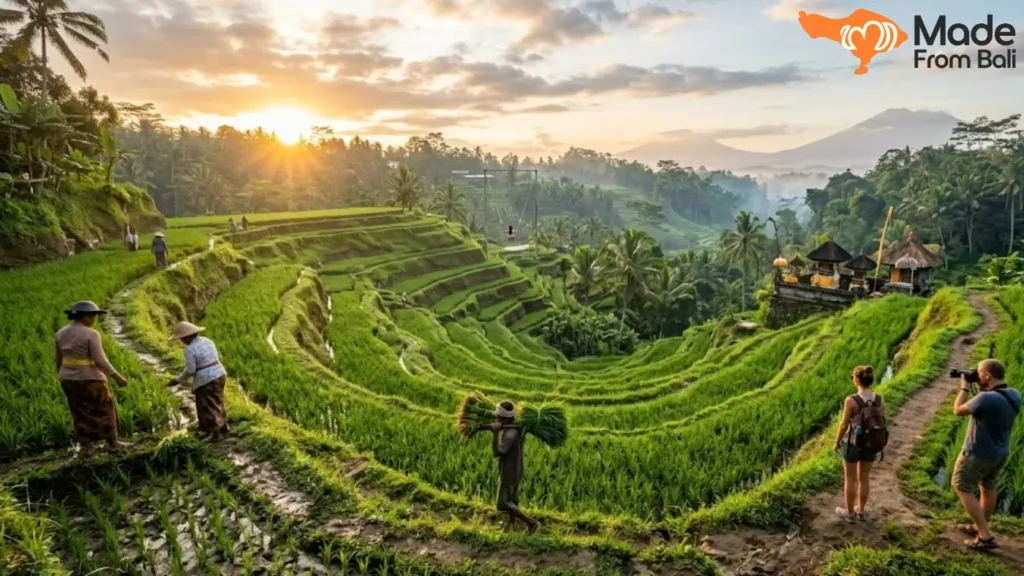
The terraces at Tegalalang are real, and they are genuinely beautiful. Layers of bright green rice paddies drop down into a narrow valley fed by the traditional Balinese subak irrigation system, which UNESCO recognized as part of the island’s cultural landscape. The engineering behind it, channels carved into hillsides to carry water across different elevation levels, is worth appreciating on its own.
What the photos do not show is what surrounds the viewing areas by 10 AM: a dense crowd of visitors, aggressive offers to purchase swings and photo opportunities, and a noise level that makes the scene feel more like a theme park than a natural landscape. This is not an exaggeration. Tegalalang is one of the most commercially developed attraction zones near Ubud.
The fix is simple but requires discipline: arrive before 8 AM. In the early morning, the light is soft, the vendors are still setting up, and the terraces have a calm that makes them feel exactly as stunning as they appear in photographs. If you cannot arrange an early visit, consider this a secondary stop on your way between other destinations rather than a primary goal.
Entry to the terrace viewing areas is typically around 20,000 to 50,000 IDR depending on which access point you use. The Bali swing experiences offered here range widely in price and quality. If you want that experience, research specific operators in advance rather than choosing one on the spot.
Tirta Empul Temple: More Than a Photo Stop
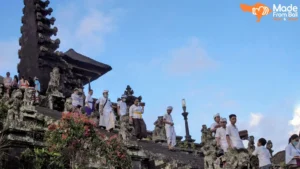
Pura Tirta Empul sits about 35 minutes northeast of central Ubud and is one of the most spiritually significant temples in Bali. The temple was built around a natural spring believed to have purifying properties, and the melukat ceremony, a ritual purification involving immersion in the spring’s pools, has been practiced here since at least the 10th century. Former US President Barack Obama visited with his family, which gives you a sense of how widely known this place has become.
Understanding the ceremony before you arrive changes the experience entirely. The purification pools are not decorative. They are active ritual spaces used by Balinese Hindus as part of ongoing spiritual practice. Visitors are welcome to participate, but participation requires a sarong (available to borrow at the entrance), respect for the queue at each spout, and an understanding of what each of the fountains represents. Some are reserved for the deceased and should not be entered.
The most common mistake visitors make is treating Tirta Empul as a scenic backdrop rather than a sacred site. The second most common mistake is arriving after 9 AM, when tour buses begin pulling in and the pools fill quickly.
Arrive by 7:30 AM if at all possible. The temple opens early, and in those first 90 minutes the atmosphere is genuinely moving. Entry is around 50,000 IDR for foreign visitors.
If Tirta Empul’s crowd level concerns you, Pura Gunung Kawi Sebatu offers a similar water temple experience in a far quieter setting, about 10 minutes further north. Most visitors skip it entirely, which is exactly why it is worth going.
Tegenungan Waterfall: The Honest Assessment
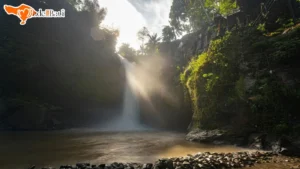
Tegenungan is the most visited waterfall near Ubud, located about 30 minutes south of town. The falls themselves are genuine and powerful, dropping around 15 meters into a wide pool that you can swim in. On a clear morning, the mist catches sunlight in a way that makes the whole scene feel dramatic and alive.
The honest assessment: the approach to Tegenungan has become heavily commercialized. The road down from the parking area is lined with restaurants, souvenir stalls, and aggressive photo sellers. By 10 AM the pool area is crowded enough that the experience feels more like a city swimming complex than a jungle waterfall.
For travelers who have time and mobility, Nungnung Waterfall, about 20 minutes northwest of Ubud, offers a more authentic alternative. The entry fee is minimal, the descent involves around 500 steps (not an easy walk), and the payoff is a significantly larger waterfall with far fewer people. It is not a convenient stop, but it is a memorable one.
If Tegenungan is your only option given time constraints, go early and swim. Do not go mid-morning expecting a peaceful nature experience.
The Attractions That Rarely Appear on the First Page of Search Results
The best things to do near Ubud are not always the most searched. Some of the most satisfying experiences in the area require a slightly longer drive, a bit of research, or simply the willingness to take a road that most tour buses do not follow.
Gunung Kawi Sebatu: A Water Temple Without the Crowds
Most visitors confuse Gunung Kawi Sebatu with the more famous Gunung Kawi complex in Tampaksiring, which features 11th-century shrines carved directly into rock cliffs. They are different places, and the Sebatu version is, for many travelers, the better experience precisely because it attracts far fewer visitors.
Gunung Kawi Sebatu is a water temple complex set among dense jungle, with clear spring-fed pools and a series of small shrines arranged around the flowing water. The atmosphere is calm in a way that Tirta Empul rarely manages during daylight hours. You can participate in a quiet melukat here without standing in a queue, and the surrounding rice field views make the short walk from the parking area genuinely enjoyable.
It sits about 40 minutes north of central Ubud, making it a natural companion stop on any northern zone day that includes Kintamani or Tirta Empul.
Kanto Lampo Waterfall: Better Than Its More Famous Neighbor
Kanto Lampo is located about 25 minutes east of Ubud and offers something Tegenungan does not: a waterfall you can stand behind. The water falls in a wide, curtain-like sheet over a curved rock face, and there are natural footholds that allow you to walk partially behind the cascade without needing special equipment.
It is not the largest waterfall near Ubud, but it is one of the most photogenic in terms of what you can actually do there. It also remains significantly less crowded than Tegenungan, partly because it requires a short hike down a slightly uneven path and partly because it has not yet been absorbed into the standard tour circuit.
Entry is typically around 20,000 IDR. Go in the morning, and bring clothes you are comfortable getting wet in.
Campuhan Ridge Walk at the Right Hour
The Campuhan Ridge Walk begins right in Ubud town, at a small bridge near Pura Gunung Lebah temple, and winds along a narrow ridge between two river valleys for about two kilometers before opening into broader countryside. The views of rolling hills, jungle, and distant rice fields make it one of the most peaceful walks available without leaving the town itself.
The walk takes roughly 45 minutes to an hour at a comfortable pace, and the path is well maintained without being commercialized. That said, it has become popular enough that mid-morning visits on weekends feel busy. Early morning, ideally before 7 AM, is when the walk genuinely earns its reputation. The light is golden, the air is cool, and the path feels like it belongs to you.
Wear light, breathable clothing and bring water. The return section includes a moderate uphill stretch that gets warm quickly once the sun rises.
Goa Gajah (Elephant Cave): Underrated and Often Misunderstood
Goa Gajah sits about 15 minutes east of central Ubud and is one of the oldest archaeological sites in Bali, dating to at least the 9th century. The entrance to the cave is carved into a rock face in the form of a demonic head, and the interior contains a small bathing complex and two shrines. The surrounding gardens include ancient carvings and statues.
It is regularly described as overrated, and the reason for that assessment is almost always the same: visitors arrive expecting a large cave and leave disappointed by a small one. Adjusting expectations before you go changes this entirely. Goa Gajah is not a cave experience in the way that Waitomo or Ha Long Bay is. It is an archaeological and spiritual site that rewards visitors who take time to read about what they are looking at rather than simply walking through it.
Entry requires a sarong and costs around 50,000 IDR. The site can be combined efficiently with a morning visit to Campuhan or Tirta Empul given its position on the eastern route.
Adventure Options Near Ubud: Choosing the Right One for Your Group
The area around Ubud offers enough active options to fill an entire trip if that is what you are after. The challenge is that white water rafting, ATV riding, and Mount Batur trekking all look similar from the outside. Choosing the wrong one for your group’s fitness level, interests, or available time is an easy mistake to make.
White Water Rafting on the Ayung River: Who It Suits Best
The Ayung River rafting route is the most popular adventure activity near Ubud, and it justifies its reputation. The route covers about 12 kilometers through rainforest, passing ancient rock carvings, hidden waterfalls, and jungle canopy so dense it blocks the sun in stretches. The rapids are graded between Grade 2 and Grade 3, which means they are exciting without requiring prior experience.
The activity works best for:
- Groups and couples who want shared adventure without serious physical demands
- First-time rafters looking for an accessible introduction
- Travelers who want nature immersion alongside the adrenaline element
The full experience, including hotel pickup, equipment, a guide, and lunch, typically runs around 2.5 to 3 hours on the water and takes up the better part of a morning. Plan for roughly half a day total once transport and the meal afterward are included.
What it is not ideal for: travelers with back or neck injuries, anyone with a strong fear of water, or small children under around 10 years old (age restrictions vary by operator).
ATV Jungle Rides: What the Experience Actually Involves
ATV riding near Ubud takes you through a different kind of terrain: muddy jungle trails, rice paddy edges, river crossings, and in some cases narrow caves carved into hillsides. It is louder and dirtier than rafting, and that is exactly what draws people to it.
The experience is genuinely fun if you go in with the right expectations. You will get muddy. The trails are not scenic in the same way rafting is. You are not going to see ancient rock carvings or sweep through jungle canopy. What you will get is a physical, hands-on experience that most travelers describe as unexpectedly entertaining.
It suits travelers who:
- Want something with a more active, adrenaline-forward feel
- Are comfortable with some physical exertion and messiness
- Are traveling in a group that enjoys activity over scenery
Combining ATV and rafting in a single day is possible, and some operators market it as a package. The honest advice: it makes for a long and tiring day. If you want both, consider whether a second day in the area is an option.
The Mount Batur Sunrise Trek: Planning It Honestly
Mount Batur is an active volcano in the Kintamani highlands, about an hour’s drive north of Ubud. The sunrise trek departs in the early hours of the morning (typically between 2 and 3 AM) and reaches the summit in time for sunrise, usually around 5:30 to 6 AM. The view from the top, looking over the caldera lake and out across the eastern coast of Bali on a clear morning, is one of the most striking things you can do on the island.
A few things that tour descriptions sometimes omit:
- The hike takes around 2 to 2.5 hours of uphill walking in the dark. It is not technical, but it is continuous. Fitness matters.
- The summit can be cold and windy. Bring a layer even if the forecast looks warm.
- Cloud cover is common, especially between October and April. A cloudy summit on a rainy season morning is a real possibility. Most operators do not offer refunds for weather.
- The descent is easier but takes about 1.5 hours and can be hard on knees.
- A licensed local guide is required and non-negotiable by regulation.
Post-hike, many tours stop at natural hot springs near the base of the mountain, which is genuinely worth including if your legs can handle it.
For travelers who can manage the early start and the physical demand, this ranks among the most memorable experiences near Ubud. For travelers who prefer comfort and a slower pace, it is not the activity to force.
Cultural Experiences That Go Beyond Temple-Hopping
The cultural depth around Ubud is real, but it requires more engagement than simply walking through temple grounds. The experiences that tend to stay with travelers longest are the ones that involve participation rather than observation.
What a Melukat Water Purification Ceremony Involves
Melukat is a Balinese Hindu purification ritual performed in holy water, typically at a water temple. The purpose is spiritual cleansing, releasing negative energy and inviting renewed clarity and balance. For Balinese people, it is a regular part of religious life rather than a special occasion.
Visitors are generally welcome to participate with appropriate preparation:
- Wear or bring a sarong and a sash, which are required at most water temples
- Understand that you will be fully immersed or standing under flowing spring water, so waterproof anything important before you approach
- Move through the spouts in sequence, pausing at each one with intention rather than rushing through for a photo
- Avoid stepping over offerings or touching sacred objects
- Speak quietly and move at the pace of the other participants
Tirta Empul offers this experience but in a busy setting. Gunung Kawi Sebatu and Taman Beji Griya, a sacred site in west Ubud with caves, waterfalls, and multiple temple structures, offer quieter alternatives that feel closer to the ceremony’s original spirit.
If you arrange this through a local guide, they can walk you through the intention-setting practice that precedes the ritual, which adds significant meaning to what might otherwise feel like a physical activity without context.
Kecak Fire Dance: Why Timing and Venue Matter
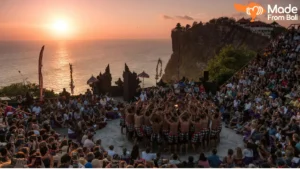
The Kecak Dance is performed by a circle of chanting men who create the rhythm and sound of the performance with their voices alone, no instruments. The story drawn from the Hindu epic Ramayana unfolds through movement, fire, and sound in a way that holds attention even for viewers who are unfamiliar with the narrative.
The experience varies enormously depending on where and when you see it. Pura Luhur Uluwatu, on the southern cliffs of Bali, is the most famous setting and produces the most dramatic backdrop: a sunset performance with the Indian Ocean below. But Uluwatu is about 90 minutes south of Ubud, which makes it a half-day trip on its own.
Within the Ubud area, Pura Dalem Taman Kaja and Arma Resort host regular Kecak and legong performances that are well-produced and more accessible. Evening performances typically begin around 7 PM, and seating fills quickly. Arriving 20 to 30 minutes early is advisable.
Attending at a temple rather than a hotel ballroom always produces a more atmospheric experience. The sound carries differently in an open courtyard, and the proximity to the performers creates a physical sensation that indoor venues cannot replicate.
Cooking Classes Near Ubud: How to Choose a Good One
A Balinese cooking class near Ubud is one of those activities that sounds like a tourist checkbox but turns out to be one of the most genuinely engaging things you do. The reason is the context: a good class does not just teach you how to make nasi goreng. It takes you to a morning market, explains how Balinese kitchens are organized around the family compound, introduces you to spices and techniques that do not appear in any other cuisine, and gives you something to take home that is practical and memorable.
The distinction between a good class and a mediocre one comes down to a few clear markers:
- Morning market visit included: A class that begins at a wet market and asks you to select ingredients teaches you something about Balinese food culture. A class that hands you pre-measured bowls on arrival does not.
- Small group size: Anything over 10 to 12 people becomes a spectator experience. Look for classes capped at 8 or fewer participants.
- Traditional compound setting: Classes held in a working Balinese family compound, rather than a commercial kitchen, give you architectural and cultural context that is itself worth experiencing.
- Lunch included: You cook, you eat. This should be standard.
Classes in the Ubud area typically run between three and five hours and cost between 250,000 and 500,000 IDR per person, sometimes higher for premium offerings. Book in advance during peak season.
A Practical Mistake That Ruins Many Ubud Day Trips
The most avoidable problems near Ubud are not about the attractions. They are about decisions made during planning. Visitors who struggle most are often those who over-researched the destinations and under-researched the logistics.
Overloading the Itinerary Is More Common Than You Think
The standard Ubud day trip advertised by many operators includes six to eight stops. Tegalalang Rice Terrace, Tirta Empul, Goa Gajah, a waterfall, a coffee plantation, the Monkey Forest, and the art market, all in a single day. On paper it looks efficient. In practice it produces a trip where you spend more time in transit and at parking areas than at the actual destinations.
The better approach is to limit yourself to three or four stops per day, grouped by zone. Fewer stops done properly produces a better experience than a long list of rushed visits. This is especially true for cultural sites like Tirta Empul, where the experience is directly proportional to the time you allow yourself to be present.
A useful rule: if you are spending less than 45 minutes at a destination, you are not visiting it. You are ticking a box.
Traffic Near Ubud: What the Maps Do Not Tell You
Google Maps does not reliably capture Bali’s traffic patterns, particularly around Ubud. The 15-kilometer distance between central Ubud and Tegalalang can take anywhere from 25 minutes to over an hour depending on the day and time. Routes that look direct on a map often run through the center of town, where slow-moving traffic, narrow lanes, and frequent stops create consistent delays between 9 AM and noon.
Practical guidance:
- Start any driving day before 8:30 AM to get ahead of the traffic peak
- Plan northern zone trips to return to Ubud by early afternoon before the southbound traffic builds
- Accept that if you are traveling between major tourist zones (south Ubud to north Ubud), you will pass through town. Allow extra time.
- A private driver who knows the back roads will consistently save 20 to 30 minutes per transit compared to standard navigation routing
Temple Etiquette That Visitors Often Miss
Bali’s temples are active religious spaces, not heritage museums. The etiquette expectations are reasonable, but they are not always communicated clearly on signage.
Beyond the sarong requirement (which is non-negotiable and enforced at every major temple), a few less-obvious points:
- Do not step over offerings placed on the ground, even small ones. They are intentional acts of devotion, not decorations.
- At some temples, menstruating women are asked not to enter the inner sanctum. This is cultural practice, not a personal judgment.
- Photography is generally permitted in outer temple areas but not always in inner ceremonial spaces. When in doubt, observe what local visitors are doing.
- Speaking loudly, playing music, or sitting with your back to the main shrine is considered disrespectful. These are common mistakes made by visitors who treat temples as scenic backdrops.
A local guide at any major temple can explain what you are looking at and why it matters. The context transforms the experience.
How to Plan Two or Three Days Near Ubud Without Wasting Time
If you have two or three days in the Ubud area, the zone-based framework makes planning straightforward. The key is committing to a zone per day rather than trying to cross zones within a single trip.
A Suggested Day One: Central Ubud and Southern Highlights
Begin early with the Campuhan Ridge Walk before 7 AM, when the light is best and the path is quiet. Return to town for breakfast, then head south to Tegenungan Waterfall (aim to arrive by 9 AM before the crowds build). On the return, stop at Goa Gajah, which is conveniently positioned along the eastern route back into town. Spend the afternoon exploring the Monkey Forest and the art market at a relaxed pace. If you want an evening experience, book a Kecak Dance performance for 7 PM in Ubud.
This is a manageable day that covers the central and southern zones without rushing.
A Suggested Day Two: The Northern Zone Toward Kintamani
Depart by 7:30 AM for the northeastern zone. Stop at Gunung Kawi in Tampaksiring first, arriving before the tour buses. Then move to Tirta Empul, which is about 10 minutes away. If your timing allows, continue north to Gunung Kawi Sebatu before climbing to the Kintamani plateau for lunch with a view of Mount Batur and the caldera. Return through the coffee plantation zone, where a stop at a working plantation includes tastings of local coffee, tea, and the famous kopi luwak. Plan to be back in Ubud by late afternoon.
This route covers a significant amount of ground, but it follows a logical geographic arc that minimizes backtracking.
Day Three Option: Slower Pace, Longer Experiences
A third day near Ubud is best used for experiences that require more time and less transit. A morning cooking class in a traditional compound, followed by an afternoon at a spa, is a natural pairing for travelers who have been moving quickly. Alternatively, white water rafting on the Ayung River takes up a full morning in the best possible way and leaves the afternoon free for recovery and exploration on foot.
If adventure is the priority, the Mount Batur sunrise trek belongs here, but it requires an extremely early departure (around 2 AM from Ubud) and will consume the full day once you account for the drive, the hike, and the recovery time. Plan nothing else on a Batur day.
What Travelers with Different Itineraries Should Prioritize
Not every traveler near Ubud has the same goals, and a blanket “best of” list does not serve everyone equally. A few honest, direct recommendations based on who is traveling.
If You Only Have One Day Near Ubud
Do not try to see everything. Pick one zone and do it properly. For most single-day visitors, the eastern zone route (Campuhan Ridge Walk in the morning, Goa Gajah, Gunung Kawi, Tirta Empul, lunch in Tampaksiring) produces a coherent day that covers cultural depth without feeling scattered. Add Tegalalang on the return if time genuinely allows, but do not sacrifice the quality of the morning for a rushed afternoon stop.
If You Are Traveling as a Couple
The experiences that tend to resonate most for couples near Ubud combine atmosphere with participation rather than just sightseeing. A melukat ceremony at Gunung Kawi Sebatu followed by lunch overlooking rice fields is a genuinely memorable morning. Kanto Lampo Waterfall offers a more intimate setting than Tegenungan without the crowds. A cooking class at a traditional compound makes for a shared experience that most couples describe as an unexpected highlight. If adventure is part of the picture, rafting works well as a shared activity because the experience itself is social and the environment is beautiful.
If You Are a Solo Traveler
Solo travel near Ubud works best when you build flexibility into the day. Consider hiring a private driver for at least one full day so that timing is entirely in your control. The Campuhan Ridge Walk is excellent for solo mornings. Cooking classes in small groups are reliably social environments where meeting other travelers is easy. Mount Batur is a strong choice for solo travelers who are comfortable with physical challenge, as the group format of most guided treks creates natural camaraderie at the summit.
One practical note: solo travelers should confirm pickup logistics in advance for any activities that involve transport, as some operators default to hotel pickup times that assume couples or groups.
If You Are in a Small Group
A small group of three to six people near Ubud is ideally suited for private driver days, where the itinerary can flex based on real-time decisions about pacing and interest. Group activities like rafting, ATV riding, and cooking classes all work naturally at this scale and often feel more enjoyable when shared. The zone-based planning approach becomes especially useful here because a group can move at its own pace without the constraints of a fixed tour schedule.
If your group includes people with very different interests (one person wants temples, another wants waterfalls, a third wants to stay near town), the central zone day combined with one targeted activity in the morning is usually the best compromise.
Planning a trip near Ubud is genuinely easier when someone who knows the area handles the logistics. The team at Made From Bali Tour and Travel works with travelers across all itinerary types, from single-day tours to multi-day private packages, and can help build a plan that fits both your interests and your schedule. Reach out before you arrive rather than after. The best experiences near Ubud tend to fill up early.